


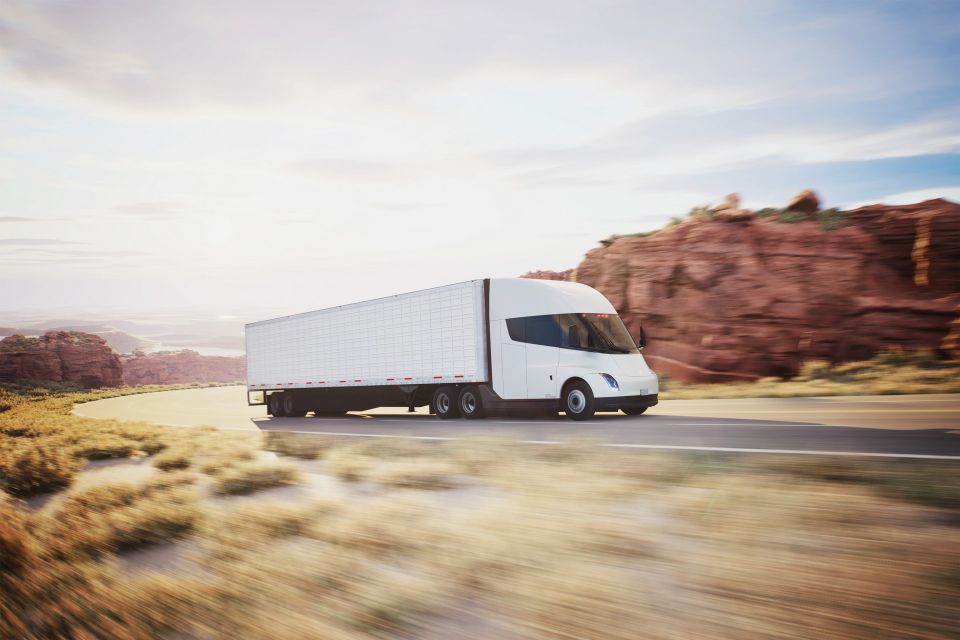
California’s flagship clean-truck incentive programme has set aside about $165 million for purchases of the Tesla Semi, despite the electric truck not yet entering full-scale production, prompting concerns among rival manufacturers over market concentration and access to public funding.
The allocation comes through the Hybrid and Zero-Emission Truck and Bus Voucher Incentive Project (HVIP), a state-backed scheme designed to accelerate the adoption of zero-emission medium- and heavy-duty vehicles. Since its launch in 2009, HVIP has distributed more than $1.6 billion in incentives aimed at reducing emissions from freight and transit fleets.
See also: Tesla Semi Production Delayed to 2026 as First Official Builds Slated for Early Next Year
According to reporting by the Los Angeles Times, nearly 1,000 vouchers in recent funding rounds were tentatively assigned to the Tesla Semi, positioning the automaker to receive a far larger share of HVIP funding than any other participant. Even after state agencies revised public data to exclude local port funding, Tesla’s potential allocation remained close to $165 million, compared with about $68 million for the next-largest recipient, Canadian bus maker New Flyer.
HVIP operates on a first-come, first-served basis and funding rounds are often fully subscribed within days. Industry participants say the early reservation of a large volume of vouchers can effectively limit access for manufacturers with production-ready electric trucks, even if final payments are only made once vehicles are delivered.
See also: Tesla Semi Charging Network Expands as PepsiCo Plans 18-Megacharger Station in North Carolina
To qualify for HVIP incentives, vehicles must be certified as zero-emission and approved by the California Air Resources Board (CARB). At the time many voucher requests were submitted for the Tesla Semi, publicly available certification records listed only the 2024 model year, with later model years not yet visible. State officials have said certification reviews involve confidential business information and that no funds are released until all regulatory requirements are met.
Voucher values linked to the Tesla Semi range from about $84,000 to $351,000 per vehicle, depending on configuration and buyer eligibility, according to revised data cited by the Los Angeles Times. The newspaper reported internal documents indicating potential list prices of roughly $260,000 for a 300-mile version and $300,000 for a 500-mile version, though Tesla has not formally announced pricing. Under HVIP rules, incentives can cover up to 90% of a vehicle’s list price for private fleet operators.
See also: DHL Supply Chain Puts First Tesla Semi Into Service After U.S. Pilot Programme
Tesla first unveiled the Semi as a prototype in 2017, with initial production originally targeted for 2019. Deliveries have so far been limited, and only a small number of vehicles have been confirmed as delivered under the HVIP programme. State officials have indicated that many outstanding voucher-backed orders are expected to be fulfilled in late 2026, when broader availability of the truck is anticipated.