




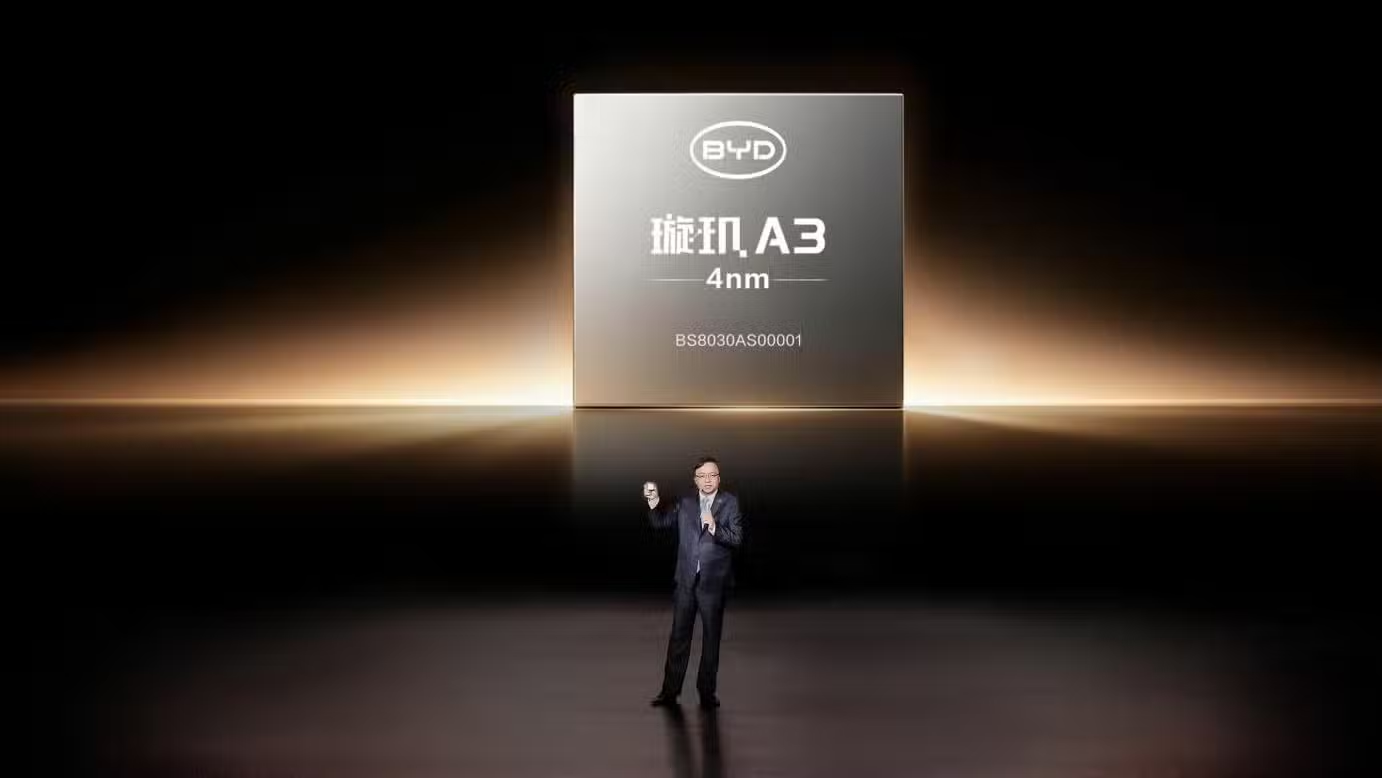
BYD plans to equip a new production model under its premium Denza brand with its in-house developed Xuanji A3 smart driving chip for the first time in 2027, according to a report by Chinese media outlet LatePost.
The move would mark the commercial debut of BYD’s first 4-nanometer autonomous driving chip as the automaker continues expanding its vertically integrated technology strategy.
Xuanji A3 Set for Production Debut
BYD introduced the Xuanji A3 chip on May 28, describing it as China’s first smart driving processor built on a 4nm manufacturing process.
While the company did not announce a commercialization timeline at the launch event, the report said the chip is expected to first appear in a Denza-branded production model in 2027.
According to an employee at an advanced driver assistance system (ADAS) solution provider cited by LatePost, automotive-grade smart driving chips typically require at least one year between tape-out and vehicle deployment because the chip, software algorithms and vehicle integration all require extensive validation.
Designed for Higher Levels of Autonomous Driving
BYD said a single Xuanji A3 processor delivers more than 700 TOPS of computing performance.
A three-chip configuration provides more than 2,100 TOPS, enabling support for Level 3 and Level 4 autonomous driving applications.
The company also claims the chip reduces power consumption per unit of computing performance by 20% compared with competing products, while optimization through BYD’s proprietary algorithms doubles computing efficiency.
Expanding Vertical Integration
Developing proprietary smart driving chips has become an increasingly important strategy among Chinese electric vehicle manufacturers seeking greater control over core artificial intelligence technologies.
Nio, Xpeng and Li Auto have already introduced self-developed autonomous driving chips in mass-produced vehicles.
BYD has invested in semiconductor development for more than two decades.
The company established its integrated circuit design department in 2002, laying the foundation for what later became BYD Semiconductor. It expanded into insulated-gate bipolar transistor (IGBT) technology through the acquisition of Ningbo Zhongwei Semiconductor in 2008 and has since developed in-house capabilities spanning power semiconductors, microcontrollers and power management chips.
BYD said its semiconductor research team now exceeds 7,000 employees, supported by four research and development centers and five wafer fabrication plants. The company’s cumulative investment in semiconductor research has surpassed 100 billion yuan (US$14.71 billion).
Smart Driving Strategy Continues to Evolve
Unlike power semiconductors used for electrification, autonomous driving chips require close integration with perception algorithms, sensors, domain controllers and vehicle electronic architectures.
To strengthen those capabilities, BYD reorganized its smart driving operations by moving its chip development business into a new technology institute during the first half of 2024.
The restructuring also consolidated smart driving software, cockpit systems, domain controller hardware and underlying software development under the same organization.
Alongside its in-house technology, BYD continues to work with external suppliers for its God’s Eye intelligent driving system, including Momenta and Huawei.
The report also noted recent personnel changes within BYD’s chip development team. Zhou Yan, a former director at Oppo’s chip design subsidiary Zeku, left the company in April and subsequently joined a semiconductor startup.


