



BYD has launched what it describes as the world’s most powerful mass-produced electric vehicle supercharger, alongside the introduction of its second-generation Blade Battery, as the Chinese automaker accelerates the expansion of its charging infrastructure.
The new supercharger delivers a maximum output of 1,500 kilowatts per charging gun, representing a 50% increase compared with the company’s first-generation flash charger introduced in March 2025.
See also: BYD Unveils Second-Generation Blade Battery With Nine-Minute Flash Charging
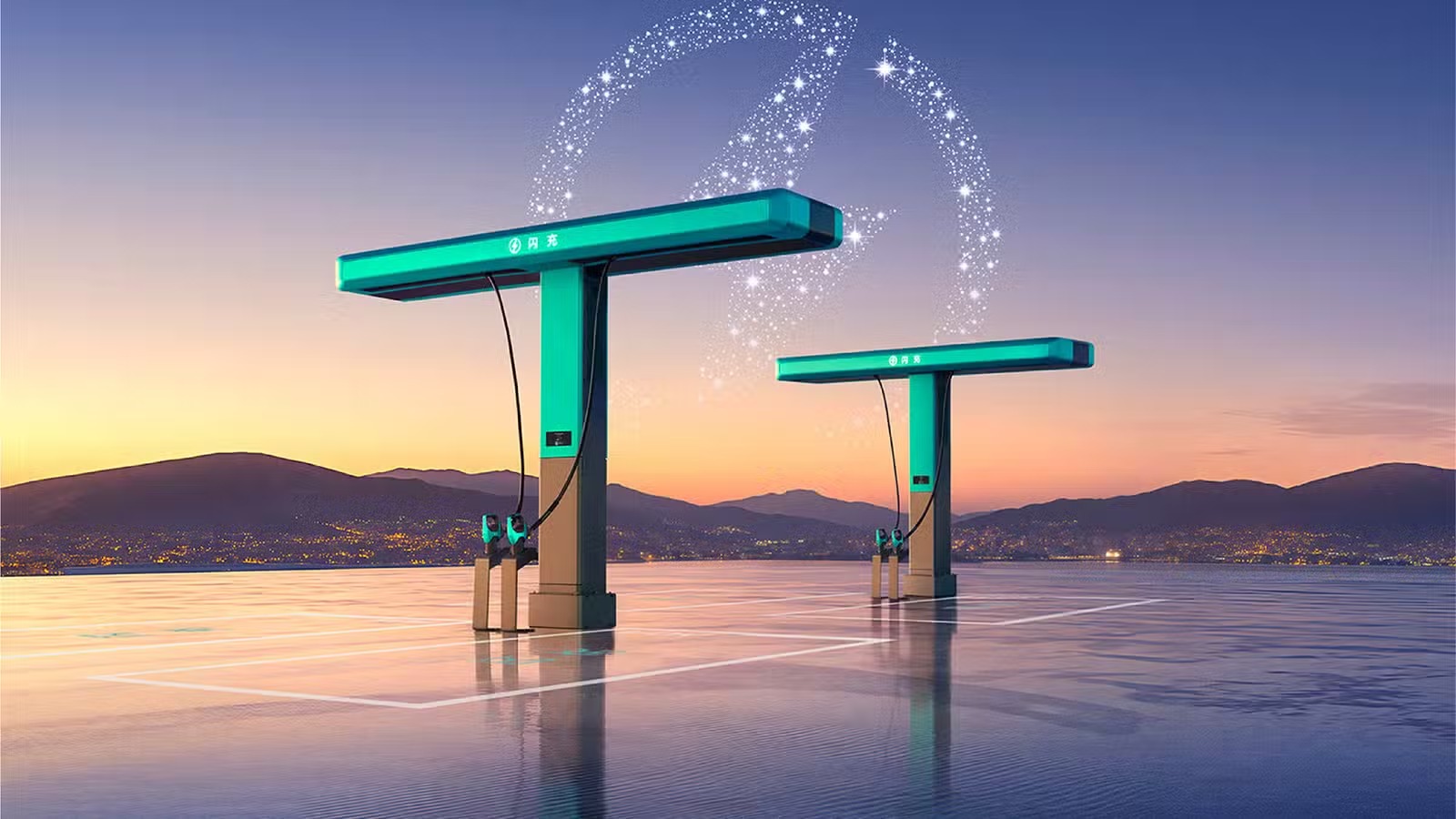
Each flash-charging station is equipped with two charging guns and an integrated energy storage system designed to support ultra-fast charging. BYD said the system can maintain flash-charging speeds even when two vehicles are charging simultaneously.
According to the company, each charging gun can serve up to 50 vehicles per day. Assuming an average charging demand of 40 kilowatt-hours per vehicle, a single gun could deliver about 2,000 kilowatt-hours of electricity daily.
The charging equipment features a sliding-rail suspended T-shaped structure designed to prevent cables from dragging on the ground. It also includes a “zero-gravity” charging gun intended to allow drivers to operate it with one hand, while the sliding rail enables the charger to move laterally to accommodate vehicles with charging ports in different positions.
See also: BYD Says Sodium-Ion Batteries Reach 10,000-Cycle Life, Mass Production to Depend on Demand
During the launch event, BYD chairman and president Wang Chuanfu also announced a nationwide infrastructure plan called the “Flash-charging China” strategy.
Under the initiative, the company plans to build 20,000 flash-charging stations across China by the end of the year. As of March 5, BYD said it had already completed 4,239 stations.
Of the planned total, 18,000 stations will be developed in partnership with Chinese charging network operators. The company said this model would not require additional grid capacity or land resources, enabling faster construction and deployment. The goal is to ensure that 90% of urban areas have a flash-charging station within a five-kilometre radius.
The remaining 2,000 stations will be built along highways, with BYD planning to deploy one station on average every 100 kilometres. The company said the first batch of 1,000 highway stations will be completed before China’s May Day holiday this year.
See also: BYD Targets 1.3 Million Overseas Vehicle Sales In 2026, Executive Says
BYD also plans to extend the network internationally. The company aims to introduce its flash-charging stations to overseas markets by the end of 2026 as part of what it calls its “Flash-charging Planet” initiative.
Wang said vehicles equipped with the second-generation Blade Battery will receive one year of free supercharging starting from the date of delivery. After the promotional period ends, charging fees will align with prevailing industry pricing.
BYD added that its flash-charging stations will be open to electric vehicles from other brands, although charging speeds may be lower for non-BYD models.


