



BYD has delivered its 100,000th new energy vehicle (NEV) in the United Kingdom, marking a significant milestone in the Chinese automaker’s rapid expansion across Europe and reinforcing its growing position in one of the continent’s most competitive automotive markets.
The achievement was announced by BYD Executive Vice President He Zhiqi, who highlighted the company’s accelerating growth and increasing influence in the UK electric vehicle sector.
Rapid growth in the UK market
According to He, BYD has become the fastest automotive brand in UK history to achieve a 5% market share.
The company entered the UK passenger vehicle market in March 2023 with the launch of the Atto 3, known as the Yuan Plus in China. Since then, BYD has rapidly expanded its presence through a broad range of battery-electric and plug-in hybrid vehicles.
The pace of growth has accelerated significantly. BYD took 19 months to achieve cumulative sales of 10,000 vehicles in the UK, but required only five additional months to double that figure to 20,000 units.
The latest milestone of 100,000 deliveries highlights the brand’s growing acceptance among British consumers.
Sales surge boosts market position
BYD sold 26,396 new energy vehicles in the UK during the first four months of 2026, representing year-on-year growth of 124%.
The strong performance pushed the company’s market share above 7%, according to BYD.
The automaker said it has now surpassed BMW, Tesla and Volkswagen to become the UK’s largest electric vehicle brand.
Notably, BYD achieved this growth despite its models not qualifying for certain UK government purchase incentives that remain available to some competing electric vehicle models.
Several rival brands continue to benefit from subsidies of up to £3,750 ($5,040), while BYD vehicles are sold without such support.
Expanding charging infrastructure
As part of its UK growth strategy, BYD is also investing in charging infrastructure.
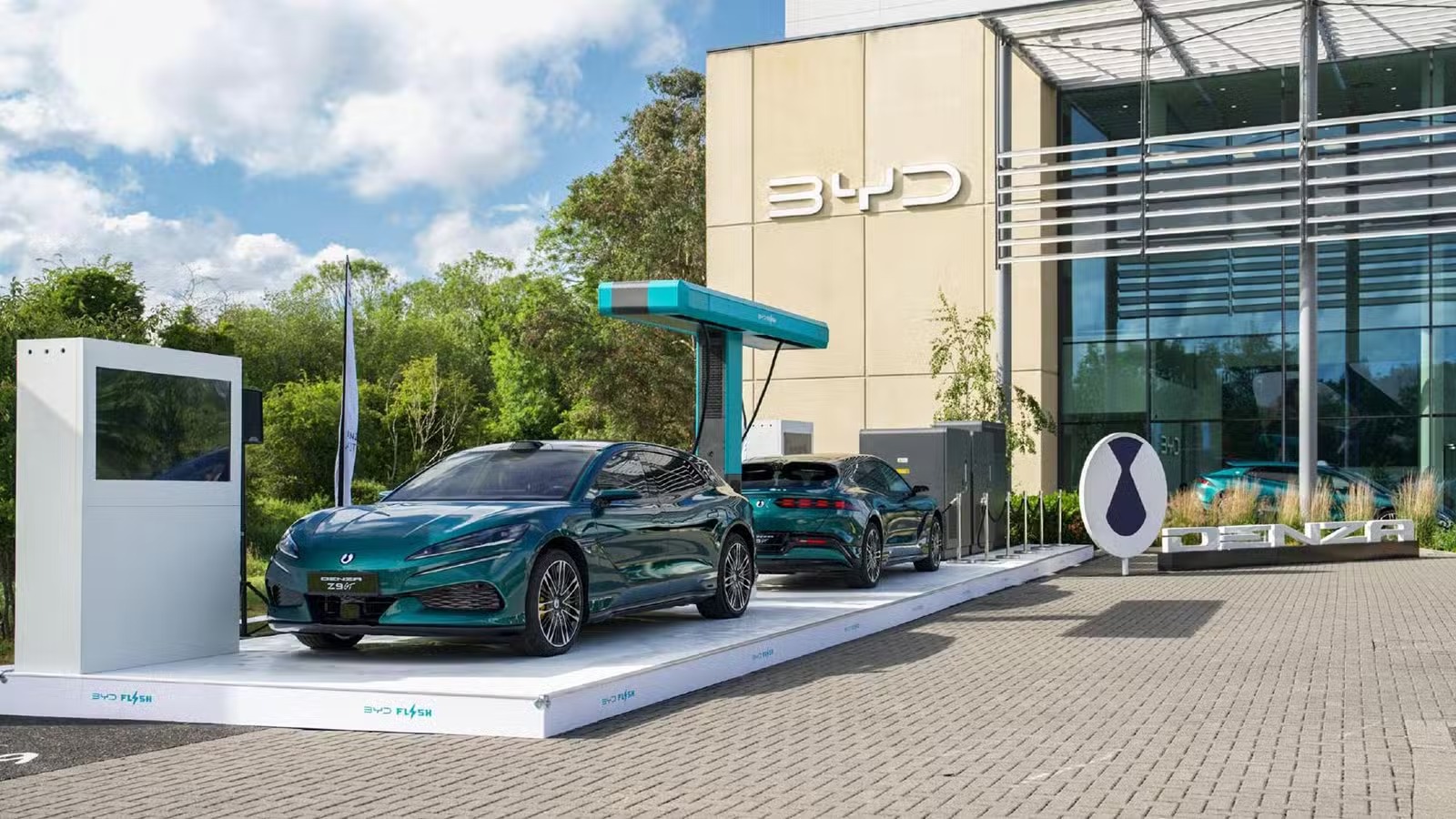
During his visit to the company’s first flash-charging station in the UK, located in Uxbridge, He announced plans to deploy 300 flash-charging stations nationwide by the end of the year.
The chargers are based on BYD’s latest fast-charging technology unveiled in China earlier this year.
When paired with the second-generation Blade Battery, the system can charge a compatible vehicle from 10% to 97% battery capacity in approximately nine minutes.
The rollout is expected to support broader EV adoption while strengthening BYD’s ecosystem in the UK market.
Broad product lineup drives demand
BYD attributes much of its success to its expanding vehicle portfolio.
The company currently offers 11 new energy vehicle models in the UK, covering both battery-electric vehicles (BEVs) and plug-in hybrid electric vehicles (PHEVs).
Its lineup spans multiple price segments, ranging from the entry-level Dolphin Surf, priced from £18,675, to the premium Sealion 7, which starts at £47,025.
This broad product offering allows BYD to compete across a wider range of customer groups compared with many rivals focused on specific market segments.
Strengthening European ambitions
The 100,000-unit milestone represents another important step in BYD’s broader European expansion strategy.
The company has been aggressively increasing its presence across key European markets through new vehicle launches, dealer network growth and investments in charging infrastructure.
As competition intensifies among global automakers in the transition to electric mobility, BYD’s rapid rise in the UK demonstrates the growing influence of Chinese manufacturers in international markets.
With sales momentum continuing to build and infrastructure investments accelerating, BYD appears well positioned to further strengthen its presence in the UK and across Europe in the coming years.


