




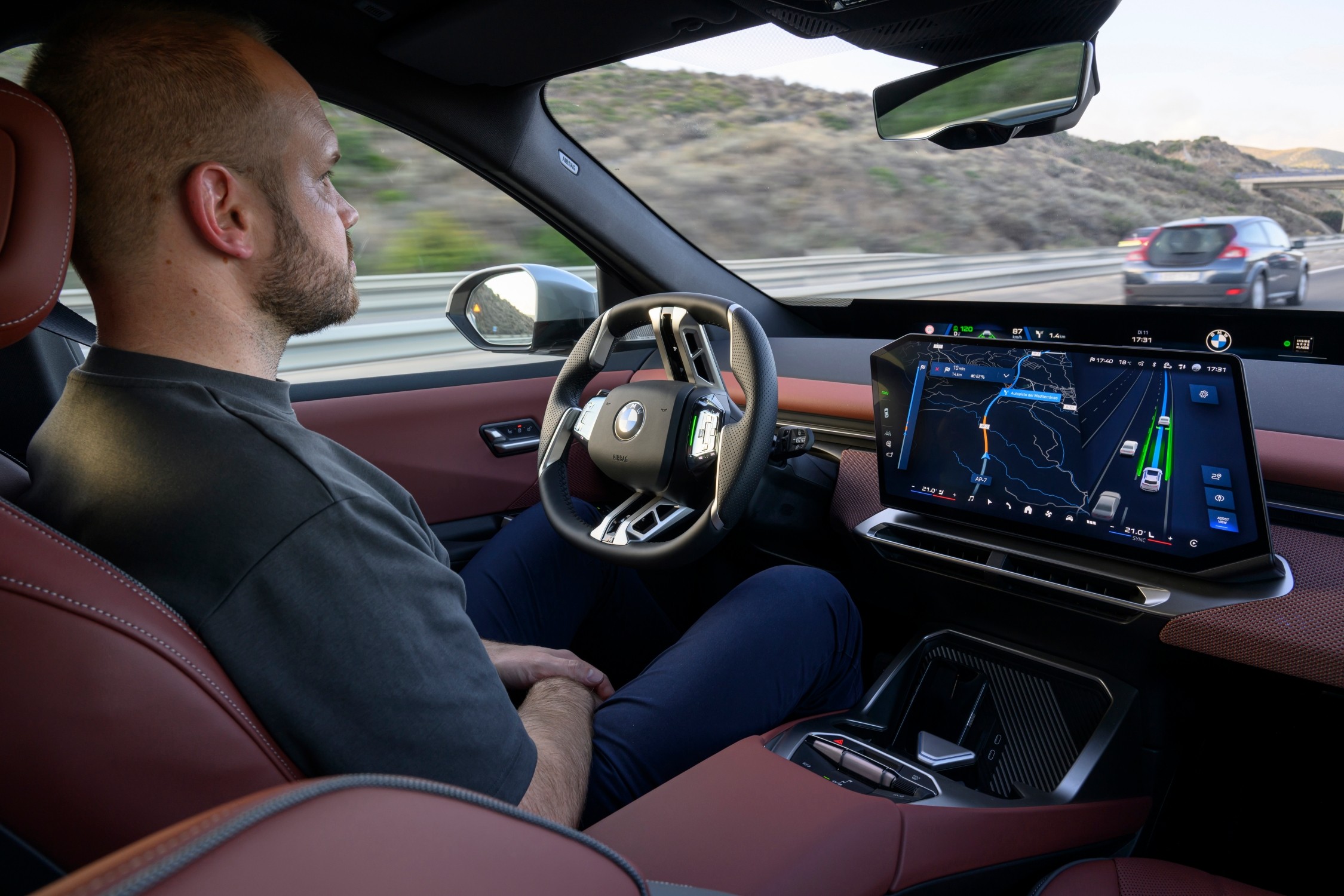
BMW has announced that customers have collectively driven more than 200 million kilometres using its Highway Assistant hands-free driving system, underscoring growing adoption of the company’s advanced driver assistance technology across multiple vehicle lines.
The Highway Assistant is currently available on several BMW models, including the 5 Series, 7 Series, iX, X5, X6, X7, XM, and the recently introduced BMW iX3.
The system enables hands-free driving on approved highways at speeds of up to 130 km/h by managing both steering and speed control while continuing to monitor driver attention.
Expanding Hands-Free Driving Across Europe
BMW said the next generation of its driver assistance systems will significantly broaden the availability of Highway Assistant in Europe.
While the previous version was limited to Germany, the United States, and Canada, the new system will be available in more than 20 European countries, beginning with the BMW iX3 and later expanding to future models including the BMW i3 and BMW 7 Series.
The company said drivers will be able to use hands-free assisted driving across borders on suitable routes in countries including Germany, Austria, Switzerland, Italy, France, Belgium, the Netherlands, and Luxembourg.
Additional markets such as the United Kingdom, Ireland, Spain, and Portugal are expected to follow, while Northern, Eastern, and South-Eastern European countries are scheduled to receive the feature at a later stage.
The enhanced system also introduces “entry-to-exit” functionality, allowing the Highway Assistant to support drivers continuously from motorway entry points to exits when route guidance is active through BMW Maps.
Driver Remains Responsible
BMW emphasized that the Highway Assistant remains a Level 2 driver assistance system, meaning drivers must remain attentive and prepared to take control at all times.
“The symbiotic interplay between driver and driver assistance during hands-free driving with our Highway Assistant, and the underlying safety concept, are unique in the industry,” said Dr. Mihiar Ayoubi, Senior Vice President Driving Experience Development at BMW.
“Over 200 million kilometres of hands-free highway driving in real-world customer use demonstrate just how reliable and relevant this system is in everyday life.”
The company noted that a driver monitoring camera continuously evaluates the driver’s line of sight, eye status, and head movements to ensure attentiveness.
When the system determines that driver intervention is required, such as when approaching a motorway exit, it prompts the driver to place their hands back on the steering wheel.
Multi-Layered Safety Architecture
BMW said the Highway Assistant is supported by a comprehensive safety framework that combines cameras, high-resolution maps, redundant positioning systems, and dedicated monitoring hardware.
Side-mounted cameras continuously assess lane positioning to ensure the vehicle remains centered, while a dedicated safety processor within the Advanced Driver Assistance System (ADAS) computer constantly monitors system functionality.
The company said these redundant systems are designed to maintain reliability during hands-free operation.
Introducing BMW Symbiotic Drive
The next generation of BMW’s highway driving technology also introduces a new concept called BMW Symbiotic Drive.
Available initially on the new BMW iX3, the system allows drivers to interact more naturally with driver assistance functions without immediately disengaging automation.
Under the new operating logic, drivers can accelerate, steer, or brake when necessary while maintaining active assistance functions.
BMW said the feature is designed to create a more seamless relationship between human drivers and automated systems, improving comfort while preserving safety.
The technology is integrated into the company’s new BMW Panoramic iDrive interface, which provides visual feedback and control functions designed to make assisted driving more intuitive.
As competition intensifies in advanced driver assistance systems, BMW’s latest rollout reflects the growing importance of hands-free highway driving technologies among premium automakers, while continuing to operate within the SAE Level 2 framework that requires active driver supervision.