


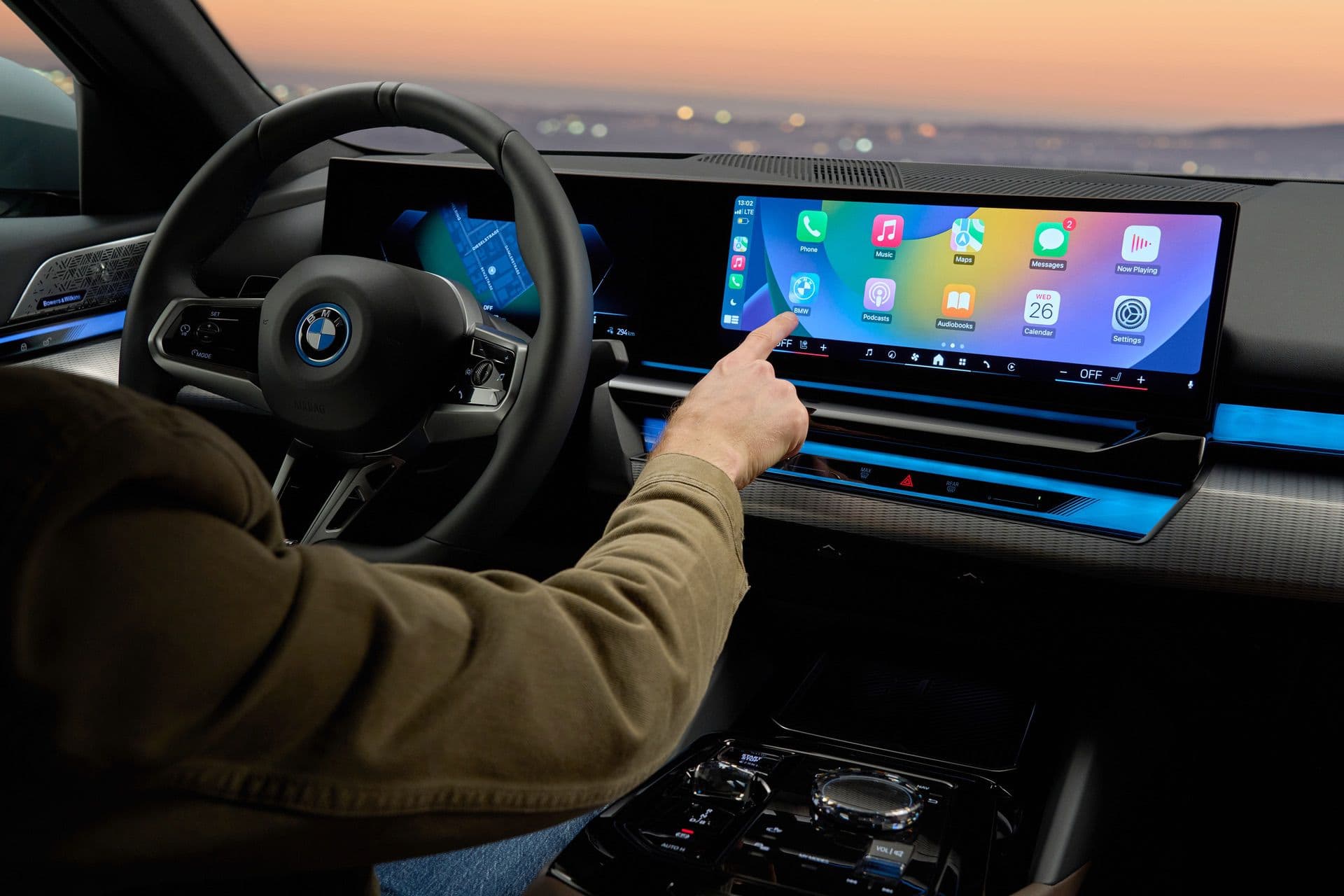
BMW is challenging the notion that Apple CarPlay is an indispensable feature for car buyers, citing in-car data suggesting customers rely more heavily on its own navigation system. The remarks come as debate over smartphone integration in vehicles intensifies across the industry.
Stephan Durach, BMW’s Senior Vice President of UI/UX Development, said analysis of usage patterns from 10 million cars shows that drivers are not using CarPlay as consistently as often assumed. “People say they’re driving all around and using CarPlay for navigation. I can tell you, that’s not true,” Durach said. He added that while phones remain connected, CarPlay is often limited to “dedicated use cases” such as messaging, with many opting for BMW’s built-in navigation.
Durach noted that BMW’s system is becoming increasingly integrated, with voice commands and simplified controls encouraging drivers to adopt in-car features. He highlighted that upcoming Neue Klasse models will offer enhanced natural voice interaction and automation functions. BMW’s Panoramic Display, meanwhile, will not support Google Maps or Waze through CarPlay, a limitation that could push more users toward the company’s own iDrive X system.
Apple disputed BMW’s conclusions, pointing to third-party research showing higher customer satisfaction with CarPlay compared with native infotainment. “There is strong third-party evidence to support it as fact—e.g. the 2024 J.D. Power APEAL Study,” Apple said, noting that satisfaction scores were higher among drivers using Android Auto or Apple CarPlay.
BMW’s position reflects a broader industry divide over smartphone integration. Tesla and Rivian have resisted adopting CarPlay or Android Auto, while most automakers continue to promote the systems as central to customer experience. Analysts say the competing narratives may influence how carmakers position infotainment features in future models.