



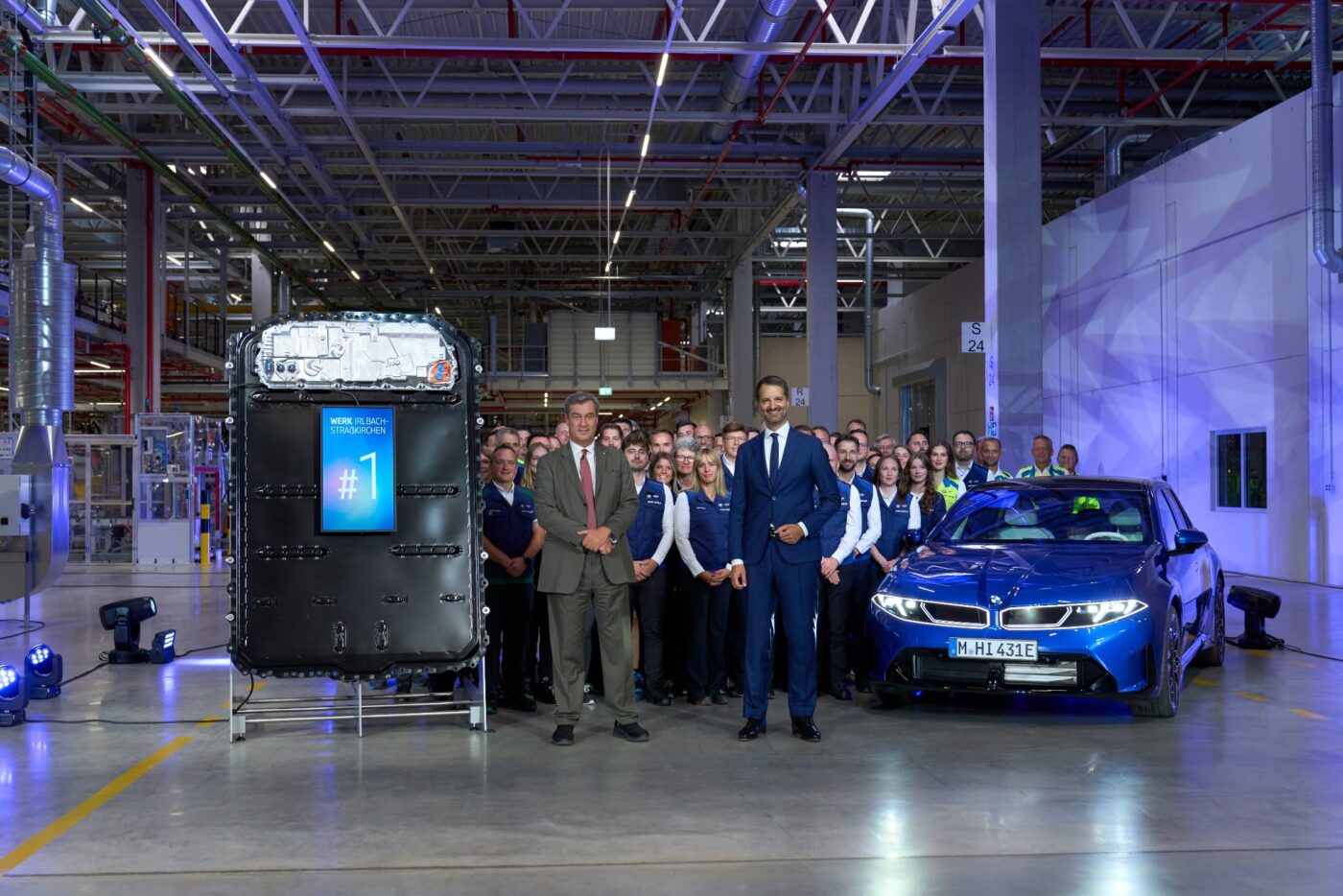
BMW has officially opened its new battery production facility in Irlbach-Straßkirchen, Lower Bavaria, and started series production of sixth-generation high-voltage batteries. The plant will initially supply batteries for the new BMW i3 produced in Munich and is planned to become an important part of BMW’s German battery production network.
Construction of the facility began in April 2024, with the first pre-series batteries produced in March 2026. BMW has invested around €1 billion in the site, which covers approximately 60 hectares south of Regensburg.
BMW Accelerates Production at New Battery Plant
BMW said the plant is ramping up production faster than originally planned due to demand for Neue Klasse models. The facility has already moved to two-shift operations.
At full capacity, around 1,600 employees are expected to work at the site. BMW plans to produce several hundred high-voltage batteries per day using two production lines.
The plant contains approximately 50,000 square metres of production space and uses around 500 robots. More than 3,500 data points are recorded during the production of each battery and monitored in real time. BMW also uses AI-based assistance systems to analyse production data and support quality control.
Gen6 Batteries Adopt 800-Volt Architecture
Irlbach-Straßkirchen is part of BMW’s transition to its sixth-generation battery technology for Neue Klasse vehicles.
Gen6 batteries use an 800-volt electrical architecture and large-format cylindrical cells with a diameter of 46 millimetres. BMW says the cells provide around 20% higher energy density than the previous prismatic cells.
The cells are integrated directly into the battery using a cell-to-pack design. BMW also uses a pack-to-open-body approach, in which the battery housing contributes to the vehicle’s structural architecture.
The manufacturer expects the technology to provide improvements in charging performance and driving range compared with its fifth-generation battery systems.
Irlbach-Straßkirchen Initially Supplies BMW i3
The plant’s first application is the new BMW i3 produced at the company’s Munich vehicle plant. The i3 uses a 108.7 kWh battery supplied from Irlbach-Straßkirchen.
For the i3 50 xDrive, BMW quotes a WLTP range of up to 906 kilometres. With its 800-volt system and DC charging capability of up to 400 kW, the vehicle can add up to 423 kilometres of WLTP range in 10 minutes under suitable charging conditions.
The i3 also supports bidirectional charging.
In the longer term, BMW plans for Irlbach-Straßkirchen to supply Gen6 batteries to additional German vehicle production facilities.
BMW Expands Global Battery Production Network
BMW is applying a “local for local” strategy for Gen6 battery assembly, with facilities being built or operated near vehicle production sites.
Alongside Irlbach-Straßkirchen, BMW has battery assembly operations or projects in Debrecen, Shenyang, Woodruff and San Luis Potosí.
BMW sources the battery cells from external suppliers. At the battery plant, the cells are inspected and assembled into cell clusters before being connected to cooling components and welded. A foaming process then bonds the components mechanically to increase stability and protection.
Each completed high-voltage battery undergoes end-of-line testing before being delivered to vehicle production.
Gen6 Batteries Target Lower Production Emissions
BMW is also using secondary materials for cobalt, lithium and nickel in its Gen6 cells. The company said renewable energy is used in the production of anode and cathode materials and during cell manufacturing.
According to BMW, these measures are expected to reduce CO2 emissions per watt-hour by around 33% compared with Gen5 cells.
The Irlbach-Straßkirchen facility is part of a wider battery development and production network in Bavaria. BMW conducts development and pilot production at locations including Parsdorf, Hallbergmoos and its Munich Research and Innovation Centre.
In Salching, the company has also operated a competence centre for direct recycling of battery cells and production residues since the end of 2025.


