
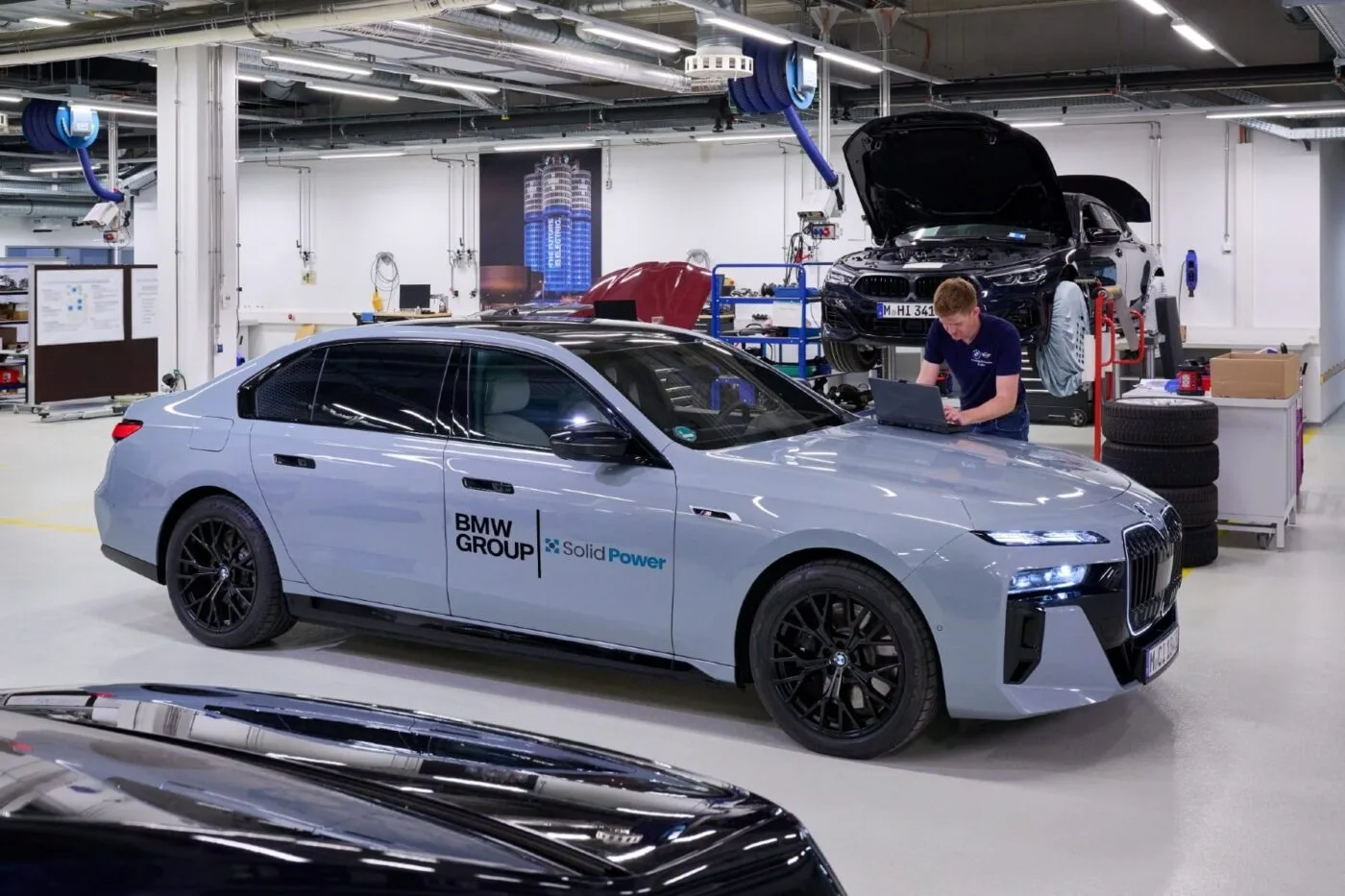
BMW Group has integrated large-format solid-state battery cells from U.S.-based Solid Power into a prototype i7 electric sedan, marking a milestone in the long-term development of next-generation battery technology. The test vehicle is now undergoing real-world evaluation to analyze the performance and stability of the all-solid-state battery (ASSB) cells.
The companies began collaborating in 2016, formalizing their partnership in 2021 through a technology transfer agreement. Under that deal, Solid Power’s sulfide-based electrolyte cells were delivered to BMW in late 2023 as part of an initial qualification phase. The cells are now installed in a fully functional test vehicle to examine thermal management, cell expansion behavior, and pressure regulation.
“Our BMW i7 ASSB test vehicle on the road is a perfect example of the BMW Group’s technology-open mindset,” said Martin Schuster, Vice President of Battery Cell and Cell Module at BMW Group. “We are continuously advancing the development of new battery cell technologies and are constantly expanding our know-how with valuable partners such as Solid Power.”
The experimental battery pack combines current Gen5 cell module architecture—used in today’s prismatic cell systems—with new structural concepts tailored to Solid Power’s solid-state cells. While Gen6 round cells are planned for future BMW models, the i7 test vehicle continues to use the established prismatic cell format as a platform for experimentation.
Solid Power’s ASSB cells are expected to deliver higher energy density compared to conventional lithium-ion technology. The company claims up to 390 Wh/kg using a silicon anode and up to 440 Wh/kg with a lithium metal anode, paired with conventional NCM-811 cathodes. No major overhaul of cathode manufacturing processes would be necessary, according to Solid Power.
“Solid Power is extremely proud that our partnership with BMW has resulted in the first demonstration of truly all-solid-state battery cells in a vehicle,” said John Van Scoter, President and CEO of Solid Power. “We believe in the promise of ASSBs and continue to drive innovation of our sulfide electrolyte in support of that future for EVs.”
BMW is also preparing to manufacture prototype solid-state cells based on Solid Power’s designs at its Cell Manufacturing Competence Centre in Parsdorf, near Munich. The company holds a research and development license to build and test the U.S.-designed cells in-house.
Founded in 2011 as a spin-off from the University of Colorado, Solid Power has emerged as one of the industry’s leading ASSB developers. In 2022, the company completed its pilot production line with an estimated annual capacity of 15,000 cells. Alongside BMW, its key partners include Ford and South Korea’s SK On.
While the first vehicle integration has now been achieved, BMW said further work is needed before the battery technology is ready for mass production. “Further development steps are required to implement ASSB technology in a competitive overall storage system,” the company said.