



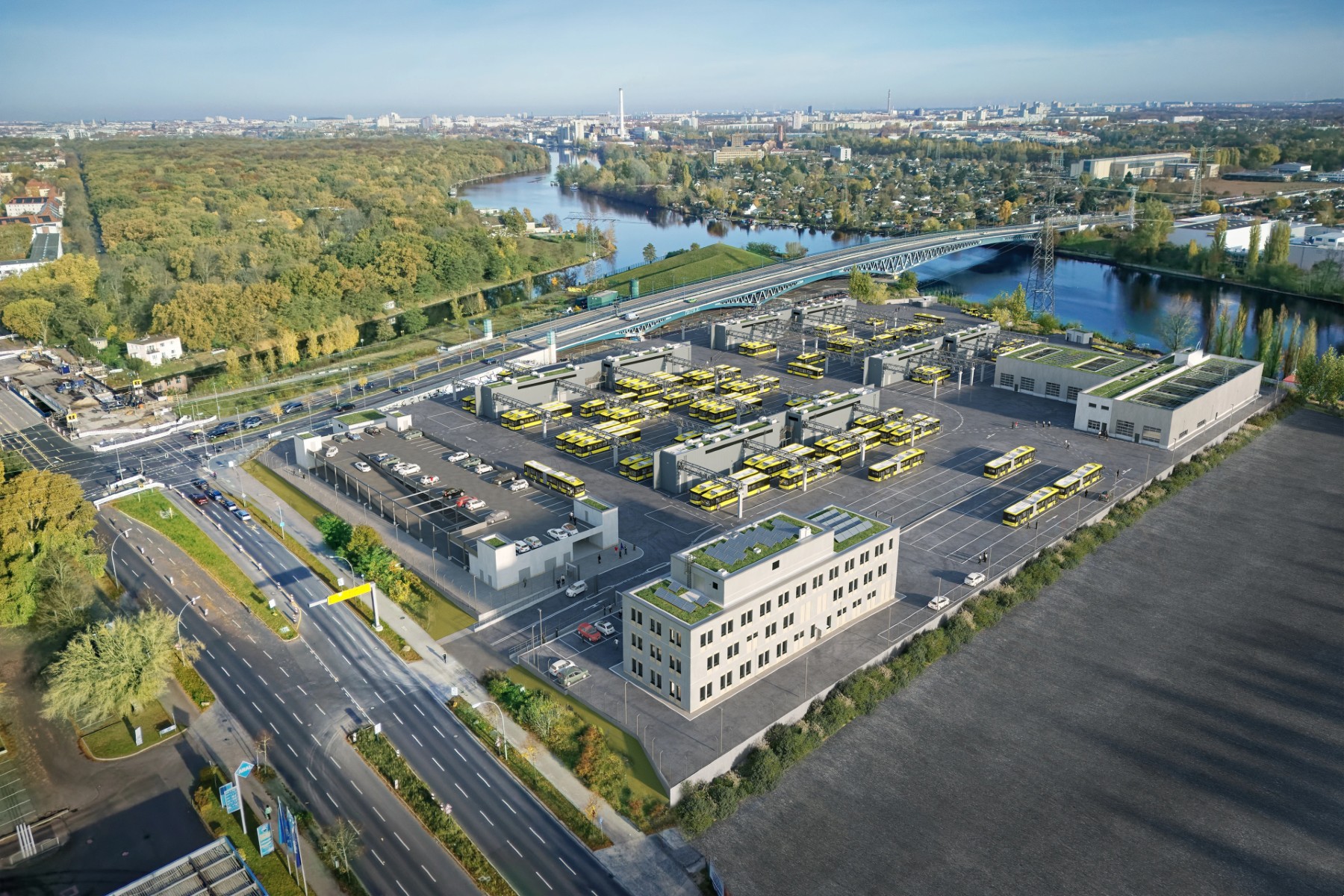
Berlin’s public transport operator BVG has reached a milestone in the construction of its new Treptow e-bus depot, celebrating a topping-out ceremony as part of its broader push to scale electric bus operations across the German capital. The Treptow site, built on a 6.6-hectare plot in Schöneweide near Köpenicker Landstraße, will accommodate around 220 battery-electric buses and will be dedicated entirely to e-bus operations.
Construction at Treptow follows the launch of another new e-bus depot project in Marienfelde earlier this year. The Treptow facilities span both sides of the Minna-Todenhagen Bridge along the River Spree. The main riverside area will include bus parking, a service hall with washing facilities, an administration building and charging bridges that allow automatic pantograph charging.
See also: Berlin’s BVG Orders 270 More Articulated Electric Buses from Solaris
On the opposite bank, BVG is building a workshop and additional parking for 32 buses. “Overall, the site will become a modern workplace for approximately 700 employees, who will in future provide Berlin’s south-east with even more emission-free mobility,” the company said.
BVG plans to equip the depot with its own automated management system to coordinate vehicle deployment, parking and charging cycles, while incorporating fire protection and maintenance planning to ensure reliable operations. The Treptow depot represents an investment of roughly €120 million, co-financed by both federal and state contributions.
See also: Berlin’s BVG Begins Construction of First All-Electric Bus Depot
The German federal government is providing a wider €160 million package for BVG’s major infrastructure projects, which the operator groups under its ‘BIG2025’ initiative. CEO Henrik Falk highlighted the significance of the dual-depot programme. “After a 60-year hiatus, we are building two new depots at once. This demonstrates how serious we are,” he said, adding that both projects are essential for a stable future bus network.
Once completed in 2027, the Marienfelde and Treptow depots will provide capacity for around 440 electric buses—nearly a third of BVG’s planned future e-bus fleet. BVG is also expanding pantograph charging stations at up to 20 terminal stops across the city. These allow buses to recharge during layovers, reducing the need for vehicles to return to depots. While most routes can operate without intermediate charging, the top-up infrastructure provides a buffer when batteries run lower than expected, and could support longer routes in the future.
See also: Volkswagen and BVG Begin Testing Autonomous ID. Buzz Shuttles in Berlin
BVG continues to progress its electrification programme: 277 of its approximately 1,500 buses are fully electric, with a target of around 500 e-buses in service by 2027. However, the operator has revised its earlier objective of full electrification by 2030, now referring more broadly to the “2030s.” Falk expects battery-electric buses to make up 80–90 percent of Berlin’s bus mobility by 2035, with HVO100 biofuel used as a transitional solution for the remaining share. Similar timeline adjustments have been made by Hamburg’s transport operator as well.


