


Norwegian food wholesaler and logistics provider ASKO has signed a service agreement with ABB E-Mobility covering the operation, maintenance and support of charging infrastructure for its growing electric truck fleet. The agreement will provide ongoing monitoring and maintenance for the installed charging systems as ASKO expands the use of battery-electric heavy-duty vehicles across its logistics operations.
Charging Network Supports Daily Logistics
ASKO operates around 700 trucks and supplies more than 1,800 food stores across Norway. The company has highlighted the importance of reliable charging infrastructure as the proportion of electric vehicles in its fleet increases.
ASKO and ABB E-Mobility have worked together since 2019. Their joint network now includes more than 60 active high-power chargers across seven Norwegian cities. According to ABB E-Mobility, the chargers have delivered more than 20 GWh of energy to date, including 5.5 GWh during the past 12 months.
Under the new agreement, ABB E-Mobility’s role will extend beyond supplying charging hardware. The company will provide ongoing monitoring, maintenance and technical support for the infrastructure, with the aim of maintaining availability and predictable service processes for ASKO’s fleet operations.
ABB Expands Maintenance Role
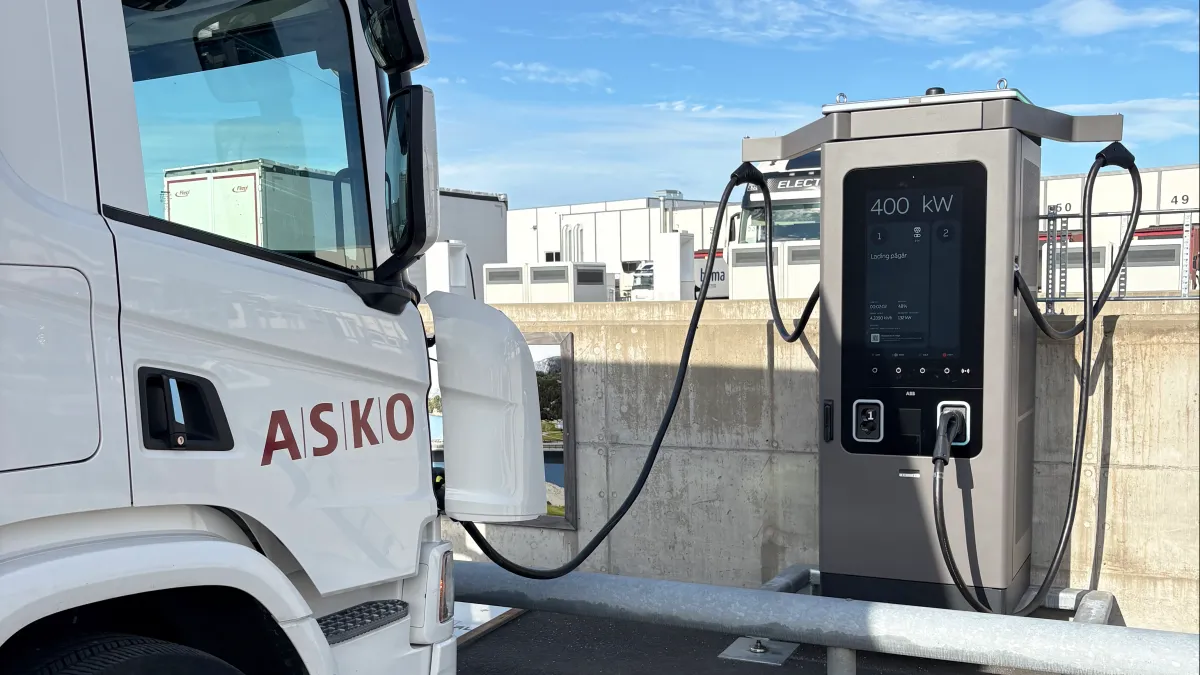
Most recently, ABB E-Mobility installed its A400 fast charger at an ASKO logistics site. The system can deliver up to 400 kW and complements existing charging infrastructure for heavy-duty commercial vehicles.
ASKO has also expanded its charging network through a collaboration with Kempower. At the Vestby site, the company operates a depot with a total charging capacity of 2.4 MW, including two Megawatt Charging System (MCS) connections and four Combined Charging System (CCS) charging points.
The two MCS connections provide charging power of up to 1.2 MW.
Kempower has installed around 190 CCS and two MCS charging points at 13 Norwegian depots for ASKO. According to Kempower, the total installed capacity across these sites is approximately 25 MW.
Electric Truck Fleet Continues to Grow
The expansion of ASKO’s charging network comes as the company continues to transition its transport operations away from fossil fuels.
By the end of 2025, around 200 of ASKO’s approximately 700 trucks were expected to be electric. The company also stated that it has been using electric trucks to serve food retail customers in the greater Oslo area since 2025.
As the number and capacity of charging points increase, the reliability and maintenance of the infrastructure become increasingly important to ASKO’s daily logistics operations. The new service agreement with ABB E-Mobility is intended to support that infrastructure as the company’s electric truck fleet continues to expand.