





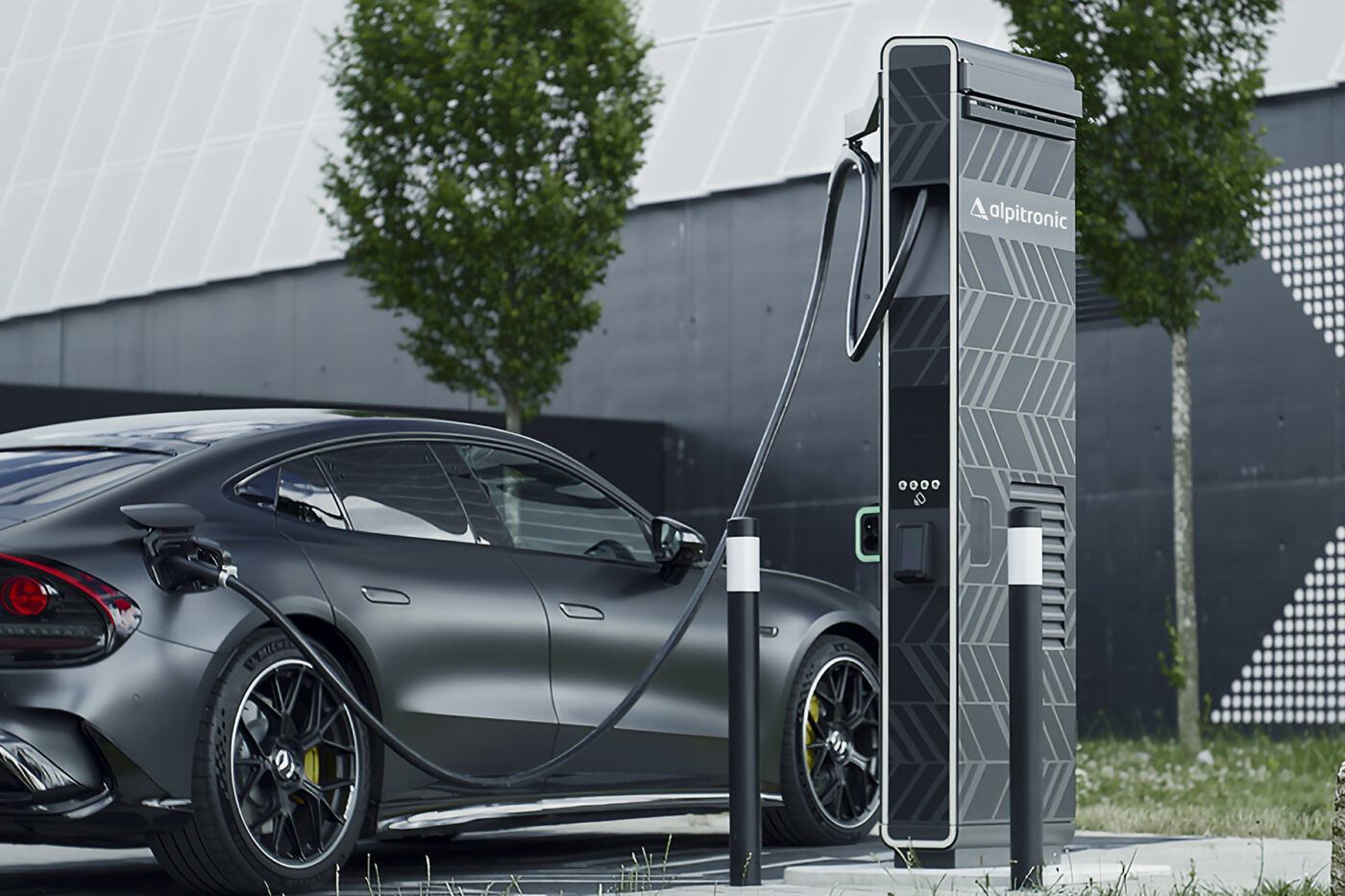
Alpitronic has introduced a new high-performance charging dispenser for its HYC1000 platform, enabling charging powers of up to 1 MW through a single CCS connector.
The launch expands the capabilities of the company’s decentralized megawatt charging system, which was introduced in 2025 with a maximum output of 1 MW distributed across multiple charging points.
Bringing Megawatt Charging to CCS
The new High Performance Dispenser, or HP Dispenser, is capable of delivering more than 1,000A and up to 1,000 kW through a liquid-cooled CCS connector.
Previously, the HYC1000 system supported a maximum charging power of 600 kW through CCS and up to 1 MW only through a Megawatt Charging System (MCS) connection.
The HP Dispenser operates across a voltage range of 150V to 1,000V and is designed for electric vehicles capable of accepting ultra-high charging rates.
Decentralized Charging Architecture
Alpitronic’s HYC1000 uses a distributed architecture in which power electronics are housed within a centralized cabinet rather than inside individual charging units.
The system consists of eight 125 kW power modules, allowing a maximum total output of 1 MW.
Under the new configuration, each HP Dispenser occupies two outputs from the power cabinet, allowing up to four dispensers to be connected to a single HYC1000 installation.
While individual vehicles can access up to 1 MW of charging power, the overall system output remains capped at 1 MW and is dynamically allocated among connected vehicles.
Flexible Site Configurations
The company said operators can combine different dispenser types within the same installation.
One example configuration includes three dual-CCS dispensers capable of delivering up to 600 kW per connector alongside a single HP Dispenser offering up to 1 MW through one CCS plug.
This setup would provide seven charging points while enabling one vehicle to access megawatt-level charging performance.
Developed From High-Power Testing
The HP Dispenser builds on technology demonstrated during testing conducted last year at Nardò, Italy.
During those trials, Alpitronic modified a charging system originally designed for electric trucks by replacing its MCS cable with a liquid-cooled CCS cable.
The system achieved average charging rates of approximately 850 kW when charging two Mercedes concept vehicles and reached a peak output of 1,041 kW at 1,176A during later testing.
The company said lessons learned from those trials were incorporated into the commercial product.
Targeting Next-Generation EVs
According to Alpitronic, the new dispenser is intended primarily for passenger vehicles capable of accepting very high charging power.
Although most electric cars currently charge at significantly lower rates, a growing number of models are approaching or exceeding 400 kW charging capability.
Examples include the Zeekr 7 GT and the Denza Z9GT, which support ultra-fast charging architectures designed to minimize charging times.
Potential Commercial Vehicle Applications
While the charging system is aimed at passenger vehicles, the technology could also support commercial vehicle operators that continue to rely on CCS connectors.
Although the industry is increasingly moving toward the MCS standard for heavy-duty vehicles, CCS remains widely deployed and supported.
By enabling megawatt-level charging through CCS infrastructure, the HP Dispenser could provide additional flexibility during the transition toward dedicated commercial vehicle charging standards.
European Launch First
Alpitronic said the HP Dispenser will be launched initially in Europe.
The company plans to introduce the product in the United States and Canada in 2027 as demand for high-power charging infrastructure continues to grow across global electric vehicle markets.


