


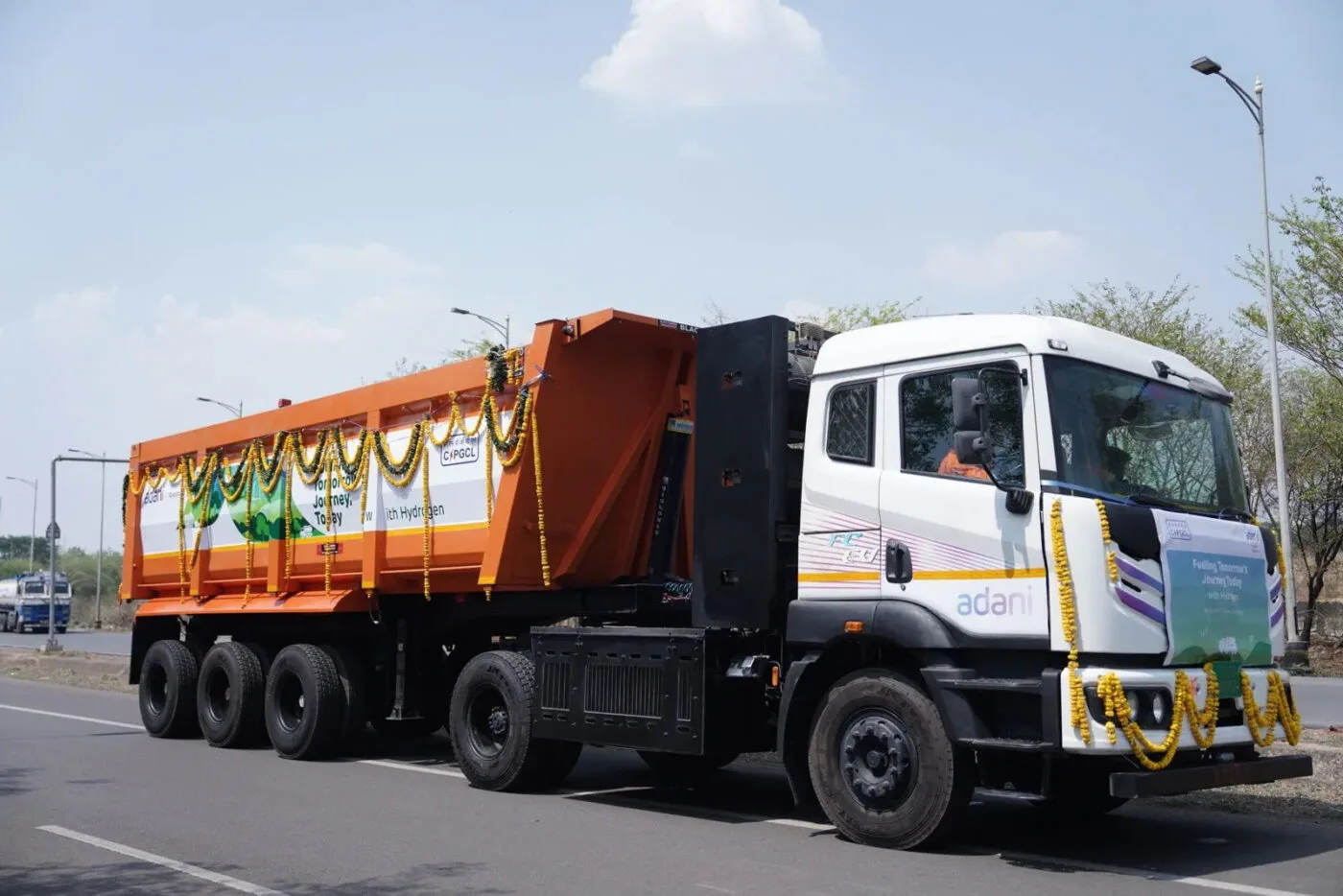
Adani Enterprises, the flagship company of the Indian conglomerate Adani Group, has launched India’s first hydrogen-powered truck for mining logistics as part of its broader commitment to decarbonisation.
The pilot project began operations on 10 May in Raipur, the capital of Chhattisgarh, a mineral-rich central Indian state. The hydrogen truck is currently transporting coal from the Gare Pelma III Block mine, operated by the Chhattisgarh State Power Generation Company Limited (CSPGCL), to a nearby state-owned power plant using a zero-emission vehicle.
While the truck’s official name has not been disclosed, it was developed by Ashok Leyland, one of India’s leading commercial vehicle manufacturers. This model aligns with a hydrogen fuel cell truck Ashok Leyland co-developed in 2023 alongside Canadian PEM fuel cell stack specialist Ballard Power Systems and Adani Enterprises. The vehicle features three hydrogen tanks, enabling a driving range of approximately 200 km, and can carry payloads up to 40 tonnes, making it well-suited for heavy-duty mining logistics. The truck is believed to use Ballard’s 120 kW FCmove fuel cell stack technology.
The project is managed by Adani Natural Resources (ANR) and Adani New Industries Limited (ANIL), divisions within Adani Enterprises focused on sustainable energy and innovation. Dr. Vinay Prakash, CEO of ANR and Director of Adani Enterprises, said, “We aim to ensure affordable and reliable electricity for all while pioneering new standards in sustainable mining practices.”
At the flag-off event, Chhattisgarh Chief Minister Vishnu Deo Sai noted that while only one hydrogen truck has been deployed so far, the state plans to introduce more units in the near future. The shift to hydrogen vehicles is expected to significantly reduce emissions and noise pollution in the diesel-dependent mining sector, supporting cleaner and quieter operations.


