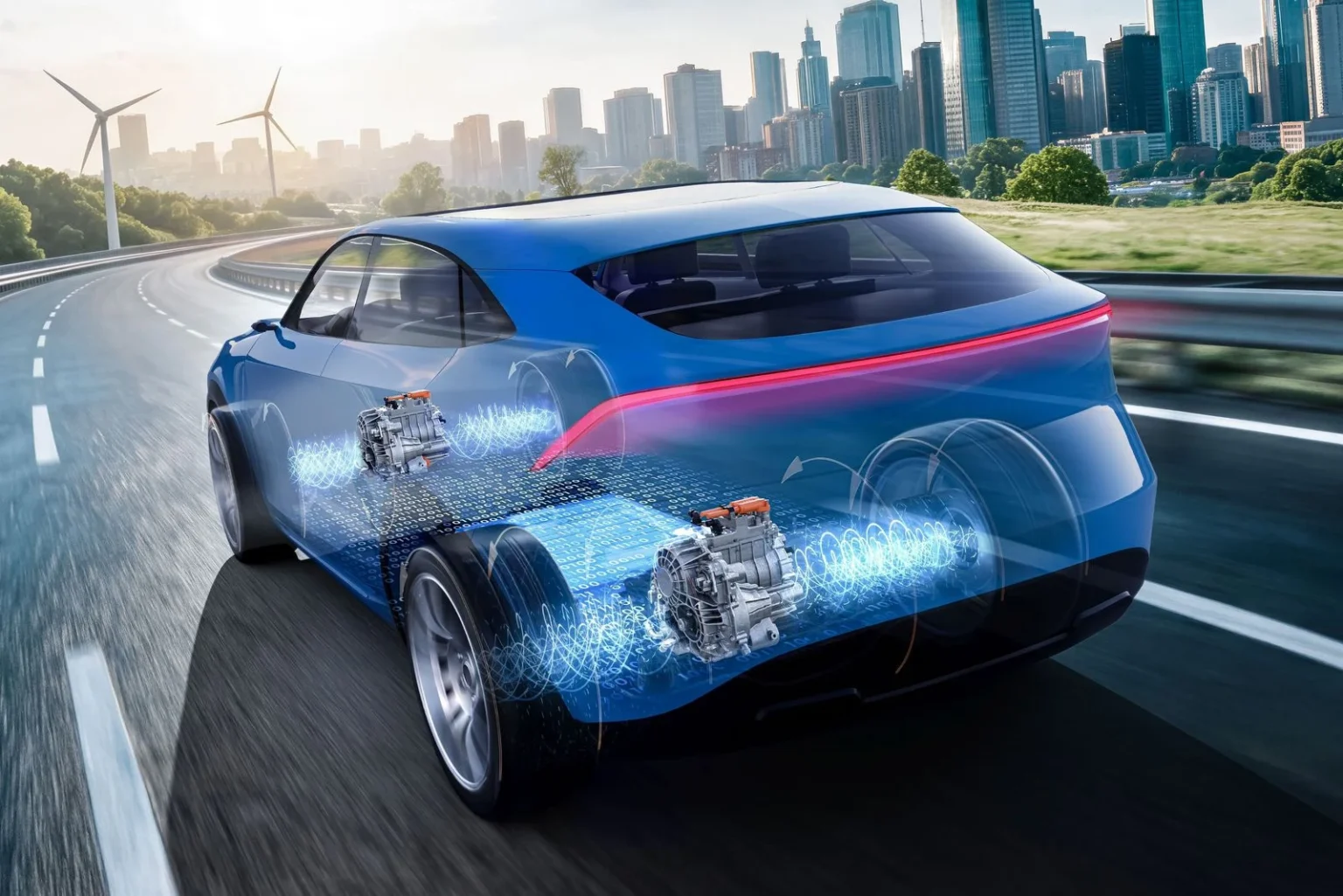
ZF has developed a compact electric drive system capable of motor speeds of up to 30,000 revolutions per minute (rpm), with production targeted for 2030. The company said the High Revolution Drive is designed for high-volume passenger cars and combines an electric motor, power electronics and transmission into a single 3-in-1 system.
Compared with a comparable ZF SELECT drive operating at 18,000 rpm, the new system is nearly 25% smaller and lighter and requires 50% less magnet mass, according to the company.
High-Speed Motor Enables a More Compact Design
The High Revolution Drive is designed for vehicles with drive outputs of approximately 150 to 200 kW and can be adapted for 400- and 800-volt electrical systems.
ZF Appoints Electrified Powertrain Chief Sebastian Schmitt to Executive Board
The version presented by ZF delivers 200 kW of peak output and up to 3,500 Nm of peak wheel torque. It uses a two-stage spur gear transmission with a ratio of approximately 18:1 to convert the motor’s high rotational speed into the torque required at the wheels.
ZF said increasing motor speed reduces the torque required to achieve the same power output. Since motor torque is closely linked to rotor volume, this allows the electric motor to be designed with smaller dimensions and lower weight.
The company reported an efficiency level of nearly 93%, comparable to the SELECT system used as its reference.
Thomas Meiser, Head of ZF’s E-Mobility Business Unit, said the system was developed by coordinating the main drive components rather than optimizing them separately.
“Rather than optimizing individual components in isolation, we systematically coordinate the electric motor, power electronics and transmission,” Meiser said.
Integrated Engineering Addresses Noise and Vibration
Operating an electric motor at higher speeds creates additional challenges in controlling noise and vibration. ZF said its development process therefore considered the electric motor, gearing, bearings and gear-tooth geometry as an integrated system.
“For the configuration presented, 30,000 rpm is the economic and technical sweet spot,” Meiser said.
The approach is intended to balance performance, efficiency, component dimensions and manufacturing costs while maintaining the operating characteristics required for passenger vehicles.
Based on ZF’s SELECT Platform
The High Revolution Drive builds on ZF’s modular SELECT platform and incorporates existing technologies. According to the company, this approach could help automakers integrate the system into new vehicle programs with shorter development times and lower development costs.
ZF Demonstrates Software-Defined Truck With Remote Safety Controls and Yard Connectivity
ZF also said the reduced magnet requirement could lower material costs and dependence on critical supply chains. The system’s lower weight may contribute to improved electric vehicle range.
The company is currently in discussions with several automakers and is targeting production by 2030.