
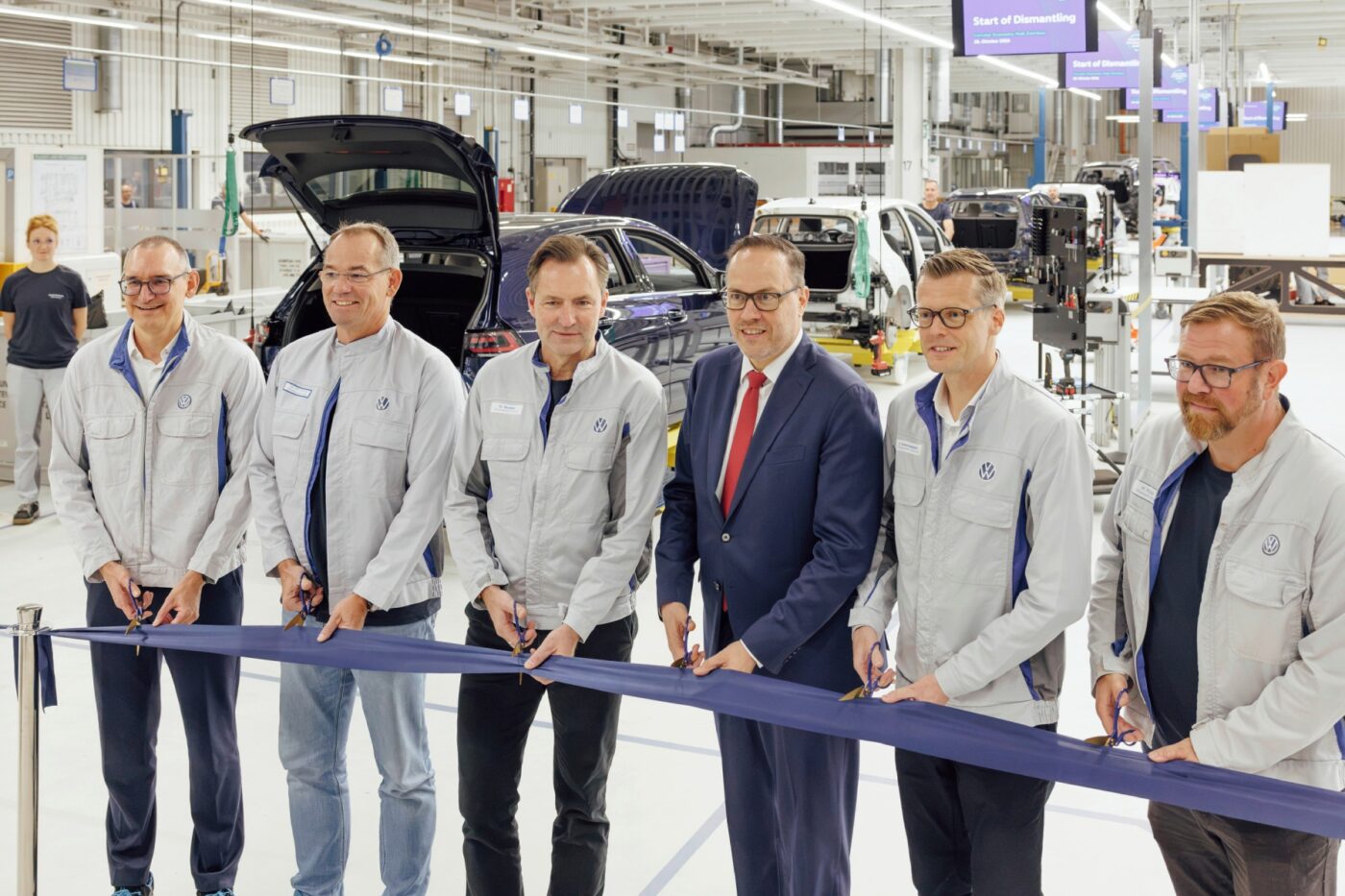
Volkswagen has officially opened a vehicle dismantling and recycling facility at its Zwickau plant in Germany, establishing the site as a central competence centre for the group’s circular economy activities. Operations are scheduled to begin in 2027, with the facility initially expected to process approximately 4,100 pre-series and end-of-life vehicles annually.
The opening follows a nine-month conversion and approval phase. Vehicles will be dismantled using an eight-stage production line operating across two shifts, requiring an initial workforce of around 100 employees.
Volkswagen also sees potential for longer-term employment growth across the wider circular economy business unit. A collective agreement finalised in December 2024 provides for the possibility of creating up to 1,000 jobs at the Zwickau site.
Danny Auerswald, spokesperson for the Management Board of Volkswagen Sachsen GmbH, said:
“The team at the Zwickau site is tackling the task with determination. We have leveraged our expertise to utilise all synergies between vehicle manufacturing and vehicle dismantling in terms of equipment and process design. Short distances at the site, specialist expertise, and the workforce’s and region’s long-standing experience enable us to transition dismantling from a workshop setting to an efficient serial process.”
Component recovery and material recycling
The facility will focus on two main areas of value creation. The first involves recovering vehicle components such as engines, transmissions, doors and bumpers for the after-sales spare parts market.
These parts will be inspected and refurbished before being distributed through Volkswagen’s dealer network and independent workshops. The approach is intended to provide more affordable replacement components for older vehicles while extending the useful life of existing parts.
The second area focuses on recovering individual raw materials from dismantled vehicles in forms suitable for reuse in manufacturing. Separating materials as cleanly as possible is expected to improve their suitability as secondary raw materials for new production processes.
Recycled plastics for new vehicle components
Plastic recovery is one of the processes planned at the Zwickau facility. The dismantling line will separate different types of plastic before the recovered material is processed into secondary raw materials for use in new components.
The process is gaining importance as European Union regulations scheduled to take effect in 2032 introduce minimum recycled-material requirements for new cars.
Since vehicle components cannot generally be manufactured entirely from recycled plastics, recovered material will be combined with newly produced material. Volkswagen estimates that the plastic recovered from one end-of-life vehicle could theoretically provide enough secondary material to meet the recycled-content requirements for three new cars.
Infrastructure designed to limit investment costs
Construction of the dismantling line involved 94 tonnes of steel and covers an area of approximately 1,200 square metres. The facility’s floor was also newly coated to support the environmentally appropriate storage of recovered materials and residual waste.
To limit investment requirements, Volkswagen reused some existing plant equipment and technology from previous vehicle production operations.
Volkswagen plans Europe-wide circular economy network
The Zwickau facility is part of Volkswagen’s broader strategy to expand industrial circular economy activities. The company plans to establish a Europe-wide network of partners to support vehicle dismantling, component recovery and material recycling.
Volkswagen Names Zwickau as Group Hub for Circular Economy, Enters Vehicle Recycling
Alongside meeting increasingly stringent environmental and recycling requirements, Volkswagen aims to reduce material costs and dependence on imported raw materials and external supply chains.
The new operation will combine the site’s existing vehicle manufacturing expertise with industrial-scale dismantling and recycling processes, creating additional opportunities to recover components and materials from vehicles at the end of their service life.