
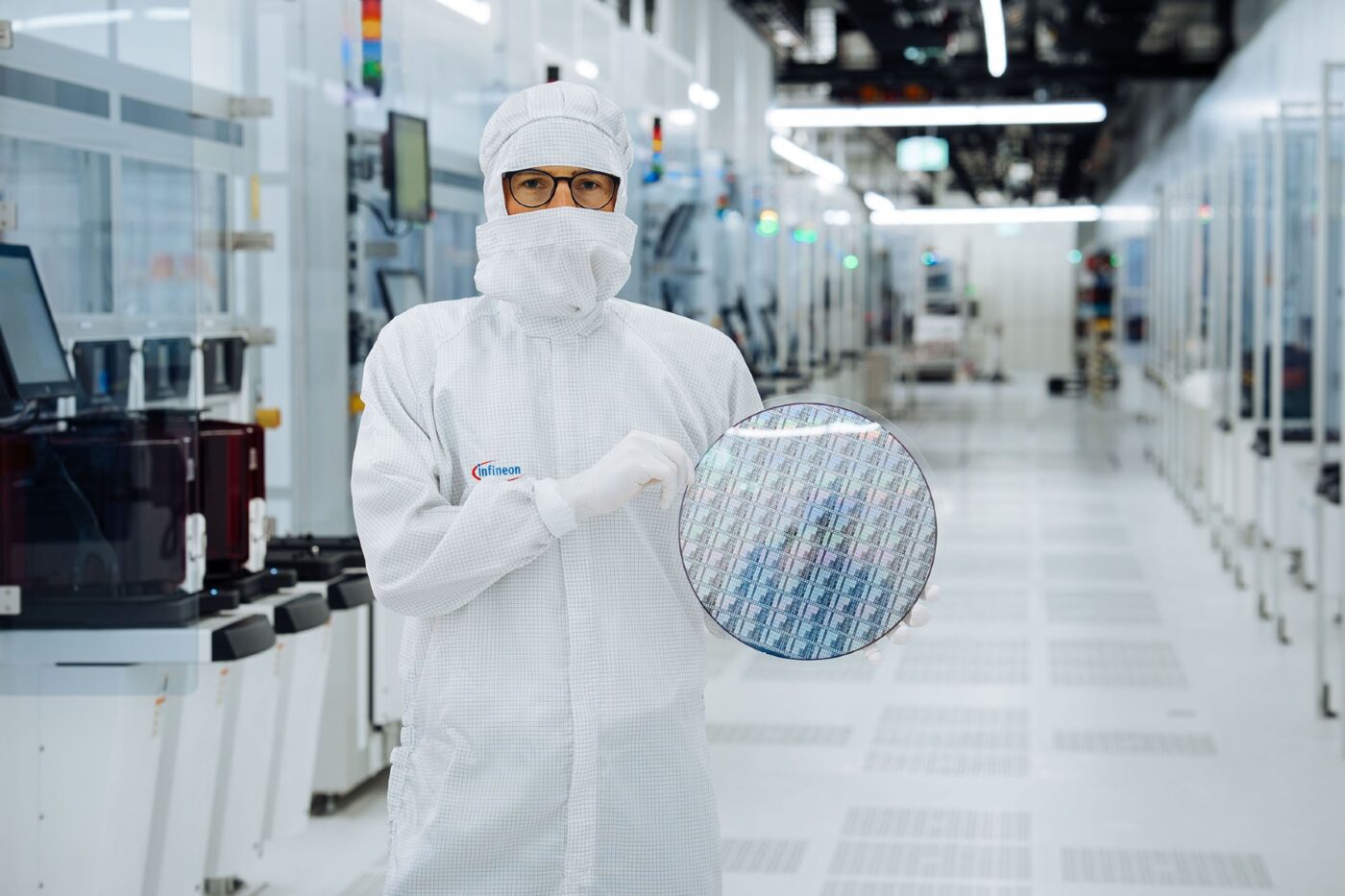
Infineon Technologies plans to invest approximately €1.1 billion in its Villach site in Austria by 2034 to expand production of gallium nitride (GaN) power semiconductors using 300-millimetre wafers. The company plans to begin high-volume manufacturing by the end of 2027, establishing what it describes as the world’s first high-volume production of GaN power semiconductors on this wafer size.
The investment will focus on upgrading and using existing cleanroom infrastructure to expand manufacturing capacity. Infineon said the approach is intended to make the expansion more efficient by building on facilities already in place.
Infineon Austria employs approximately 5,800 people, including around 4,800 at the Villach site.
“This substantial investment shows our clear commitment to strengthening the European semiconductor ecosystem and Europe’s technological sovereignty. By establishing high-volume manufacturing on 300-millimetre wafers, we will be the first company in the world to bring gallium nitride power electronics into volume production,” said Jochen Hanebeck, CEO of Infineon Technologies AG.
300-mm Wafers Enable Higher Production Capacity
Infineon reported a production milestone in 2024 when it transitioned GaN semiconductor manufacturing from 200-mm to 300-mm wafers. According to the company, the change increased production volume by a factor of 2.3, supporting its plans for high-volume manufacturing.
Larger wafers allow more semiconductor devices to be produced in each manufacturing cycle, potentially improving production efficiency. Infineon’s planned investment will build on this technology transition and expand its capacity for GaN power components.
Demand From AI and Electrification
GaN power semiconductors are used to switch and convert electrical power. Compared with conventional silicon-based components, they can reduce energy losses and heat generation in suitable applications, enabling smaller and more efficient power systems.
Infineon expects the technology to serve markets including AI data centers, electric vehicles, renewable energy systems, robotics and consumer electronics.
Industry analysts cited in the announcement forecast annual growth of approximately 35% for the GaN power semiconductor market between 2025 and 2031, reaching around US$3.5 billion by the end of that period.
European Chips Act Support
The project is supported by the European Chips Act, with the European Commission having approved €319 million in state aid. Formal funding approval from Austria’s Ministry of Economic Affairs was expected to follow, according to the announcement.
Austrian Chancellor Christian Stocker said the investment would support the country’s semiconductor manufacturing industry and contribute to European production capacity.
“With Infineon’s billion-euro investment, we are witnessing one of the largest single investments in the history of Austria’s high-tech industry. This is not only a strong commitment to Austria as a business location but also helps ensure that the future of the semiconductor industry will not be shaped solely in Asia or the United States, but also in Austria and Europe,” Stocker said.
Austria’s Economic Minister Wolfgang Hattmannsdorfer said the project aligns with the country’s strategy to translate semiconductor research into industrial-scale production.
“Austria is already a leader in energy-efficient chips. Relative to our population, we rank first in the EU in business R&D spending in the semiconductor sector. With our industrial strategy, we intend to build on this lead and not only research new technologies but also manufacture them on an industrial scale,” Hattmannsdorfer said.
Expanding Austria’s Semiconductor Manufacturing Base
Sabine Herlitschka, CEO of Infineon Technologies Austria AG, said the project would connect research and industrial production while supporting skilled employment and cooperation across the country’s semiconductor ecosystem.
Infineon Opens €5 Billion Smart Power Fab in Dresden to Boost Semiconductor Production
The planned investment will expand Infineon’s existing operations in Villach rather than establish a new manufacturing site. High-volume production is scheduled to begin by the end of 2027, while investment in the site’s infrastructure is expected to continue through 2034.