
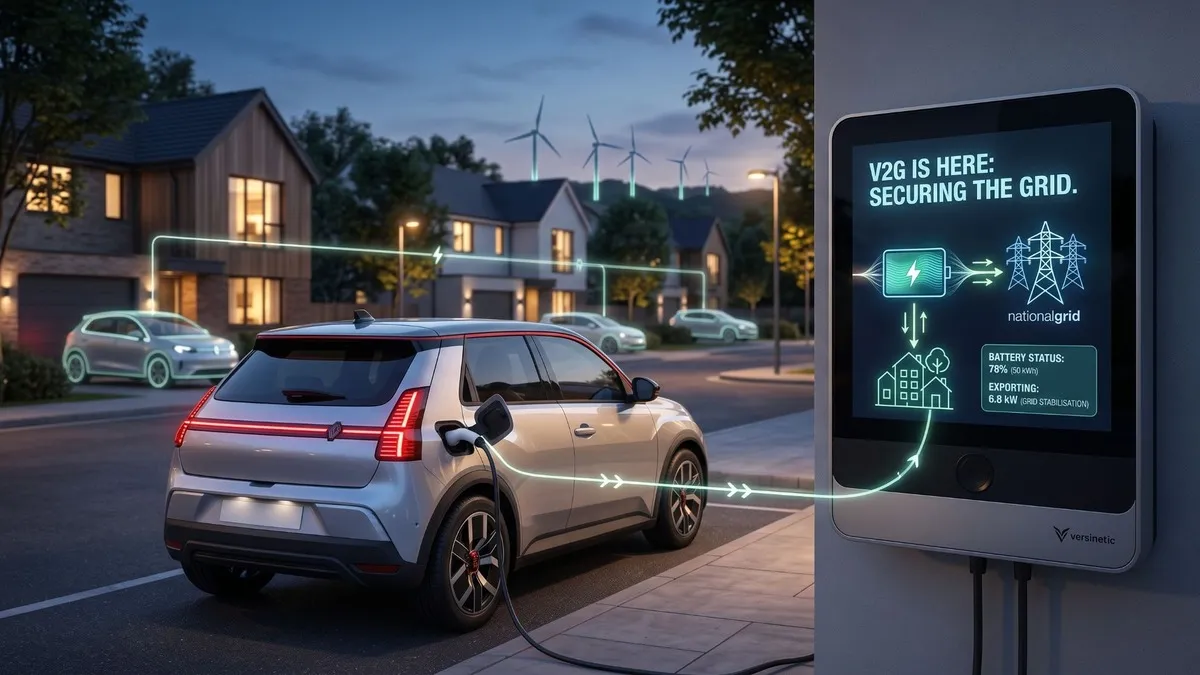
Commercial vehicle-to-grid (V2G) services are operating in the United Kingdom, Germany, France and Australia, according to an analysis published by engineering consultancy Versinetic. The report examines the development of bidirectional charging, which allows compatible electric vehicles to return electricity to the grid.
In its report, Vehicle-to-Grid is Here, Finally: Where V2G Stands in 2026, EV analyst Julian Skidmore estimates that the UK’s 2.28 million battery-electric vehicles hold approximately 114 GWh of theoretical battery capacity. This compares with around 137 GWh of installed stationary battery storage, giving a combined theoretical capacity of approximately 251 GWh.
Versinetic cautions that the figures represent potential storage capacity rather than electricity that can currently be accessed on demand. The amount available for grid services depends on vehicle compatibility, driver participation, battery charge levels, charging infrastructure and permission to export electricity.
UK Electric Vehicles Represent Potential Grid Storage
According to the analysis, battery-electric vehicles account for approximately 7.15% of cars in the UK. Versinetic calculates the 114 GWh estimate using 2.28 million vehicles and an assumed average battery capacity of 50 kWh.
The consultancy also models a scenario in which every UK car is electric. Under that assumption, vehicle batteries could theoretically supply around 48 hours of current UK electricity consumption without other energy sources, although this calculation does not represent a practical operating scenario.
Versinetic estimates that UK consumers spend approximately $26.5 billion (£20 billion) annually on electric vehicles.
The analysis also considers how coordinated charging and vehicle-to-grid services could affect local electricity networks.
In a model involving 300 homes and 450 electric vehicles, assuming 1.5 vehicles per household, charging each vehicle overnight to cover approximately 20 miles of driving could create sustained demand of around 296 kW. Versinetic compares this with a typical local distribution substation capacity of approximately 300 kW.
Spreading charging across a 24-hour period could reduce average charging demand to around 100 kW, according to the model. Separately, the accompanying release states that the vehicles in this scenario could provide up to 2.1 MW for household or local peak demand.
These figures are modeled outcomes, not measurements of an operating V2G network.
Commercial V2G Available in Four Markets
Versinetic identifies the UK, Germany, France and Australia as markets where commercial V2G services are available. In other countries, including Norway, the technology remains largely at the pilot stage, according to the analysis.
In Germany, the report cites an offer from E.ON and BMW, alongside a Volkswagen–Elli package planned for the fourth quarter of 2026.
In France, it points to commercial activity involving Renault, Mobilize and The Mobility House, which began in October 2024.
The availability of commercial services varies by market and vehicle. Having a vehicle capable of bidirectional charging does not necessarily mean its owner can access a compatible tariff or export electricity under local grid rules.
UK Regulations and Charging Packages
Versinetic identifies grid connection requirements as a factor that historically limited domestic V2G deployment in the UK.
The report notes that the G98 small-generation threshold is approximately 3.68 kW, or 16 A. Typical single-phase AC charging operates at around 7.3 kW, while three-phase charging can reach 22 kW, bringing many domestic bidirectional charging installations under G99 connection requirements.
The UK streamlined G99 approval in 2025, according to Versinetic, helping establish a route combining certified bidirectional charging equipment with approval from the relevant Distribution Network Operator.
The consultancy identifies Octopus Energy’s Power Pack as a commercial UK V2G tariff. According to the release, the package is currently compatible with the BYD Dolphin and a Zaptec Pro V2G charger. UK Power Networks also offers automatic V2G connection approval.
Commercial packages remain limited compared with the number of vehicles that may support some form of bidirectional charging.
Versinetic cites Nissan as the first manufacturer in the UK to obtain G99 grid-code certification for an AC V2G solution, following a University of Nottingham trial. The system used the vehicle’s onboard charger rather than a separate bidirectional charging unit.
The analysis lists 27 V2G-capable models in the UK, drawing on EV Database UK. These models come from manufacturers including Renault, Volkswagen, Mercedes-Benz, Kia, Volvo, Alpine, Skoda, Audi, BMW, Hyundai and Polestar. However, technical capability alone does not establish that every model can participate in a currently available commercial service.
Versinetic Highlights Potential Grid Benefits
Dunstan Power, managing director of Versinetic, said the development of V2G could change how electric vehicles are considered in relation to electricity networks.
“The argument around EVs and the grid is starting to turn on its head. We have spent years asking how the electricity system will cope with millions of electric cars. V2G means those same cars could become part of how we manage that challenge,”
Power said.
“After nearly 30 years of research and trials, that is the real significance of V2G moving towards commercial reality. We can start thinking about the EVs arriving on our roads not simply as vehicles that need electricity, but as millions of batteries with a potential role in the energy system.
“As winter approaches, the opportunity to manage peak demand and make better use of renewable electricity becomes particularly relevant. The challenge now is to turn that potential into practical services that work for drivers, energy suppliers and network operators.”
Versinetic said policymakers should consider charging infrastructure, interoperability standards and energy-market arrangements as part of efforts to support commercial V2G. The consultancy also works with technologies and standards including IEC 61851 and ISO 15118 for charging and vehicle-grid communication.
Commercial Availability Remains a Constraint
The report describes commercial V2G as an emerging service rather than a widely available function across electric vehicles. Regulatory approval, compatible charging equipment, vehicle support and the availability of suitable energy tariffs remain relevant to deployment.
For the UK, Versinetic highlights streamlined grid approval, certified hardware and automated connection processes as elements of the commercial pathway.
Its estimates of 114 GWh of EV battery capacity and 251 GWh when combined with stationary storage illustrate the potential scale of distributed storage. They do not represent capacity that grid operators can currently call on in full. The modeled 48-hour national supply scenario and 2.1 MW neighborhood figure should likewise be understood as theoretical or modeled potential, rather than existing electricity supply.