
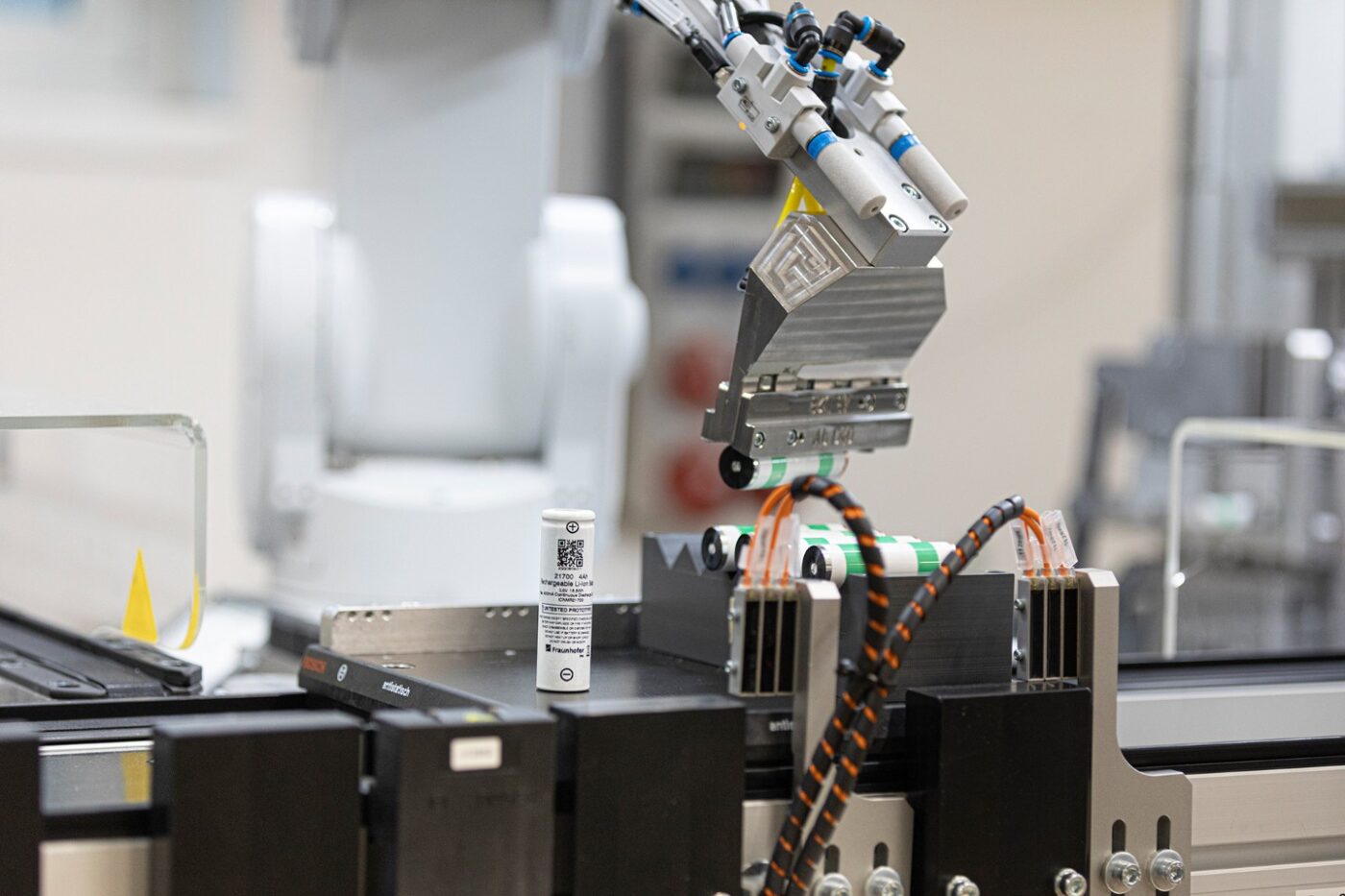
The Fraunhofer Institute for Manufacturing Engineering and Automation IPA and the University of Stuttgart have developed and patented a cell and electrode technology designed to enable aluminum anodes in practical battery applications.
The technology addresses a key challenge associated with aluminum as an anode material: repeated volume changes during charging and discharging can cause mechanical damage, reduce electrical contact within the electrode and shorten battery life.
According to the researchers, their approach stabilizes the electrode structure and maintains electrical contact over repeated charge and discharge cycles. Several prototypes have been produced and are undergoing testing at Fraunhofer IPA’s Centre for Digitalised Battery Cell Production.
Addressing Aluminum Anode Degradation
Aluminum has attracted interest as a potential alternative to graphite and silicon in lithium-ion battery anodes because of its availability, cost and capacity potential. However, changes in volume during battery operation can generate mechanical stress, leading to cracks, pore formation and the breakdown of electrode material.
These effects can contribute to capacity loss and reduced service life, limiting the practical use of aluminum in conventional battery designs.
The research team, working with the Institute for Photovoltaics at the University of Stuttgart, developed an electrode structure intended to manage these changes and reduce the associated degradation.
We are making a battery technology that has been known for a long time but has been difficult to control practically usable,
Kai Peter Birke, scientific director for battery and hydrogen systems and storage at Fraunhofer IPA, said in a German-language press release.
The technology eliminates graphite and silicon from the anode. This could reduce demand for graphite, which is considered a critical raw material for Europe’s battery industry, while also avoiding the volume-change challenges associated with silicon-rich anodes.
Aluminum Foil Combines Two Functions
A central feature of the design is the use of commercially available alloyed aluminum foil as both the active anode material and the current collector.
Conventional battery anodes typically use a separate current collector, commonly made from copper, with active material applied through a coating process. The new approach eliminates the need for both the separate copper foil and the additional coating step for the anode’s active material.
According to Fraunhofer IPA, this design could reduce electrode manufacturing costs and energy consumption by simplifying production.
The researchers identify lithium manganese oxide (LMO) as a potential cathode material for use with the aluminum anode. They suggest that the combination could achieve competitive energy density, although the institute has not published specific energy-density measurements in its current announcement.
The proposed chemistry would also be phosphate-free, potentially offering an alternative to lithium iron phosphate (LFP) batteries.
Potential for Fluorine-Free Battery Cells
The aluminum anode could also be paired with electrolyte solvents that have a high flash point. In combination with a fluorine-free LMO cathode, Fraunhofer says the design could enable a battery cell without fluorine-containing components and, consequently, without per- and polyfluoroalkyl substances (PFAS).
The institute also identifies the potential to avoid hydrogen fluoride formation in the event of a battery fire. These are proposed benefits of the cell configuration rather than independently confirmed safety outcomes; further testing will be needed to establish its performance under practical operating and failure conditions.
Initial Applications and Manufacturing Prospects
Fraunhofer IPA sees potential early applications in areas where safety, robustness and compact installation are important. These include air freight, tracking systems for transport containers and specialized medical devices.
The researchers also say the cell chemistry could be manufactured using existing production facilities, potentially avoiding the need for a complete overhaul of battery manufacturing infrastructure.
The technology remains under development. Although several prototypes have been built, the institute has not disclosed specific cycle-life results, gravimetric or volumetric energy-density figures, or a timetable for commercial deployment.
Further Research into Battery Architecture
The aluminum anode project is part of broader research into improving battery performance through changes to materials and cell architecture.
In September, the Fraunhofer Institute for Solar Energy Systems ISE presented a battery-cell architecture using substantially thicker electrodes. By reducing the proportion of current collectors within the cell, the approach could increase energy density by 10% to 15%, depending on battery type and design.
That technology also remains at the research stage, with its industrial scalability still to be demonstrated.
Together, these research efforts examine different ways to reduce material requirements, simplify manufacturing and improve battery-cell performance. The commercial potential of the aluminum anode technology will depend on further prototype testing and validation of its durability, energy density, safety and production economics.