
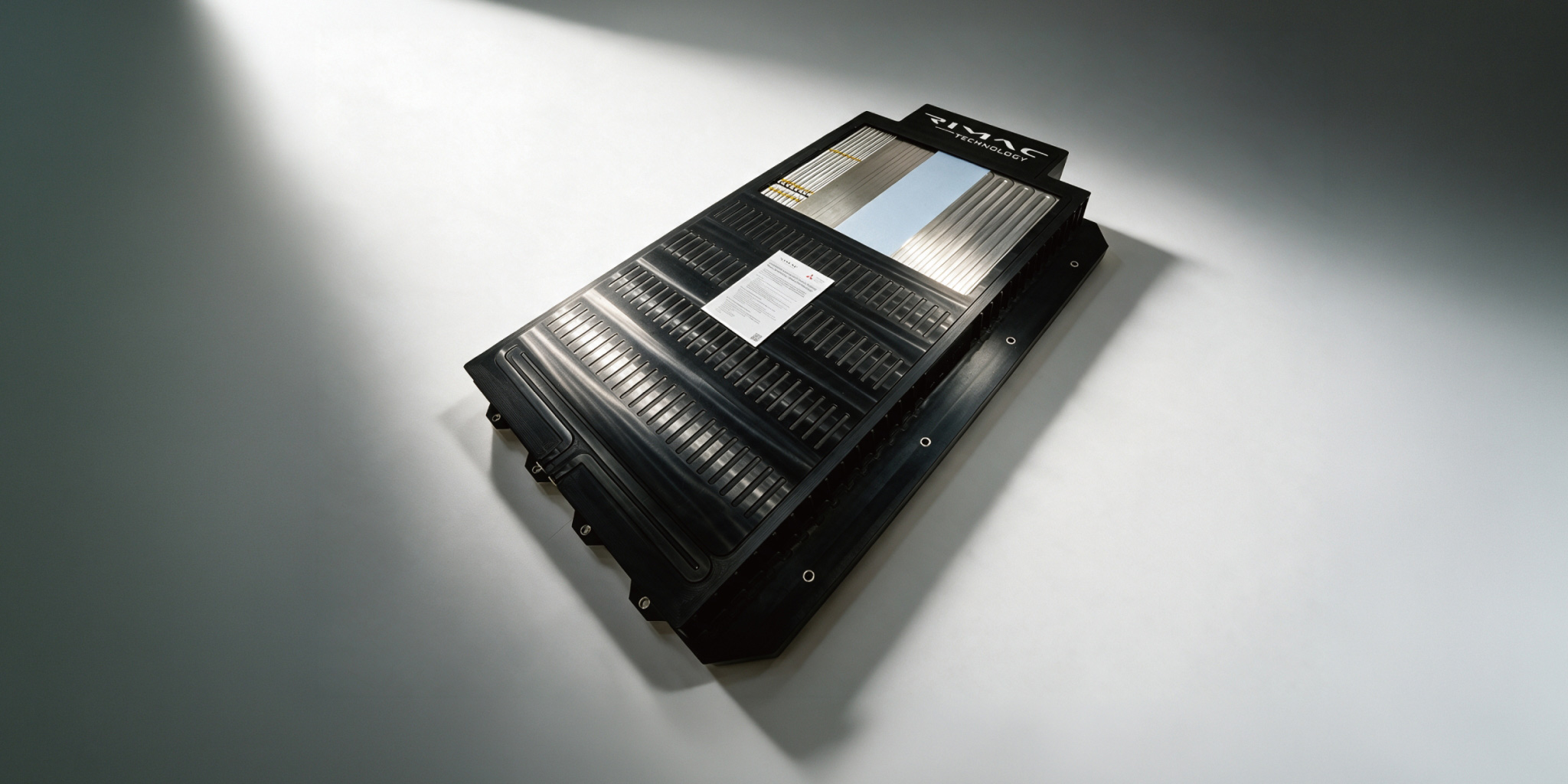
ProLogium and Rimac Technology have unveiled a concept mockup of a pouch cell-to-pack battery at the Paris Motor Show, outlining a development roadmap that places battery integration alongside cell chemistry as a key factor in advancing solid-state batteries for automotive applications.
The companies plan to present a functional battery segment at CES 2027, followed by a full-scale working battery pack later in the year. On-road testing and in-vehicle trials are scheduled for the second half of 2028.
The collaboration, formalised through a memorandum of understanding at IAA in September 2025, combines ProLogium’s battery cells with Rimac Technology’s pack engineering capabilities. The development programme is intended to validate thermal management, cell integration and system architecture against automotive requirements before progressing towards vehicle-level testing.
Testing Multiple Battery Integration Approaches
Rimac Technology is evaluating several cell-to-pack integration concepts in parallel using functional battery segments. The work covers thermal management, cell swelling, cell integration and overall system design, according to Daniel Kišić, Principal Product Architect at Rimac Technology.
The approaches involve different engineering priorities. Some focus on maximising energy density while reducing battery weight and space requirements, while others prioritise performance.
Managing cell swelling is among the practical challenges being addressed as the company develops its integration technology around solid-state pouch cells. With vehicle trials planned for the second half of 2028, the programme remains in the engineering and validation phase, and any production application would follow further development.
Kišić said the development process begins with vehicle-level requirements and seeks to simplify battery architecture, combine functions and reduce weight while considering cost, charging times and power output.
Rimac Technology is developing a scalable cell-to-pack integration technology for solid-state pouch cells, designed to meet and exceed the requirements the automotive industry is expected to set over the coming decade.
He added that the company is testing multiple solutions to determine how the cells can be integrated into a battery system that meets automotive performance and packaging requirements.
Potential Benefits for Electric Vehicles
A validated battery pack could reduce overall battery weight and give automakers greater flexibility in balancing range, capacity and packaging.
According to Kišić, manufacturers could use the weight savings to install more energy capacity without increasing the battery’s mass, adopt a smaller and lighter pack while maintaining the same driving range, or combine both approaches.
These outcomes would depend on the final pack architecture and its performance after vehicle-level validation. The companies have not yet disclosed specific production applications or detailed battery performance figures for the concept.
Development Roadmap and Next Steps
ProLogium founder and Chief Executive Vincent Yang described the Paris Motor Show display as the starting point for the collaboration’s engineering programme. The concept mockup has been completed, while functional battery segments are under development.
Since jointly announcing our collaboration with Rimac Technology at IAA in 2025, both teams have continued to advance the project, translating our shared technical vision into concrete engineering development work. What we are presenting at the Paris Motor Show is the baseline of that collaboration.
Yang said the next stages will focus on developing a functional battery, progressing towards a full-scale pack and subsequently validating its integration into a vehicle.
Bringing next-generation batteries to the automotive market requires more than cell technology. It also takes the engineering expertise to integrate those cells into a battery pack with optimized architecture and thermal management.
The roadmap sets out several milestones before the technology can be assessed in an automotive environment: a functional battery segment at CES 2027, a full-scale working pack later in 2027, and planned on-road and in-vehicle trials in the second half of 2028.
The programme highlights the role of pack engineering in determining how effectively next-generation solid-state cells can be used in electric vehicles. The technology’s eventual commercial prospects will depend on the results of integration testing, validation and subsequent development.