
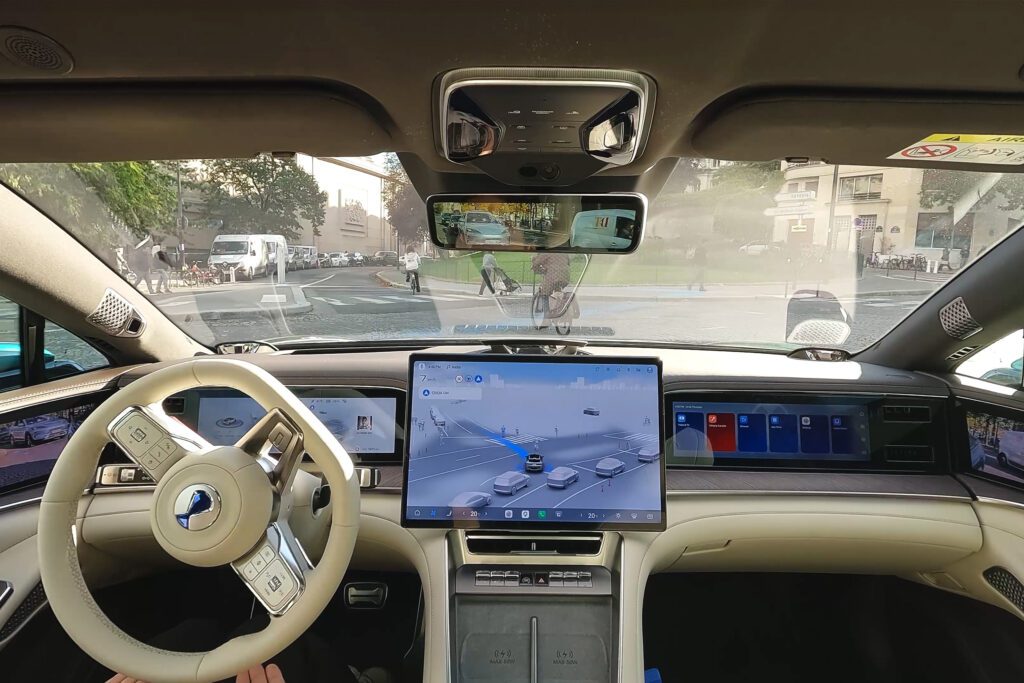
BYD’s premium brand Denza plans to introduce its God’s Eye City Navigation Driving Assistant (CNOA) system in Europe in 2027, with the Z9 GT station wagon set to become the first model from the automaker to receive the technology in the region.
The company disclosed the plan at the Paris Motor Show 2026. The software is expected to reach the Z9 GT through an over-the-air update, subject to the required European type approval.
Denza markets the system under the God’s Eye name. Although designed to assist with urban navigation, it is a Level 2 driver-assistance system, meaning drivers must continue to monitor driving conditions and remain ready to intervene. It should not be considered a fully autonomous driving system.
Urban Navigation Assistance
The God’s Eye CNOA system is designed to assist with driving in complex urban environments, including traffic lights, roundabouts, intersections and situations involving double-parked vehicles.
According to BYD, the Z9 GT has the necessary hardware fitted as standard. Its sensor suite includes a lidar sensor, 11 cameras, three millimetre-wave radars and 12 ultrasonic sensors.
The system is undergoing calibration ahead of type approval under UN Regulation 171, which is required before the planned European rollout.
Stella Li, executive vice president of BYD, said the planned update would bring the company’s city-navigation assistance functions to the Z9 GT.
We are delighted to deliver on our commitment by bringing the benefits of God’s Eye, including city navigation assist, to the Z9GT. This technology will help make city driving less stressful, from traffic jams to busy intersections and roundabouts.
Li also confirmed the planned software availability and noted the vehicle’s existing hardware configuration.
The necessary hardware has been fitted as standard to the Z9GT since its launch, and the software is expected to be available in 2027. Combined with Flash charging and our e3 platform, this technology will further strengthen Denza’s position among the brands at the forefront of driver-focused innovation. It once again demonstrates our commitment not only to developing breakthrough technologies, but also to bringing them to our customers around the world.
Competition in European Driver-Assistance Technology
The planned launch comes as other Chinese automakers prepare to introduce urban navigation assistance features in Europe. Xpeng has also announced plans to bring its Navigation Guided Pilot (NGP) system to the region in the first quarter of 2027.
Xpeng has indicated that models equipped with its Turing AI chip are expected to receive the technology first. These include the P7+ sedan, X9 minivan, L03 coupe crossover and G9L SUV.
The planned introductions reflect growing efforts by Chinese automakers to adapt their driver-assistance systems for European markets. Availability will depend on local regulatory requirements, vehicle compatibility and software rollout schedules.
God’s Eye Technology in China
In China, the Denza Z9 GT uses the God’s Eye 5.0 driver-assistance system, which incorporates BYD’s Xuanji A3 system-on-chip. The chip is manufactured using a 4-nanometer process and has a reported peak computing capability of approximately 700 tera operations per second (TOPS).
The system processes data from lidar, millimetre-wave radar, ultrasonic sensors and cameras to support its driver-assistance functions.
The European version’s final software capabilities and rollout details remain subject to the approval process. BYD has not confirmed that the system has received European type approval or that the Z9 GT can operate without driver supervision.
Part of Denza’s European Technology Rollout
The planned CNOA update follows Denza’s introduction of the Z9 GT in Europe with BYD’s Flash charging technology. BYD has also announced plans to equip the Atto 8 large SUV with Flash charging.
The combination of driver-assistance software, charging technology and the e3 vehicle platform forms part of Denza’s broader European product strategy. The Z9 GT is scheduled to receive the God’s Eye city-navigation function in 2027, with further rollout details expected as the approval process progresses.