
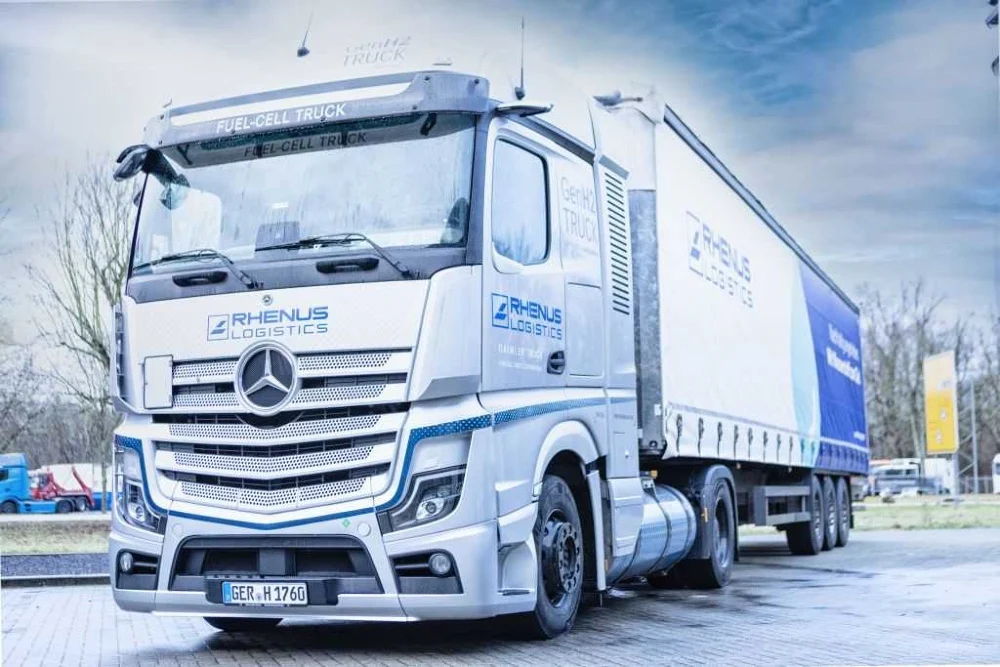
Hydrogen-powered mobility has demonstrated technical feasibility in Germany and Europe, but progress toward commercial deployment has remained limited by high costs, uncertain green hydrogen prices and competition from battery-electric trucks. A new alliance led by Daimler Truck, Volvo Group and Toyota now aims to address those barriers by developing the hydrogen ecosystem needed for heavy-duty transport across Europe.
The alliance is expected to present its plans in detail on September 15 at IAA Transportation 2026 in Hanover. Daimler Truck has already indicated that the initiative will involve coordinated efforts across vehicle manufacturers, suppliers, transport companies and energy providers.
Manufacturers And Energy Companies Join Forces
The initial alliance includes Daimler Truck, Volvo Group and Toyota, alongside Bosch, Air Liquide, TotalEnergies, TEAL Mobility and MB Energy.
EKPO and Akkodis Test 360 kW Fuel Cell System in Hydrogen Truck
The participation of the three vehicle manufacturers builds on their existing cooperation in fuel cell technology. Daimler Truck and Volvo Group have worked together through Cellcentric, their fuel cell joint venture. Toyota joined Cellcentric this year as an equal third partner, creating a direct link between the existing fuel cell collaboration and the new broader industry initiative.
The companies have already invested significant resources in developing fuel cell technology for heavy-duty applications. The new alliance is intended to support the commercial deployment of that technology by addressing infrastructure and hydrogen supply constraints.
Focus On Infrastructure And Hydrogen Costs
Daimler Truck said the alliance aims to accelerate the commercialization of hydrogen-powered mobility and establish the ecosystem required to scale deployment across the value chain.
“accelerate the commercialization of hydrogen-powered mobility and build the ecosystem needed to scale it along the whole value chain,” Daimler Truck said.
The initiative is expected to include the development of hydrogen refuelling stations along key strategic corridors in Europe. The partners also want to establish access to hydrogen at competitive prices.
The hydrogen initiative will operate alongside the continued expansion of battery-electric trucks, which Daimler Truck said remains unaffected by the alliance.
The companies’ broader objective is to make hydrogen trucks economically viable for customers by reducing the overall cost of operating the vehicles.
Germany Targets Hydrogen Truck Network
The alliance’s plans also align with Germany’s efforts to establish an initial hydrogen refuelling network for heavy-duty transport.
The German government recently received more than 500 applications under its first funding call for hydrogen truck infrastructure. Funding decisions are expected during the second half of 2026.
Germany has allocated €220 million in subsidies to expand hydrogen mobility. The funding is intended to establish a basic network for heavy-duty transport in line with requirements under the European Alternative Fuels Infrastructure Regulation.
Hyundai Motor Group Opens Waste-to-Hydrogen Facility in South Korea
The program also covers hydrogen internal combustion engines, which use technology based largely on conventional reciprocating piston engines.
According to Germany’s Transport Ministry, major heavy commercial vehicle manufacturers were among the applicants, indicating significant industry participation in the government-backed program.
Automakers Move Beyond Vehicle Development
The emerging alliance suggests that manufacturers may become more directly involved in building the infrastructure required to support hydrogen-powered trucks.
Daimler Truck and Volvo Group committed to hydrogen technology alongside their battery-electric strategies several years ago. However, the commercial rollout has been slowed by the lack of a sufficiently developed hydrogen ecosystem.
Aging Hydrogen Tanks Could Become Costly Challenge for Early Fuel-Cell Vehicles
The companies initially expected their first series-production fuel cell trucks to arrive around 2027. Cellcentric was established in 2021 with the objective of developing and producing fuel cell systems at scale.
The industry has since adjusted those timelines as infrastructure development and market conditions have proved more challenging than anticipated.
Cellcentric Production Plans Face Delays
Cellcentric is continuing construction of a large-scale fuel cell production facility in Weilheim an der Teck, Germany. The project has experienced multiple delays, requiring the partners to adjust their plans as the commercial deployment of hydrogen trucks moves further into the future.
Daimler Truck’s Next GenH2 Truck is now approaching customer testing, including planned operations with transport company Dachser. However, Daimler Truck has postponed series production of the hydrogen truck until the 2030s.
The revised vehicle timeline also affects Cellcentric’s production plans and the broader rollout of fuel cell technology.
Stadler and ARST Develop World’s First Hydrogen Train for Narrow-Gauge Railways
Volvo Trucks, meanwhile, has provided fewer recent updates on its planned fuel cell trucks. The company is now preparing to showcase a fuel cell truck at IAA Transportation, providing a renewed indication of its continued commitment to hydrogen-powered heavy-duty transport.
The September 15 presentation in Hanover is therefore expected to clarify how the participating companies intend to move beyond vehicle development and establish the infrastructure, hydrogen supply and commercial conditions required for wider adoption.