
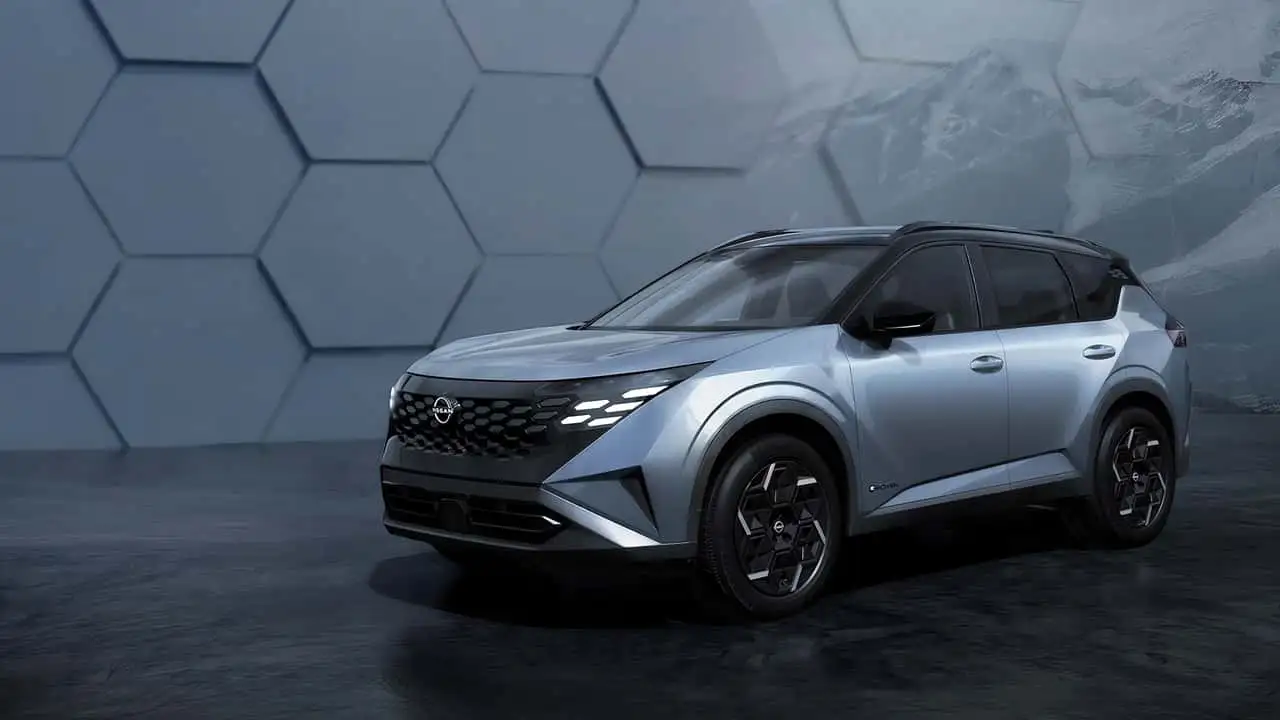
Nissan is accelerating the US launch of the Rogue e:Power hybrid as it seeks to capitalize on growing demand for hybrid vehicles. The fourth-generation Rogue will arrive in the US with the hybrid version first, followed by non-hybrid variants.
Nissan has brought the launch forward twice, moving it from mid-2027 to January and now to November 2026, according to Automotive News. The accelerated schedule reflects the automaker’s effort to compete more directly in a hybrid SUV market dominated by Toyota and Honda.
Nissan Targets Growing Hybrid Demand
Nissan was an early player in battery-electric vehicles with the first-generation Leaf, which launched in 2010. However, the company has had a relatively limited presence in the US hybrid market.
Nissan Surpasses 1.25 Million Electrified Vehicle Sales in Europe
The Rogue e:Power is intended to change that by offering a hybrid system designed to deliver an electric-like driving experience without requiring drivers to plug in the vehicle.
“We believe this hybrid is a home run, so we did everything we could to bring it earlier,” said Tiago Castro, senior vice president of US marketing and sales at Nissan.
The timing comes as hybrid sales continue to gain momentum in the US, with buyers increasingly looking for improved fuel efficiency while retaining the convenience of gasoline-powered vehicles.
Series-Hybrid Powertrain
The Rogue e:Power will use a different hybrid architecture from the systems employed by Toyota and Honda.
Instead of mechanically connecting the gasoline engine to the wheels, Nissan’s system uses the engine primarily as a generator. The wheels are driven exclusively by electric motors, giving the Rogue a driving experience closer to a battery-electric vehicle.
The powertrain combines a 1.5-liter turbocharged three-cylinder gasoline engine with a relatively small 2-kilowatt-hour battery. The engine generates electricity that charges the battery or supplies power to the electric motors, while regenerative braking also contributes energy.
Because the vehicle has no plug-in charging capability, the battery is charged through the gasoline engine and regenerative braking.
The configuration is commonly described as a series hybrid and shares some characteristics with extended-range electric vehicle systems. However, the Rogue e:Power differs from larger plug-in EREVs because of its much smaller battery and lack of external charging.
More Than 40 MPG Target
Nissan expects the Rogue e:Power to deliver more than 40 miles per gallon.
If achieved, that figure would put the hybrid roughly in line with the Toyota RAV4 and slightly ahead of the Honda CR-V Hybrid, giving Nissan a potentially competitive position in the US compact SUV market.
Nissan Reportedly Halts Development of Electric Qashqai Amid EV Strategy Review
The system also allows Nissan to retain the Rogue’s established SUV format while adding improved fuel efficiency without requiring customers to change their refuelling habits.
Rogue Has Existing US Momentum
The Rogue already has a strong presence in the US market. Nissan sold 135,970 Rogue vehicles during the first six months of 2026, up 24% from the same period a year earlier.
However, the model remains behind its key hybrid-SUV competitors in overall sales.
Honda sold 226,114 CR-V vehicles during the same period, with hybrids accounting for 55% of those sales. Toyota sold 153,955 RAV4 vehicles, although RAV4 sales declined 35% year on year as production of the sixth-generation model ramped up.
The latest RAV4 is now offered exclusively with hybrid or plug-in hybrid powertrains, further highlighting the direction of the compact SUV segment.
Nissan Enters Hybrid Race
The Rogue e:Power represents a significant shift in Nissan’s US electrification strategy. Rather than relying exclusively on battery-electric vehicles, the automaker is adding a series-hybrid option designed to bridge the gap between conventional gasoline vehicles and fully electric models.
Nissan to Launch N7 EV as Primera EV in Philippines, Marking First Overseas Market
The November launch will put Nissan directly against established hybrid offerings from Toyota and Honda. The key test will be whether the Rogue e:Power can combine its electric-driven powertrain with competitive fuel economy and the practicality that has already made the Rogue one of Nissan’s strongest-selling US models.