
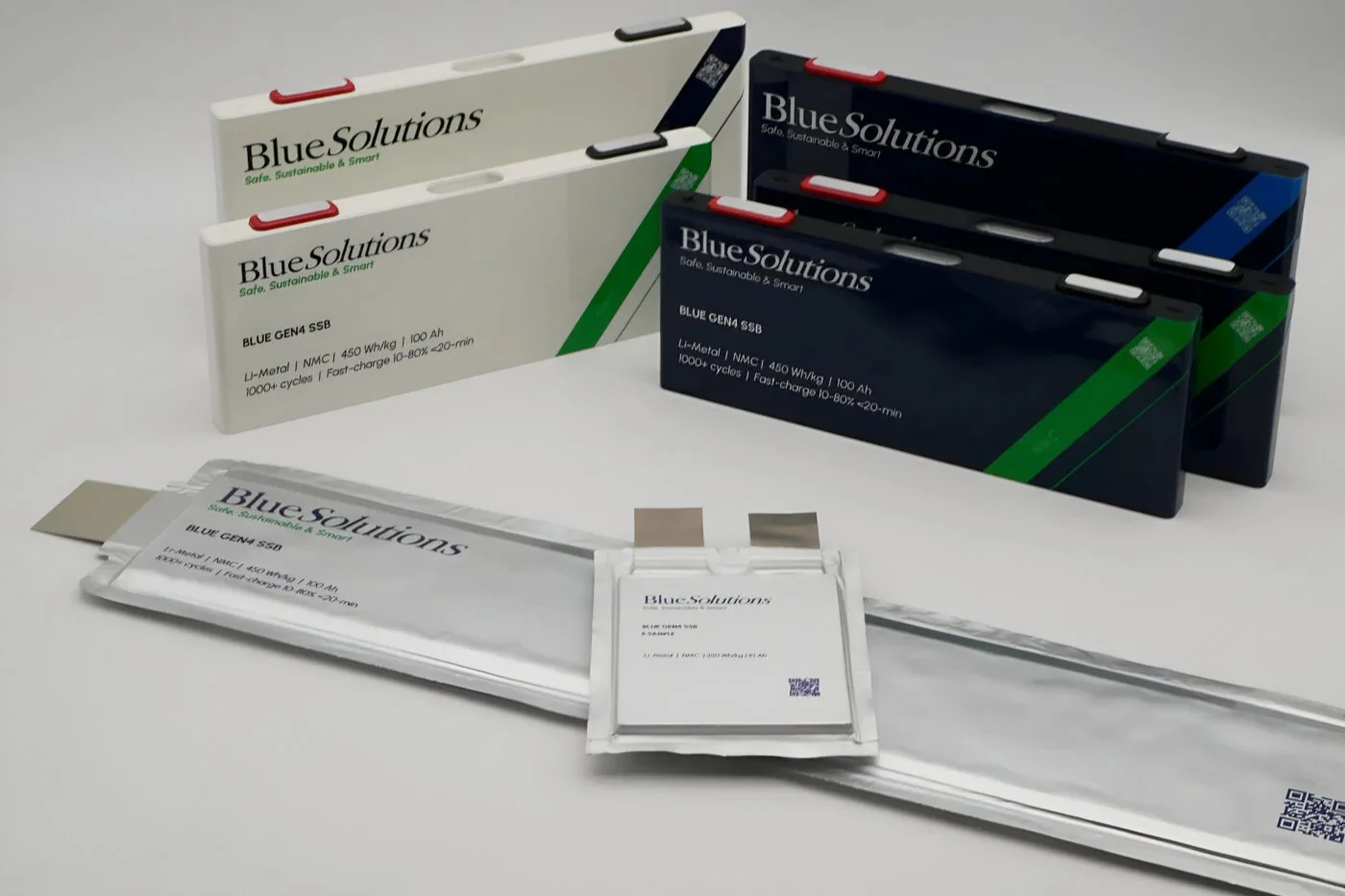
Blue Solutions and AVL have completed a joint development programme evaluating the safety of Blue Solutions’ next-generation solid-state battery technology, marking another step toward commercialising high-energy batteries for electric vehicles.
The collaboration focused on assessing battery behaviour under extreme operating conditions while validating safety measures designed to support future industrial-scale production.
Evaluating Next-Generation Battery Safety
The programme combined Blue Solutions’ solid-state battery technology with AVL’s expertise in battery simulation, testing and validation.
Blue Solutions Plans 2 Billion Euro Gigafactory in France for 20-Minute Charging Battery
Engineers examined how the battery cells respond to increasing internal pressure, mechanical stress and a range of failure scenarios to better understand their performance under demanding conditions.
Blue Solutions’ latest battery design incorporates a lithium-metal anode, enabling significantly higher energy density than conventional lithium-ion batteries while introducing additional engineering considerations related to pressure management and battery pack design.
Preventing Thermal Propagation
A central objective of the programme was reducing the risk of thermal propagation—the spread of heat from a failed or overheating battery cell to neighbouring cells, which can trigger a chain reaction across an entire battery pack.
According to the companies, the development programme demonstrated that this risk can be significantly reduced through simulation-led engineering, pressure-optimised cell design and safety-focused battery pack architecture.
Forsee Power, Blue Solutions, and Bluebus Collaborate to Develop Solid-State Battery Made in France
The partners reported that simulation and validation results were consistent and confirmed compliance with key requirements of China’s GB 38031-2020 battery safety standard, which establishes mandatory safety criteria for electric vehicle traction batteries at the cell, module and pack levels.
Higher Energy Density
Alongside improving safety, the companies aim to preserve the performance advantages of solid-state technology.
Blue Solutions and AVL said the battery pack is expected to deliver volumetric energy density up to 25% higher than comparable nickel manganese cobalt (NMC) lithium-ion battery packs while improving gravimetric energy density by approximately 13%.
The higher energy density could allow electric vehicles to travel farther or accommodate smaller battery packs without sacrificing driving range.
Supporting Commercialisation
Paul Schiffbänker, Director of Battery Development at AVL, said the project has strengthened the company’s understanding of solid-state battery safety while advancing its battery engineering capabilities.
“Working with Blue Solutions’ latest solid-state battery technology is a significant step forward for AVL.”
“It not only deepens our understanding of the specific safety characteristics of this next-generation chemistry, but also actively drives the further development of our safety methodologies and battery design solutions.”
He added that the collaboration enables safety considerations to be integrated into battery development from the earliest design stages through advanced simulation and validation techniques.
PPC Blue and Dedeman Partner to Install More Than 600 EV Charging Points Across Romania
Blue Solutions Battery Systems Director Olivier Caumont said the programme confirms the technology’s readiness for future commercial applications.
“AVL’s vision and mastery in multiple sectors, combined with our extensive manufacturing experience in solid-state batteries manufacturing and pack integration, including the safety, thermal or mechanical aspects, has enabled us to confirm that our solution is fully aligned with market needs and capable of fulfilling the most stringent safety requirements.”
Blue Solutions is currently developing the fourth generation of its solid-state battery platform and is working with industry partners to evaluate potential vehicle applications.
The company plans to commercialise the technology for passenger vehicles before the end of the decade, with findings from the joint safety programme scheduled to be presented at international battery industry conferences.