
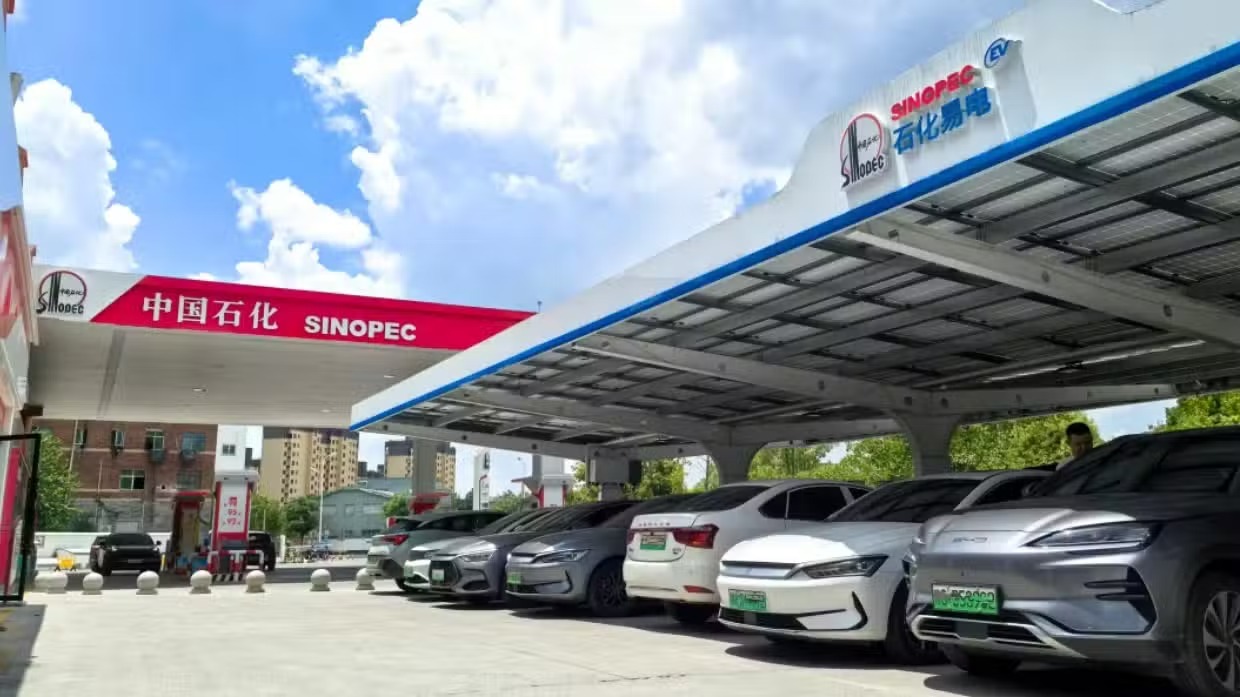
BYD has entered into a strategic partnership with Chinese energy company Sinopec to accelerate the rollout of its fast-charging infrastructure across China.
The two companies signed an industrial and capital cooperation framework agreement in Beijing on June 3, focusing on charging network construction, ecosystem integration and supply chain collaboration.
Focus on Flash Charging Expansion
Under the agreement, BYD will work with Sinopec to expand its flash charging network by utilizing the energy company’s extensive nationwide service station footprint.
The partnership is expected to support BYD’s “Flash Charging China” initiative, which aims to significantly expand high-power charging infrastructure for electric vehicles.
Sinopec chairman Hou Qijun and BYD chairman and president Wang Chuanfu attended the signing ceremony.
Leveraging Sinopec’s Nationwide Network
Sinopec operates one of China’s largest energy service networks, with more than 30,000 integrated service stations across the country.
The company also manages more than 14,000 charging and battery-swapping stations and serves approximately 20 million customers daily.
“The two parties will engage in deep cooperation to jointly promote the green transformation and upgrading of China’s transportation network,” said Hou Qijun, chairman of Sinopec.
BYD plans to use Sinopec’s existing infrastructure to support the construction and operation of flash charging stations nationwide.
Supporting BYD’s Charging Ambitions
The agreement supports BYD’s previously announced goal of building 20,000 flash charging stations across China by the end of 2026.
The automaker unveiled its “Flash Charging China” strategy in March alongside its latest charging technology and second-generation Blade Battery.
“With the release of its second-generation Blade Battery and flash charging technology, BYD is redefining the energy replenishment system with its ‘Flash Charging China’ strategy,” said Wang Chuanfu, chairman and president of BYD.
BYD’s latest charging system is designed to deliver up to 1,500 kW of charging power through a single connector.
According to the company, vehicles equipped with the technology can charge from 10% to 97% in approximately nine minutes under suitable conditions.
Expanding Beyond Infrastructure
The partnership extends beyond charging network deployment.
The companies said they plan to collaborate on membership systems, customer services and broader ecosystem integration.
They also intend to explore cooperation across supply chains, including battery materials, automotive materials, lubricants and energy storage technologies.
Existing Cooperation Already Underway
Sinopec highlighted the Longzhuyuan service station in Shenzhen as an early example of collaboration between the two companies.
The site became Sinopec’s first BYD megawatt flash charging station and serves as a pilot project for future deployments.
As of May 27, BYD had built more than 6,100 self-operated flash charging stations, making it one of the largest automaker-owned charging networks in China.
Broader Mobility Ecosystem Strategy
The charging partnership follows other recent moves by BYD to expand its mobility ecosystem.
In May, the automaker signed a framework agreement with vehicle rental company Car Inc covering the potential procurement of up to 100,000 vehicles.
As part of that collaboration, BYD’s flash charging infrastructure is also expected to be deployed at selected Car Inc rental locations.
The Sinopec agreement further strengthens BYD’s efforts to build an integrated electric mobility ecosystem that combines vehicle manufacturing, charging infrastructure and energy services.