
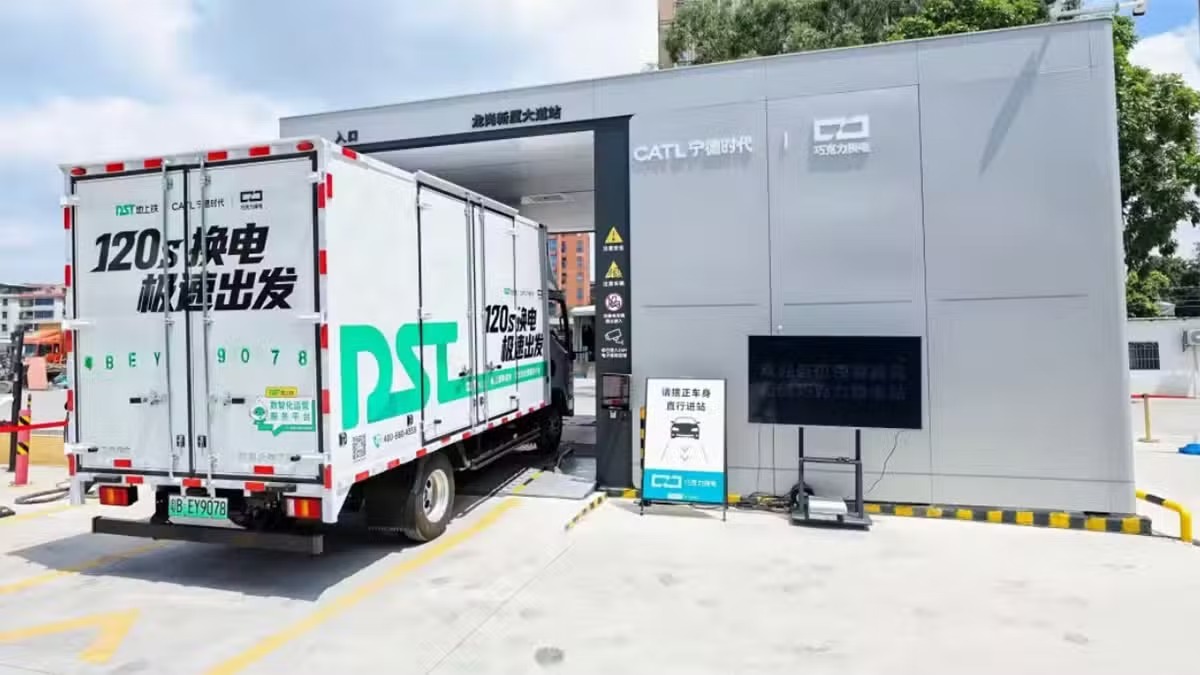
CATL has partnered with logistics operator DST to launch what the companies describe as China’s first standardized battery swap ecosystem for light-duty trucks.
The first batch of battery-swappable logistics trucks has already been delivered and deployed into urban logistics operations, CATL said on Monday.
The system uses CATL’s “Choco-swap” battery exchange technology, which the company said can complete battery replacement in approximately 120 seconds.
According to CATL, the model could save more than 2,000 hours of refueling time over an eight-year vehicle lifecycle, while energy replenishment costs are estimated at roughly half those of conventional fuel-powered light trucks.
The modular battery swap stations are designed to support both passenger vehicles and commercial light trucks with wheelbases ranging from 2.7 metres to 3.75 metres.
The stations are compatible with CATL’s 25# and 35# standardized battery packs, allowing interoperability between passenger and commercial vehicle applications, the company said.
CATL stated that 31 battery swap stations for light trucks have already been deployed across the Guangdong-Hong Kong-Macao Greater Bay Area.
The company plans to expand that number to 140 stations by the end of 2026, focusing primarily on highway freight corridors and logistics distribution hubs.
CATL, its subsidiary Contemporary Amperex Energy Service Technology (CAES), and DST said they aim to deploy 5,000 standardized battery-swappable light trucks across the Greater Bay Area by the end of 2026.
The companies said the initiative is expected to become China’s largest standardized urban logistics battery swap network, with plans for future nationwide expansion.
The rollout forms part of CATL’s broader battery swapping strategy. The company previously announced plans to build more than 3,000 battery swap stations for passenger cars and light trucks during 2026, with a long-term target of 30,000 stations.
In the heavy truck segment, CATL signed a logistics electrification partnership with STO Express last month to promote battery-swappable heavy-duty freight vehicles.
Using the Shanghai-to-Ningbo freight corridor as an example, CATL said electric heavy trucks reduced operating costs by approximately 0.8 yuan ($0.12) per kilometre compared with diesel-powered alternatives.
The company’s Qiji Energy division also plans to establish 900 heavy truck battery swap stations during 2026.
Separately, CATL signed a battery swap cooperation agreement last month with Guangzhou Public Transport Group focused on developing taxi battery swap infrastructure.