
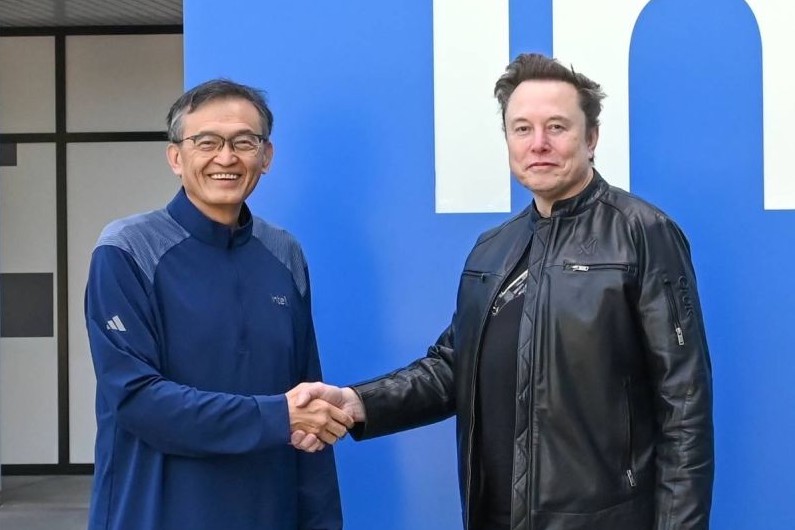
Intel is joining the Terafab initiative, a large-scale semiconductor manufacturing project led by companies associated with Elon Musk, including Tesla, SpaceX and xAI, according to company statements and media reports.
The Terafab project, unveiled in March, aims to construct and operate two chip fabrication plants in Texas with an estimated investment of between $20 billion and $25 billion. The facilities are intended to deliver a combined computing output of one terawatt per year—roughly double the current annual semiconductor production capacity of the United States.
One of the planned plants will focus on producing chips for Tesla’s Full Self-Driving system, its Cybercab robotaxi programme and humanoid robotics applications. The second facility is expected to manufacture semiconductors for artificial intelligence data centres, including those envisioned for deployment in space.
The project also stands out for its vertically integrated approach. Terafab plans to combine chip design, lithography, fabrication, memory production, advanced packaging and testing within a single site—an uncommon model in the semiconductor industry.
Analysts have questioned how Musk’s companies, which lack extensive in-house chip manufacturing experience, could deliver such an ambitious project. The involvement of Intel is seen as a key step in addressing those concerns.
Intel said its capabilities would support the project’s scale and complexity. “Our ability to design, fabricate, and package ultra-high-performance chips at scale will help accelerate Terafab’s aim to produce 1 TW/year of compute,” the company said.
The collaboration could also support Intel’s efforts to regain competitiveness in the semiconductor sector, where it has been overtaken by Nvidia in AI chips and by TSMC in contract manufacturing.
According to Electrek, Terafab could become a major customer for Intel’s foundry business, a relatively new division focused on contract chip manufacturing that mirrors the model used by TSMC.
Lip-Bu Tan expressed confidence in the partnership and its long-term potential. “Elon has a proven track record of reimagining entire industries. This is exactly what is needed in semiconductor manufacturing today,” said Lip-Bu Tan, Intel CEO.
The Terafab initiative is widely viewed as one of the most ambitious semiconductor manufacturing projects to date, with its scale, integration and cross-industry backing positioning it as a potential disruptor in the global chip supply chain.