
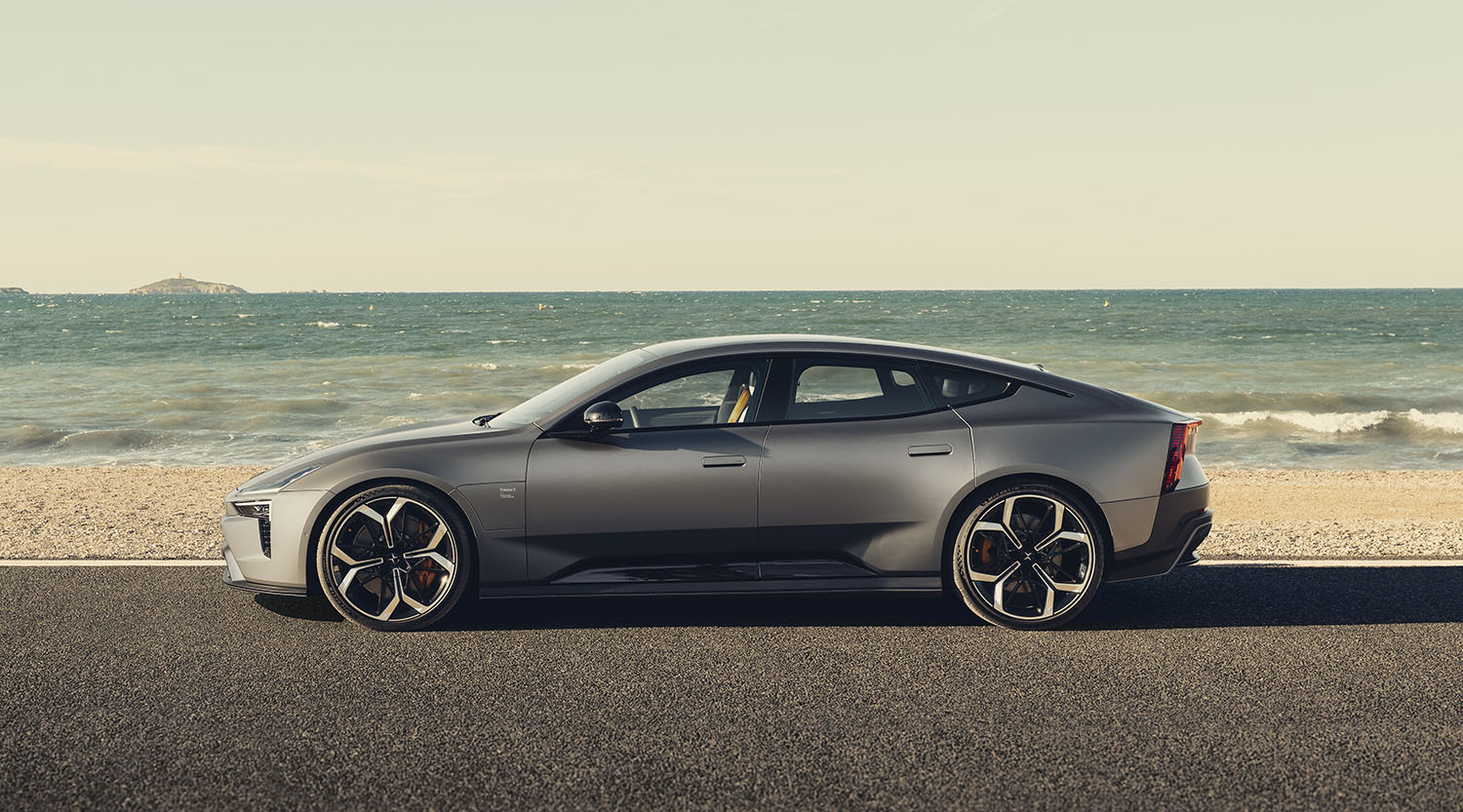
Polestar has released the full life cycle assessment (LCA) for the Polestar 5, continuing its initiative to publish detailed climate impact data for every vehicle in its lineup.
The automaker has published LCAs for its vehicles since 2020, becoming the first original equipment manufacturer to disclose the full carbon footprint of all models. The cradle-to-gate carbon footprint of the Polestar 5 is calculated at 23.8 tonnes of carbon dioxide equivalent (tCO₂e), covering emissions from raw material extraction through production and delivery to customers.
See also: Polestar Expands Grid Rewards Smart Charging Program to Germany and France
According to the company, material sourcing plays a major role in reducing vehicle emissions, particularly aluminum, which is one of the most carbon-intensive materials used in vehicle manufacturing.
Polestar said 13% of the aluminum used in the Polestar 5 comes from recycled sources, while 83% is supplied by smelters powered by renewable electricity. The company estimates this approach avoids more than 14 tonnes of carbon emissions per vehicle compared with conventional aluminum production.
“You cannot reduce what you don’t measure,” said Fredrika Klarén, Head of Sustainability at Polestar, “Making the carbon footprint of a car visible helps focus the industry on where emissions occur, particularly in materials and manufacturing.”
See also: Polestar Plans Expanded Focus on High-Performance EVs and BST Sub-Brand
Renewable electricity is also used across production facilities that manufacture the vehicle, its battery cell modules, and other key battery materials, helping lower emissions associated with vehicle assembly and battery production.
The interior of the Polestar 5 incorporates several materials designed to reduce environmental impact. Natural fiber composites developed with Bcomp use flax-based ampliTex, a bio-based alternative to carbon fiber that can be up to 40% lighter than conventional plastic composites while reducing fossil-based material content.
Other recycled materials include Econyl carpets made from discarded fishing nets and recycled PET textiles. The vehicle’s front luggage compartment also uses a mono-material PET structure designed to simplify recycling at the end of the vehicle’s lifecycle.
See also: Polestar Announces Major Product Expansion With Four New Electric Models by 2028
For customers selecting leather interiors, the car offers chrome-free Nappa leather sourced from Bridge of Weir Leather, produced as a by-product of the food industry.
Despite its sustainability focus, the Polestar 5 maintains high performance specifications. The electric four-door GT produces up to 650 kW (884 hp) and 664 lb-ft of torque. The vehicle offers a WLTP driving range of up to 678 kilometers and supports fast charging through an 800-volt architecture with up to 350 kW DC charging, allowing a 10% to 80% charge in about 22 minutes.