
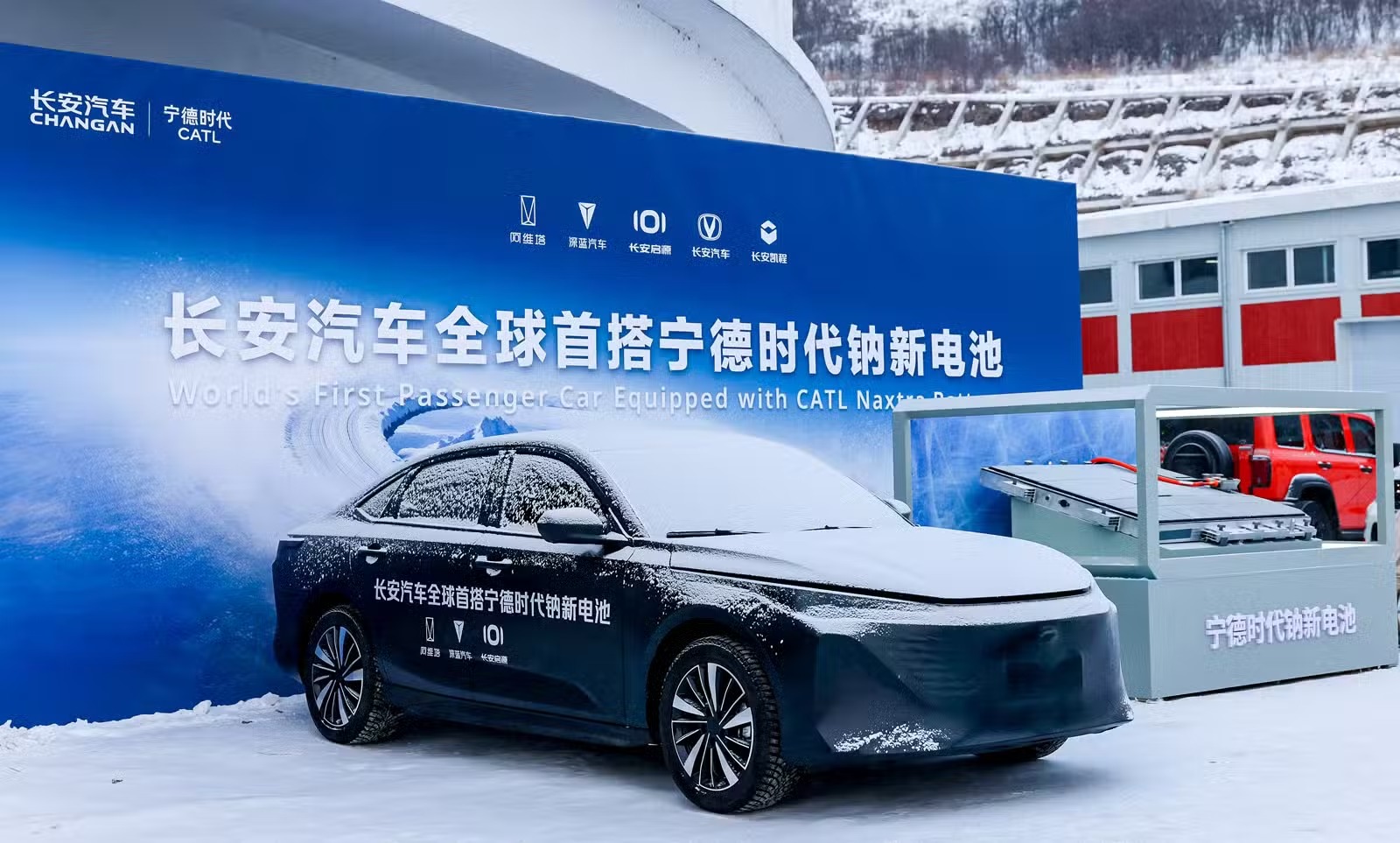
CATL said on Thursday it has begun deploying sodium-ion batteries in production-ready passenger vehicles, marking a milestone as the world’s largest battery maker seeks to establish an early lead in an alternative to lithium-ion technology.
The company unveiled a sodium-ion battery–powered vehicle jointly with Changan Automobile in Yakshi, Hulunbuir, in China’s Inner Mongolia region, with market launch targeted for mid-2026. CATL said the model represents the world’s first mass-produced passenger vehicle equipped with sodium-ion batteries.
See also: CATL, BYD Retain Over 55% Share of Global EV Battery Market in 2025 – SNE Research
While several Chinese automakers announced plans for sodium-ion passenger cars in recent years, none have reached large-scale production. Under the partnership, CATL will act as Changan’s exclusive strategic supplier of sodium-ion batteries, providing its Naxtra cells across all Changan brands, including Avatr, Deepal, Qiyuan and UNI.
“The arrival of sodium-ion technology marks the beginning of a dual-chemistry era,” said Gao Huan, chief technology officer of CATL’s China E-car business.
See also: CATL Unveils Next-Generation 5C Battery, Citing 1.8 Million-Kilometre Lifespan
Launched in April 2025, CATL’s Naxtra sodium-ion battery has an energy density of up to 175 watt-hours per kilogram, comparable to mainstream lithium iron phosphate (LFP) batteries, the company said. Electric vehicles fitted with a 45-kilowatt-hour Naxtra pack can deliver up to 400 kilometres of range, with future improvements expected to lift that figure to 500–600 kilometres as the supply chain matures.
For extended-range electric vehicles and plug-in hybrids, CATL said models using Naxtra batteries are expected to achieve 300–400 kilometres of pure electric range. The company highlighted low-temperature performance and long-term cost potential as key advantages, citing the wider availability of sodium compared with lithium.
See also: CATL Begins Deploying Sodium-Ion Batteries in Passenger Cars, Report Says
CATL said sodium-ion batteries can operate reliably in extreme cold, with discharge power at minus 30 degrees Celsius nearly three times that of comparable LFP batteries and capacity retention above 90% at minus 40 degrees. Power output remains stable at temperatures as low as minus 50 degrees, it added.
The company also pointed to safety testing results, saying the batteries had withstood crushing, drilling and sawing without smoke or fire while maintaining power output. CATL expects 2026 to be a pivotal year for wider adoption of sodium-ion batteries across more vehicle models and markets.
See also: CATL Wins World Economic Forum’s 2026 MINDS Award for AI-Driven Battery Design Platform
To support broader electrification, CATL plans to deploy more than 3,000 Choco-Swap battery swap stations across 140 Chinese cities by 2026, including over 600 in colder northern regions, though it did not disclose how many would use sodium-ion batteries.
CATL began researching sodium-ion technology in 2016 and has invested nearly 10 billion yuan ($1.44 billion), developing close to 300,000 test cells. Its sodium-ion research team includes more than 300 engineers and scientists, including 20 doctoral researchers.