
A growing number of countries are committing to expand electric mobility as part of their national climate pledges, with 66 nations now setting concrete targets for electrification, the highest number recorded to date, according to analysis by the think tank Agora Verkehrswende.
In total, 104 countries have included plans to expand electric mobility in their Nationally Determined Contributions (NDCs) submitted to the United Nations, which underpin the Paris Agreement. Of those, 66 countries – including all 27 EU member states – have defined specific expansion targets for electric mobility, accounting for more than 60% of global automobile sales, Agora Verkehrswende said. The data reflects submissions as of Dec. 15, 2025.
See also: EV Buyers Prioritise Cost and Usability Over Emissions, GreenCars Survey Shows
“NDCs are national climate action plans that form a central element of the Paris Agreement,” Agora Verkehrswende said, adding that they outline how countries plan to reduce greenhouse gas emissions and adapt to climate impacts. According to the think tank, 52 countries have set concrete electric mobility targets for the first time since 2015.
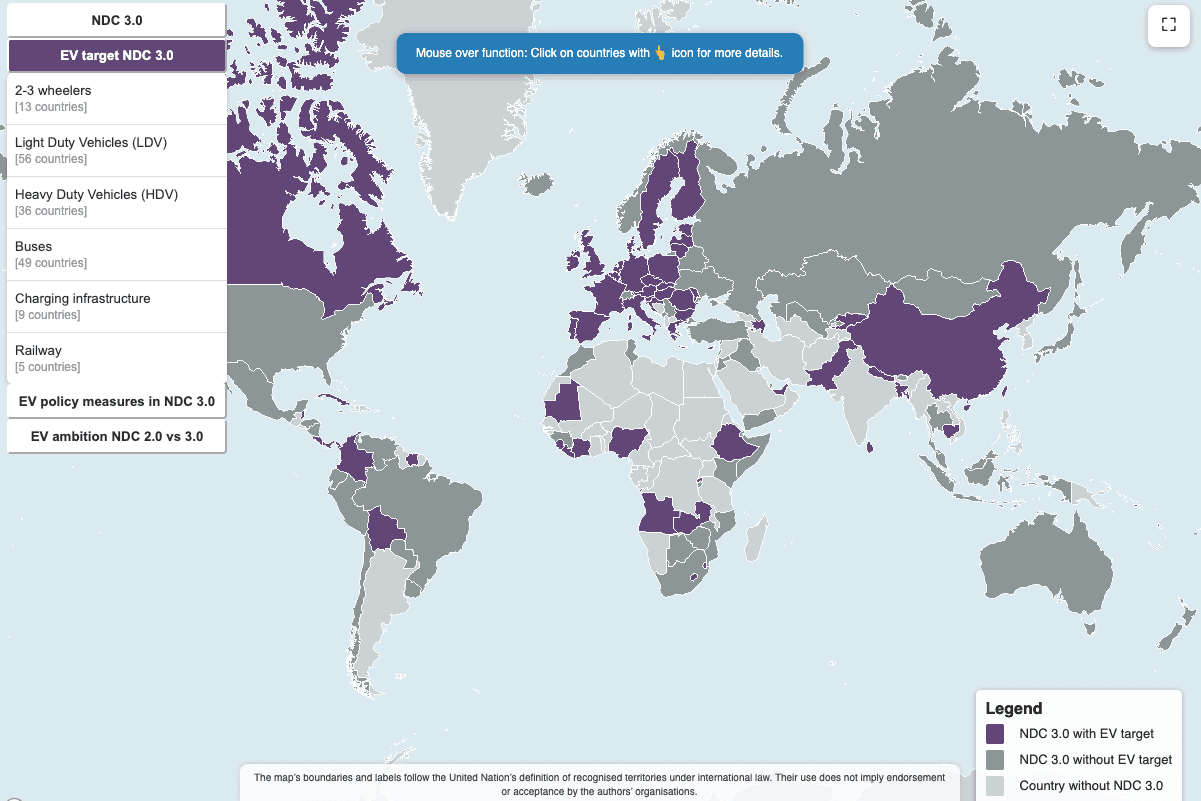
Passenger cars and light commercial vehicles remain the main focus, with 56 countries setting electrification targets in those segments. Targets for electric buses have been defined by 49 countries, while 36 have done so for trucks and 13 for electric motorcycles. By contrast, far fewer governments have included supporting infrastructure in their climate plans, with only nine countries setting targets for charging networks and five addressing rail electrification.
See also: Ellen MacArthur Foundation Flags Circular EV Batteries as Shield Against Mineral Shortages
Within the European Union, EV ambitions are largely driven by bloc-wide CO₂ regulations. While the EU Commission has proposed softening the 2035 target for passenger cars from a 100% CO₂ reduction to 90%, the original target remains formally in place pending legislative approval.
Beyond major markets such as the EU, the United Kingdom and Canada, Agora Verkehrswende highlighted countries including Barbados, Cuba, Nepal and Rwanda for adopting broad electrification targets across vehicle segments, alongside commitments to infrastructure development, industrial policy and financial planning.
See also: Frequent Fast Charging Linked to Slightly Faster EV Battery Wear, Geotab Study Finds
However, the analysis likely underestimates global ambitions, as it only captures measures formally reported in NDCs. Several countries, including China – the world’s largest EV market – have adopted additional strategies and targets through domestic legislation and policy frameworks that are not fully reflected in their UN submissions, the think tank said.
At the other end of the spectrum, the United States has not submitted a national electric mobility target in its NDC, despite state-level initiatives such as California’s plan to phase out new internal combustion vehicle sales by 2035. Norway, widely seen as a global EV leader, has also not formally included its electromobility goals in its NDC, instead communicating them through other international channels.
See also: Design Plays Key Role in Attracting EV Buyers, Research Indicates
Agora Verkehrswende said countries with explicit electric mobility targets in their NDCs currently account for just 34% of global transport-sector greenhouse gas emissions. A total of 62 countries – including large automotive markets and emitters such as the United States, Brazil and Russia – have yet to include concrete electrification targets. India has not submitted an updated NDC.
“It is encouraging to see the global shift from internal combustion engines to electric motors gaining momentum,” said Christian Hochfeld, director of Agora Verkehrswende. He added that Germany and the EU should accelerate efforts to become lead markets and technology providers for electric mobility.
See also: Global Battery Price Decline Moderates After 8% Drop in 2025, Says BloombergNEF
Linda Cáceres Leal, the think tank’s project manager for international cooperation, said major emitters without commitments need to act quickly. “The transition to climate-neutral transport is not a hypothetical vision of the future but a binding international obligation,” she said, adding that while electric mobility alone will not meet Paris Agreement goals, it remains “an indispensable part of the solution.”