
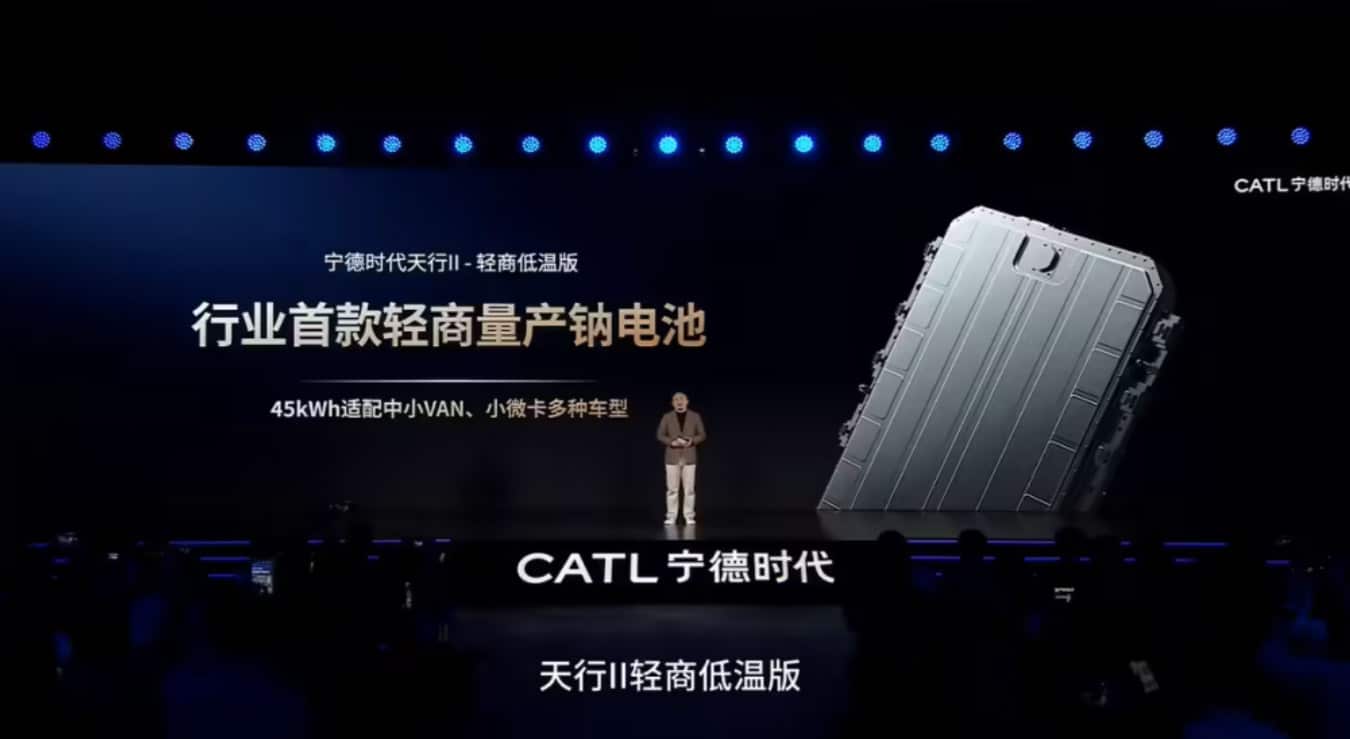
CATL has launched a sodium-ion battery designed for light commercial vehicles, marking its first major step this year toward large-scale adoption of the alternative battery chemistry, as the world’s largest battery maker looks to reduce costs and improve performance in extreme climates.
The company unveiled its new Tectrans II series of power batteries on Thursday, positioning the range primarily for light commercial vehicle applications such as small vans and micro trucks. A low-temperature variant within the series uses sodium-ion technology, which CATL said is the industry’s first mass-produced sodium-ion battery specifically developed for light commercial vehicles.
The sodium-ion battery pack has a capacity of 45 kilowatt-hours and is designed to operate reliably in very cold conditions. CATL said the pack can still be charged at temperatures as low as minus 30 degrees Celsius, while retaining around 90% of usable capacity at minus 40 degrees Celsius, addressing a key limitation of conventional lithium-ion batteries in cold climates.
The launch follows CATL’s broader push to commercialise sodium-ion technology. At a supplier conference held in Ningde in December, the company said sodium-ion batteries would see large-scale adoption from 2026 across battery swapping, passenger vehicles, commercial vehicles and energy storage. At the time, CATL described sodium-ion and lithium-ion batteries as forming a “dual-star” development trend within the industry.
Alongside the sodium-ion option, the Tectrans II series also includes several lithium-based variants aimed at different operating conditions. CATL introduced an ultra-fast charging version capable of charging from 20% to 80% in 30 minutes at minus 15 degrees Celsius, as well as a high-temperature fast-charging variant that can add around 60% of driving range in 18 minutes, with a cycle life of up to 5,000 charge cycles at 45 degrees Celsius.
For long-haul applications, the series offers a high-capacity version with battery packs of up to 253 kWh, enabling a claimed driving range of up to 800 kilometres. CATL also highlighted battery swap-compatible options within the Tectrans II lineup, including the #20 swap block with 42 kWh capacity, the #25 block with 56 kWh and the #35 block with 81 kWh, supporting faster turnaround times for commercial fleets.
CATL has been expanding its portfolio beyond traditional lithium-ion technology as automakers and fleet operators seek lower-cost, safer and more climate-resilient battery solutions. Sodium-ion batteries, which rely on more abundant raw materials than lithium, are increasingly seen as a viable option for cost-sensitive segments such as commercial vehicles and energy storage, particularly in regions with harsh winter conditions.