
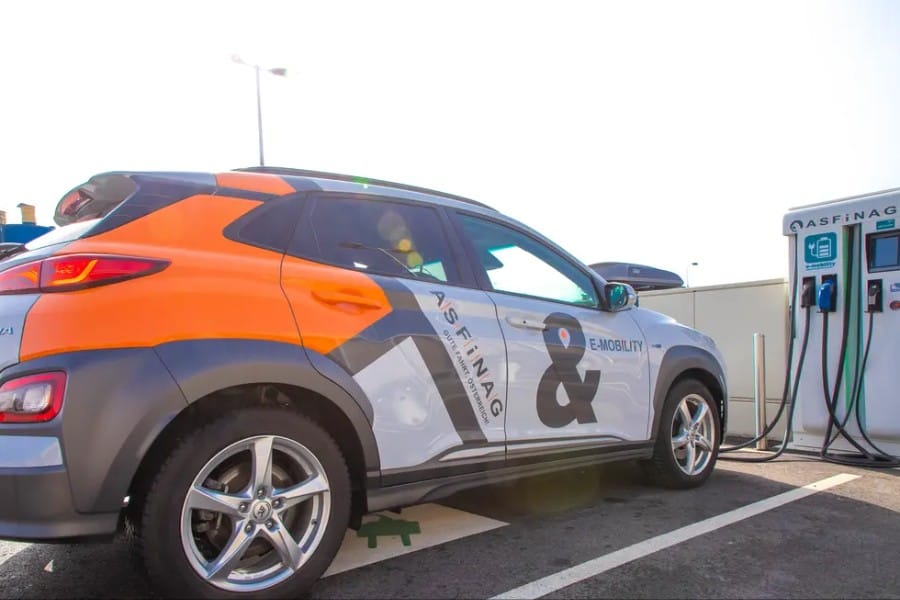
ASFINAG, Austria’s state-owned motorway and expressway operator, has completed the transition of its entire passenger car fleet to electric vehicles, removing its last combustion-engine car and bringing the total number of electric service vehicles to 502.
The company said the move forms a central pillar of its broader mobility strategy aimed at promoting low-emissions transport for its roughly 3,500 employees. The transition was carried out over six years and was accompanied by measures to reduce business travel through digitalisation and to encourage greater use of public transport.
See also: Austria’s da emobil Integrates 2,600 Charging Points Into Cariqa Platform
ASFINAG said its electric passenger cars now travel more than 10 million kilometres per year. “This makes ASFINAG’s passenger car fleet a ‘big player’ in Austria,” board members Hartwig Hufnagl and Herbert Kasser said in a joint statement. “By switching to a total of 502 electric cars, we save 1,450 tonnes of CO₂ per year. Phasing out combustion-engine cars marks the end of the ‘combustion vehicle’ era and the beginning of a new chapter with our fully electric passenger car fleet, as part of our sustainability strategy.”
The transition was welcomed by Austria’s transport minister. Peter Hanke, Federal Minister for Innovation, Mobility and Infrastructure, said ASFINAG’s move demonstrated that environmental goals and economic considerations can be aligned. “This milestone not only ensures a cleaner fleet but also sends an important signal for Austria’s entire business sector,” Hanke said.
See also: Biogena Rolls Out Austria’s Largest Electric Mini Fleet with 126 Cooper SE Models
To support the electric fleet, ASFINAG has installed more than 300 charging points across 44 service areas and one motorway rest stop. The operator said charging facilities are currently available at average intervals of around 60 kilometres along Austria’s motorway and expressway network.
ASFINAG plans further expansion of charging infrastructure. From 2027, charging stations are to be rolled out more widely at rest stops, with the goal of providing charging opportunities every 25 kilometres across the network. By 2030, the company aims to operate more than 1,500 charging points for passenger cars, alongside around 1,300 charging points for electric trucks by 2035.