
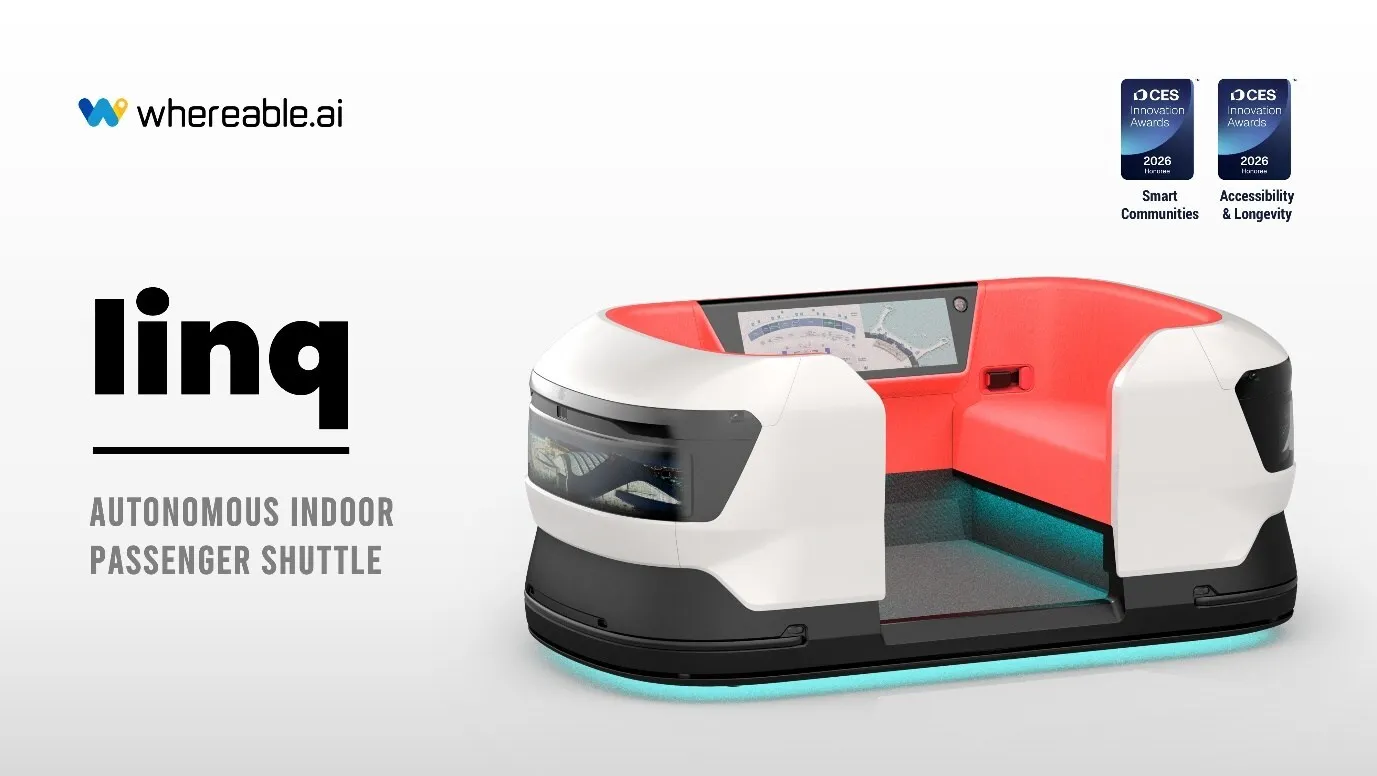
South Korea–based autonomous mobility startup whereable.ai said its Linq indoor shuttle has been named a CES 2026 Innovation Awards Honoree, receiving recognition in the Smart Communities and Accessibility & Longevity categories as the company prepares for commercial deployment next year.
The autonomous shuttle is designed for use in large indoor environments such as airports, transit hubs and public facilities, and is scheduled to enter the market in early 2026. The company said the award underscores growing interest in scalable, infrastructure-light mobility solutions for complex indoor environments.
The Linq shuttle operates using a mapless, end-to-end autonomous driving system based on what whereable.ai calls a “World Model” approach. Unlike conventional systems that rely on high-definition maps, the vehicle navigates using real-time perception and decision-making, allowing it to adapt more easily to changing indoor environments.
“Recognition at CES validates our belief that autonomous mobility must be flexible, scalable and practical for real-world deployment,” said Doosan Baek, chief executive officer of whereable.ai. “Our goal is to enable safe and efficient movement in places where people live, work and travel every day.”
The vehicle is equipped with four-wheel independent steering, enabling zero-turn and lateral movement, features designed to support operations in confined or crowded spaces. Passenger interaction is managed through a multi-modal interface that includes touch-based and voice-enabled controls.
Whereable.ai said the shuttle is supported by a fleet management system that allows real-time monitoring, remote operation and performance analytics across large deployments. The company has already tested its autonomous technology in live environments, including a pilot program involving 10 vehicles operating at Incheon International Airport’s Terminal 2 since August 2025.
The startup is also pursuing proof-of-concept projects with global airport operators and exploring additional applications in logistics, public infrastructure and defense-related mobility. It has received seed investment from NAVER D2SF and Quad Ventures, and has been selected for South Korea’s Defense Venture Innovation Technology Support Program.