
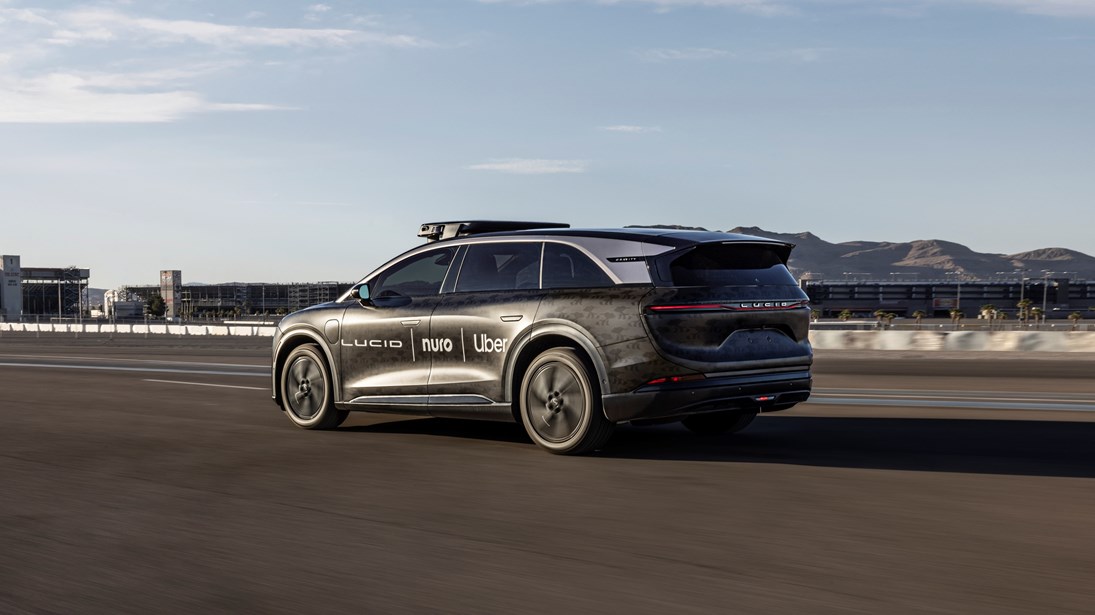
Uber selected Lucid’s Gravity electric sport utility vehicle for its next-generation robotaxi fleet because the vehicle required minimal structural and electrical modification to support fully autonomous operations, Lucid’s chief financial officer said this week.
Under the three-way partnership announced earlier this year, Uber will deploy driverless ride-hailing services using more than 20,000 Lucid Gravity vehicles equipped with autonomous systems from startup Nuro. Uber has also agreed to invest $300 million in Lucid as part of the arrangement. The robotaxis are expected to begin entering service next year.
See also: Uber Invests in Lucid and Nuro to Launch Premium Robotaxi Service with Gravity SUVs
Speaking at the UBS Global Industrials and Transportation Conference, Lucid Chief Financial Officer Taoufiq Boussaid said the Gravity stood out because it was already engineered with extensive system redundancy required for safe autonomous use. “We had a fit-for-purpose car with a redundant architecture, with all the safety required for this type of application,” Boussaid said.
Autonomous vehicles typically require duplicate steering, braking, power and communication systems, which often forces automakers to carry out extensive and costly retrofitting. Boussaid said the Gravity avoided much of that work. “[The Gravity] required minimal changes, minimal fitting to operate as a robotaxi as opposed to some of the existing solutions right now where you have to add a lot of sensors like lidar and so forth,” he said.
See also: Lucid Delivers First Gravity SUV to Nuro-Uber for Robotaxi Testing
Lucid will integrate Nuro’s full autonomous hardware suite, including lidar, radar and cameras, directly onto factory-built Gravity vehicles. Uber will then purchase the autonomy-ready SUVs and deploy them exclusively through its app. While the Gravity currently offers Lucid’s Level 2 DreamDrive Pro driver-assistance system, the Nuro system is intended to enable fully driverless operation.
Boussaid acknowledged that the Gravity’s high price makes it less suitable for long-term mass robotaxi deployment. He pointed instead to Lucid’s upcoming midsize electric vehicle platform, expected to enter production next year, which the company says will also support advanced autonomous functions using Nvidia’s automotive AI technology.
See also: Uber, Lucid Motors, and Nuro to Launch Gravity Robotaxis in San Francisco Bay Area by 2026
Uber currently works with more than a dozen autonomous vehicle partners worldwide, including Waymo, Avride, May Mobility and Momenta, as it seeks to scale driverless ride-hailing services across multiple markets.
Source: InsideEVs