
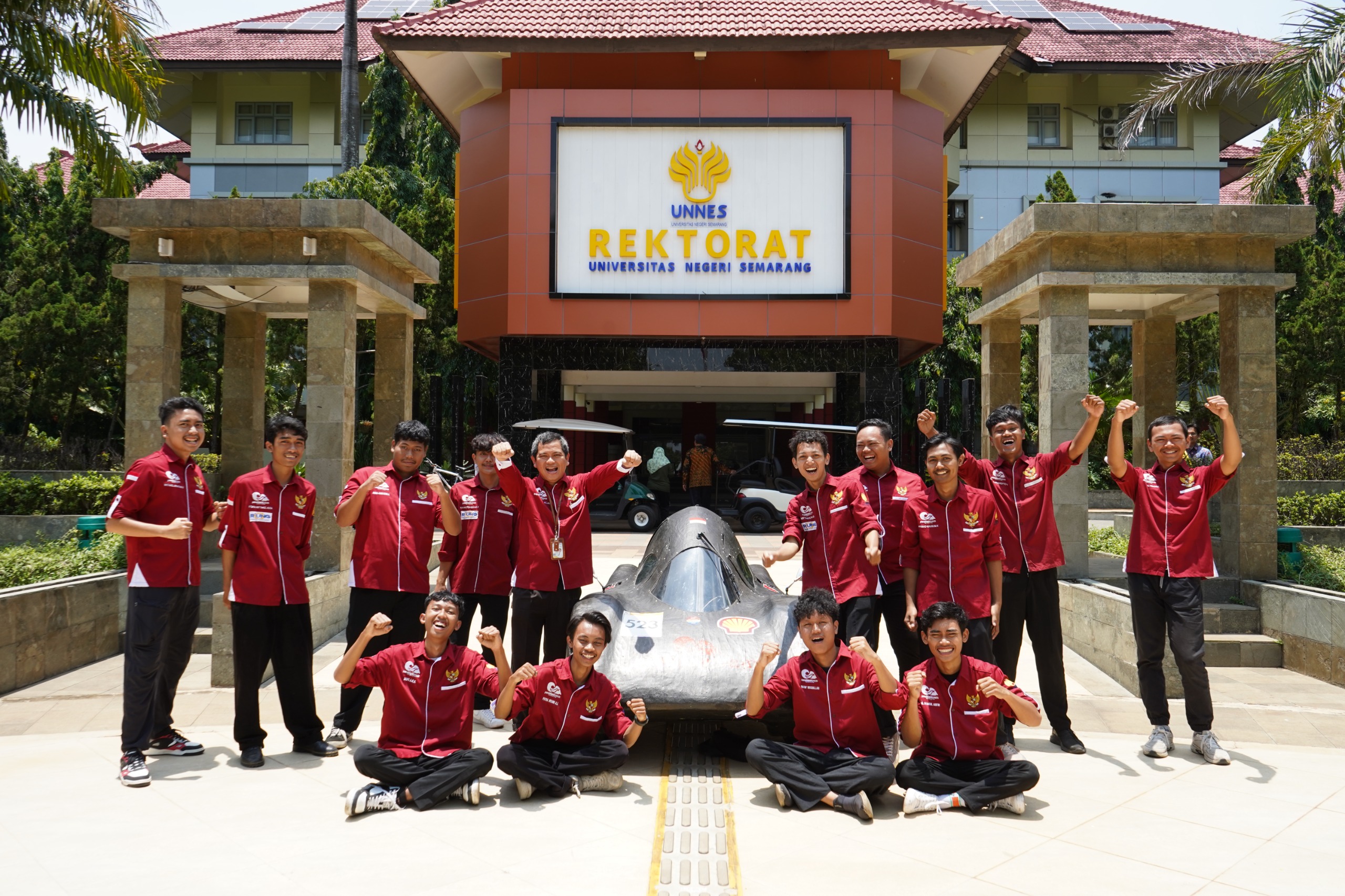
The Pandawa Team from Universitas Negeri Semarang (UNNES) finished fourth overall in the 2025 Energy-Efficient Car Contest (Kontes Mobil Hemat Energi/KMHE), showcasing one of the strongest fuel-efficiency performances in the national competition.
The event, organised by Indonesia’s Ministry of Education, Culture, Research, and Technology in collaboration with the University of Jember, was held from Oct. 23 to Oct. 27. Pandawa competed in the Urban Internal Combustion Engine–Ethanol category and recorded fuel efficiency of 276.361 kilometres per litre, placing the university among Indonesia’s leading institutions in energy-efficient vehicle development.
See also: UNNES Expands Electrification Efforts with Solar and Alternative Energy Systems
General Manager of the Pandawa Team Ahmad Khusom Kurniawan said the result would be used as a platform for further improvement. “Through this achievement, we will use the results as evaluation and learning material to continue innovating, developing new ideas, and increasing vehicle efficiency. We hope that in future competitions, Pandawa Team can achieve even better outcomes and bring home the championship title,” he said.
The KMHE competition is a national student engineering programme aimed at promoting creativity, innovation and collaboration in the development of environmentally friendly vehicles and alternative energy solutions. Activities began with vehicle registration, followed by technical inspections to ensure compliance with safety and engineering standards before competitive race sessions.
See also: UNNES Develops Laplace Electric Motorcycle to Advance Indonesia’s Zero-Emission Goals
UNNES said the Pandawa Team’s vehicle was developed with an aerodynamic body, lightweight construction and an optimised propulsion system to maximise fuel efficiency. The project involved collaboration between students and faculty researchers focused on sustainable vehicle technology and clean energy systems.
The university also said the project supports its commitment to the United Nations Sustainable Development Goals, particularly SDG 7 on clean energy, SDG 9 on innovation and infrastructure, and SDG 13 on climate action. UNNES promotes itself as a Conservation and Impact Campus, with research programmes aimed at environmental and social sustainability.