
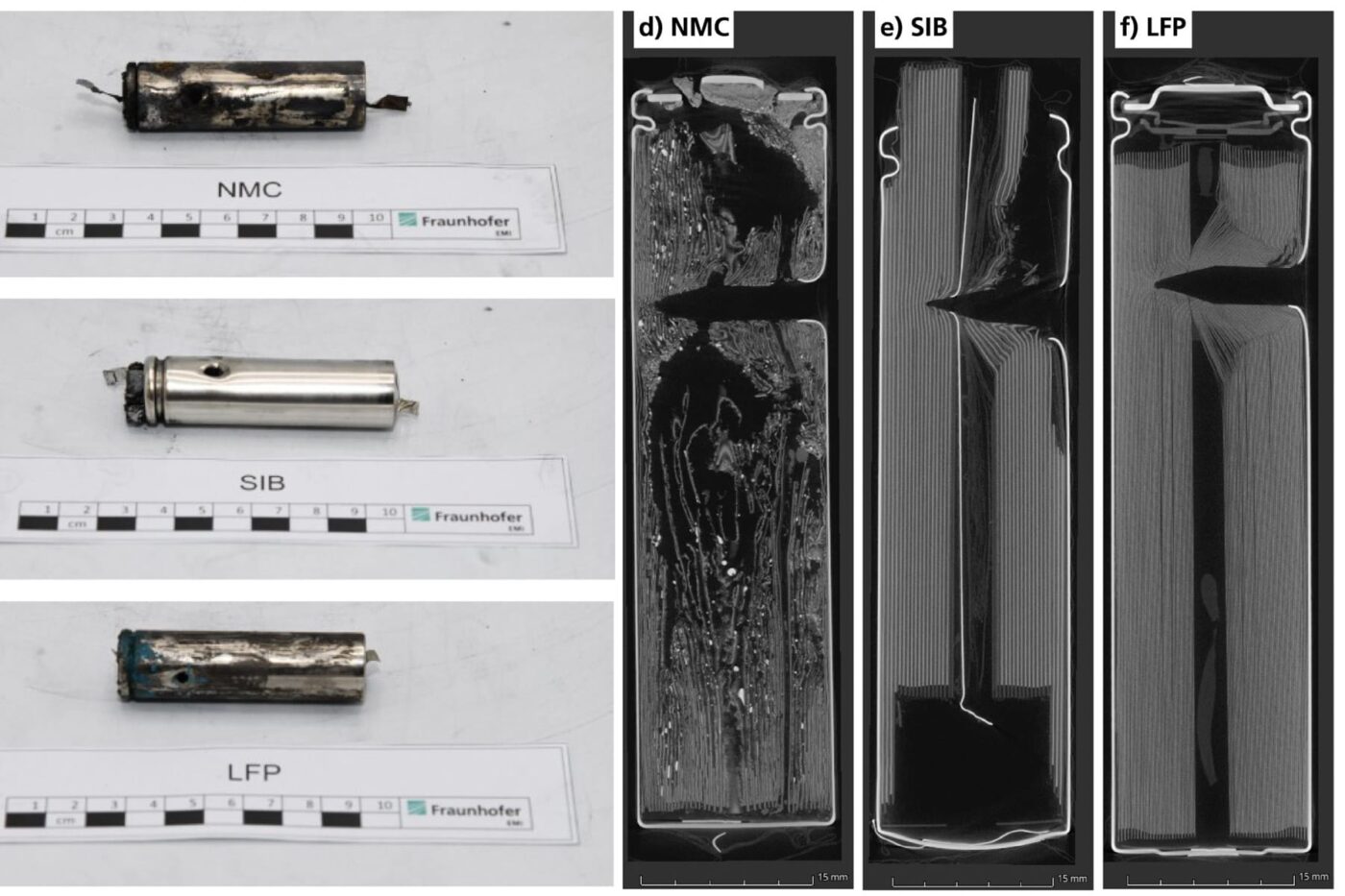
Germany’s Federal Institute for Materials Research and Testing (BAM), working with the European Synchrotron Radiation Facility (ESRF) and the Fraunhofer Institute for High-Speed Dynamics (EMI), has reported that sodium-ion batteries require tailored safety designs after a series of controlled stress tests revealed major differences in behaviour compared with established lithium-based cells.
The institutions examined three cylindrical 18650 cell types: sodium-ion cells containing nickel, iron and manganese (NFM), lithium-ion cells with nickel-manganese-cobalt (NMC532) cathodes commonly used in electric vehicles and portable electronics, and lithium iron phosphate (LFP) cells often deployed in energy storage systems. The assessment focused on mechanical abuse conditions during a nail penetration test, a method used to trigger internal short circuits and assess the likelihood of thermal runaway.
Using high-speed X-ray imaging at ESRF and a specialised EMI-designed test chamber, researchers observed the internal structural response of each battery type during the simulated failure event. LFP cells demonstrated high stability, and the NMC cells responded in line with expected safety performance. The sodium-ion cell, however, showed a rapid and forceful reaction that differed significantly from the other chemistries.
BAM attributed the outcome not to the sodium-ion chemistry itself, but to a structural malfunction in the tested venting system. The pressure-relief mechanism, which is intended to release excess gas during thermal events, became obstructed by other safety components, preventing controlled venting and leading to a sudden pressure release.
The institute said the findings highlight that safety systems proven in lithium-ion formats cannot be directly applied to emerging battery technologies without redesign. It added that sodium-ion cells remain fundamentally viable from a safety standpoint but require careful adaptation of mechanical safeguards such as venting components. BAM is contributing to ongoing standards development for sodium-ion battery safety and published the results in the Journal of Power Sources Advances, along with slow-motion imaging of the tests.