
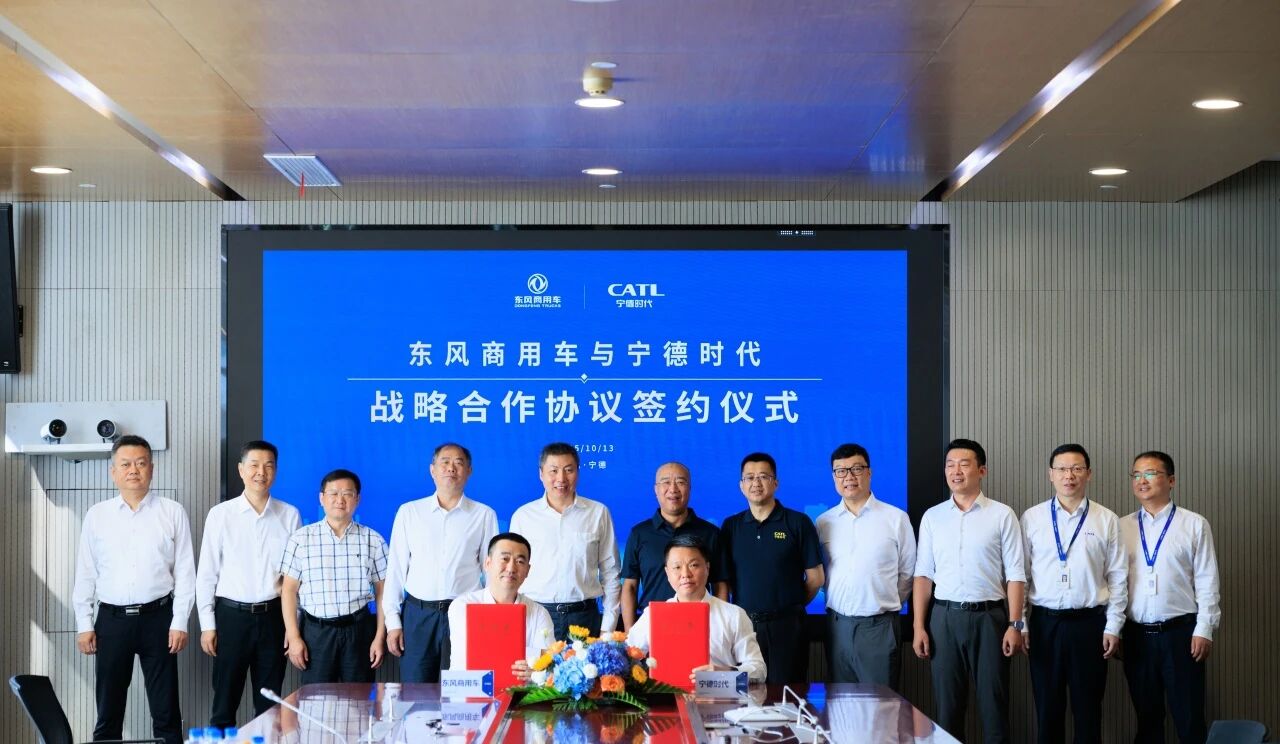
Dongfeng Commercial Vehicle and CATL have signed a new five-year strategic cooperation agreement to deepen their collaboration in commercial vehicle electrification, according to a post from CATL on its WeChat account on October 13. The signing ceremony took place in Ningde, Fujian, marking a new phase in the long-standing partnership between the two Chinese industry leaders.
Building on previous cooperation, the renewed alliance will focus on three key areas — product R&D, the establishment of industry standards, and the development of a collaborative ecosystem. Together, the companies aim to accelerate innovation in battery technologies, drive global market expansion, and establish a more sustainable commercial transport value chain.
See also: CATL Expands Global Partnership with Maersk to Boost Supply Chain Efficiency and Electrification
In product development, Dongfeng and CATL plan to leverage their respective strengths across segments such as tractor-trailers, dump trucks, cargo vehicles, and specialty models to create more efficient and reliable zero-emission logistics solutions. On the standards front, both companies will jointly promote advancements in battery materials, systems, and technologies to help define new benchmarks for the commercial vehicle industry.
The partnership also includes efforts to expand infrastructure — including battery banking models, battery-swap station networks, and ultra-fast charging technologies — to build a robust ecosystem supporting large-scale electrification.
See also: CATL Says Sodium-Ion Battery Reaches 175 Wh/kg, Ready For Mass Supply In 2026
Dongfeng Commercial Vehicle, a key division of Dongfeng Motor Group specializing in medium and heavy-duty trucks, remains one of China’s leading commercial vehicle manufacturers. Through this strengthened collaboration with CATL, the company aims to lead the transition toward new energy commercial transport. The two sides plan to jointly pursue technological breakthroughs and innovative business models to build a safe, efficient, and scalable new energy ecosystem — contributing to a zero-carbon future for global logistics.