
Researchers at the Indian Institute of Science (IISc) are exploring the use of amorphous materials in magnesium batteries, a development that could improve energy storage beyond the limits of conventional lithium-ion systems.
Lithium-ion batteries, which power most consumer electronics, are limited by their energy density, meaning they can store only a fixed amount of energy per unit of mass or volume. “In order to store even more energy with the same mass or volume, you will have to explore alternative energy storage technologies,” said Sai Gautam Gopalakrishnan, Assistant Professor at the Department of Materials Engineering at IISc.
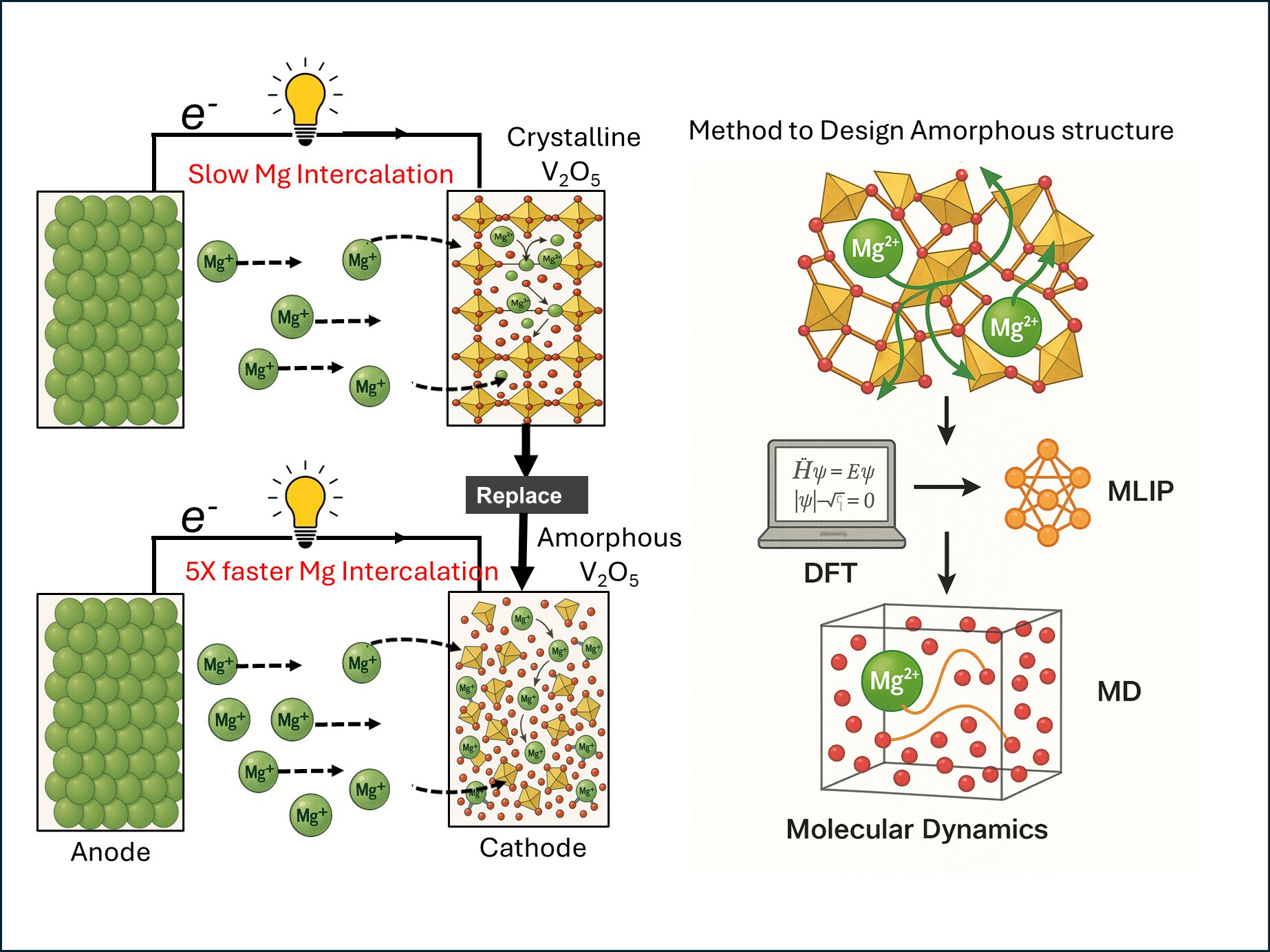
Magnesium batteries theoretically offer nearly double the energy per atom, as each magnesium atom can transfer two electrons compared with one for lithium. However, their commercialization has been slowed by a lack of suitable cathode materials capable of efficiently absorbing and releasing magnesium ions.
Gopalakrishnan’s team used machine learning to model an amorphous vanadium pentoxide cathode, simulating magnesium ion movement at a larger scale. Compared with crystalline magnesium materials, the amorphous form showed about five orders of magnitude improvement in ion mobility. “Our work offers a completely different pathway to identify electrode materials for batteries and takes us a step closer to commercialization of magnesium batteries,” Gopalakrishnan said.
While promising, the findings still require experimental validation. “One disadvantage is that we don’t know how stable the amorphous materials can be when used in a practical battery,” said Debsundar Dey, co-author of the study. “The key takeaway is that using amorphous materials increases the mobility of ions, but we also need to experimentally validate our observations.”
The study is published in the journal Small.
- Reference: Vijay Choyal et al, Exploration of Amorphous V2O5 as Cathode for Magnesium Batteries, Small (2025). DOI: 10.1002/smll.202505851