
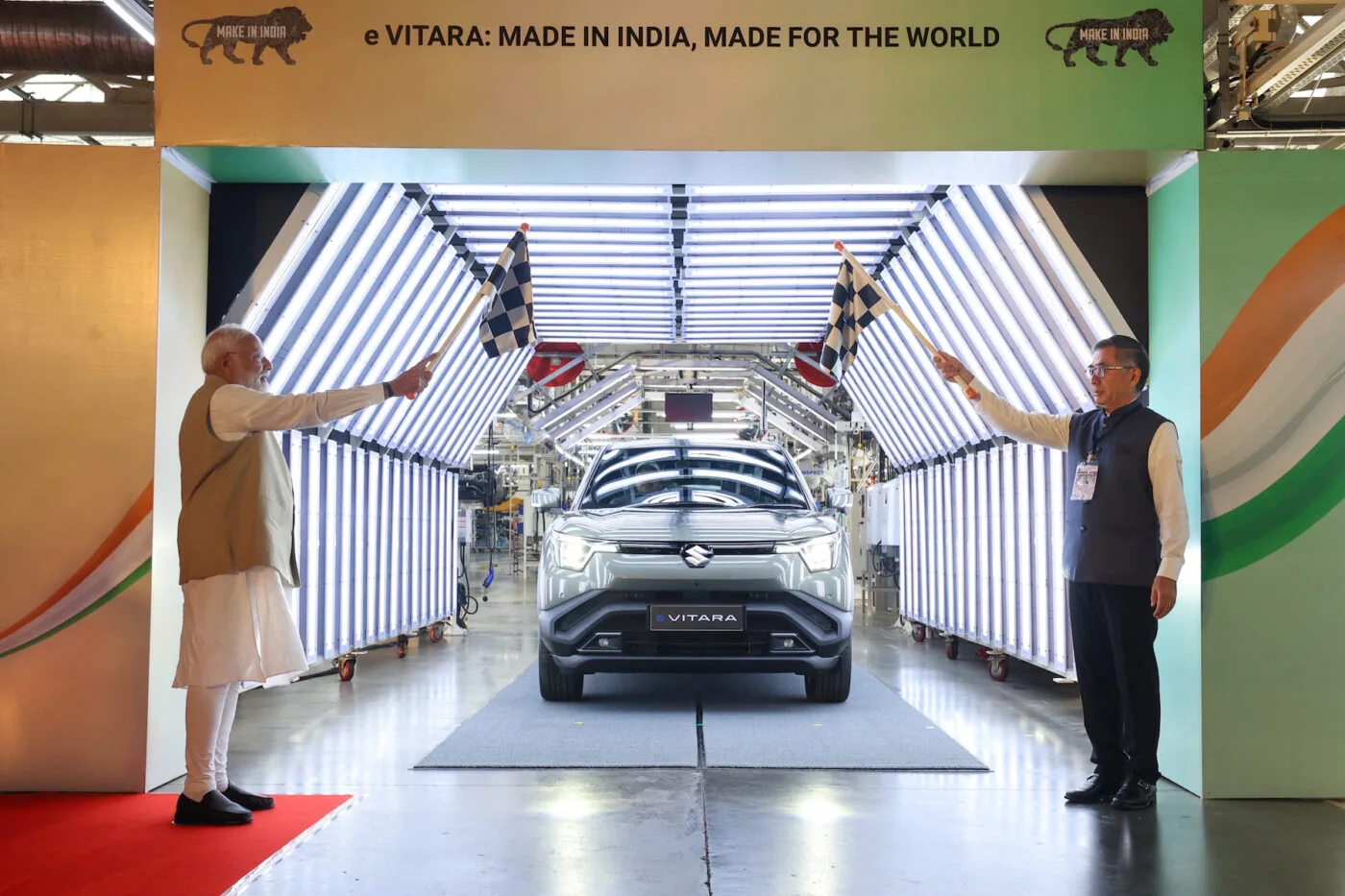
Maruti Suzuki, India’s largest carmaker, has started production of its first electric vehicle, the e Vitara, at its Hansalpur facility in Gujarat. The electric sub-compact SUV is being manufactured for both domestic and international markets, the company said on Tuesday.
The launch was marked by Indian Prime Minister Narendra Modi and Suzuki President Toshihiro Suzuki, who jointly flagged off the first unit from the production line. Maruti Suzuki described the model as “India’s most globally significant EV to date,” with Hansalpur designated as the global hub for its production.
The company said the plant will build both right- and left-hand drive versions for more than 100 markets, including emerging economies such as Indonesia, the Philippines, South Africa and Thailand, alongside developed markets such as France, Germany, Japan and the UK.
Initially, Maruti Suzuki planned to produce 26,512 units of the e Vitara between April and September, but in June it cut the target to 8,221 units citing China’s rare earth export curbs. The company now projects total production of 67,000 units by March 2026, with most earmarked for export. The first batch is scheduled for Europe, where Suzuki plans to begin sales in the autumn.
The e Vitara will be offered in three versions: standard-range FWD, long-range FWD and long-range AWD. The base variant comes with a 49 kWh battery pack and a 106 kW motor, delivering a WLTP range of 344 km. The long-range FWD uses a 61 kWh battery and the same motor, with a 426 km WLTP range, while the AWD version adds a second motor for a system output of 135 kW and a WLTP range of 395 km. All versions employ lithium iron phosphate (LFP) cells supplied by China’s BYD.
The Hansalpur site houses three production lines with a combined capacity of 750,000 vehicles annually. The e Vitara is being built on the third line, which opened in 2021. Maruti Suzuki said it plans to add a dedicated EV line by March 2026 with a further 250,000-unit capacity, part of a broader 700 billion rupee ($6.9 billion) investment over the next five to six years.