
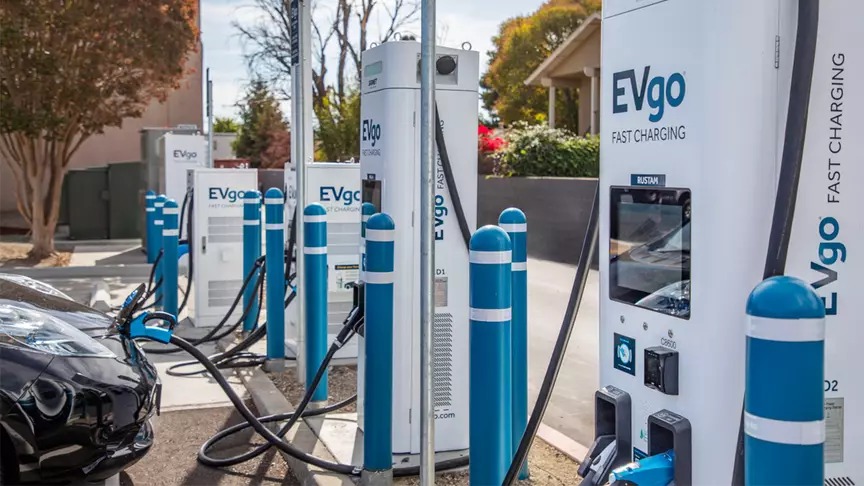
California has rolled out a $55 million program to expand public fast charging for electric vehicles (EVs), offering up to 100% of eligible installation costs for direct current (DC) fast chargers at commercial and community sites across the state.
“This is the biggest CALeVIP project ever. It’s the first to be statewide. And, it’s the first to cover up to 100% of eligible costs,” said Hannon Rasool, director of the California Energy Commission’s (CEC) Fuels and Transportation Division. “Installing more fast chargers is vital to California’s zero emission vehicle transition, and the Fast Charge California Project prioritises ready-to-build fast charging projects, with eligible projects in disadvantaged communities going to the top of the list.”
Projects with at least four charging points and an output of 150 to 274.99 kilowatts can receive up to $55,000 per port, while those with chargers exceeding 275 kW are eligible for up to $100,000 per port. All funded chargers must be DC fast chargers, with at least half of the connectors using the CCS standard. Tesla’s NACS, now referred to as J3400, also qualifies for incentives, while CHAdeMO connectors are permitted but not counted toward maximum funding.
Applications will be prioritised for tribal lands, low-income neighbourhoods and disadvantaged areas with limited charging access. The Fast Charge California Project, part of the California Electric Vehicle Infrastructure Project (CALeVIP), represents the most comprehensive effort to date and is funded through the state’s Clean Transportation Program and Greenhouse Gas Reduction Fund.
“State-funded incentives are essential for the rapid and equitable expansion of California’s electric vehicle charging network,” said Evan Wright, director of EV infrastructure and operations at the Centre for Sustainable Energy, which administers CALeVIP. “This programme is designed to get fast chargers in the ground…fast.”
Since 2017, CALeVIP has supported the installation of nearly 10,000 chargers statewide. California currently has over 2.2 million registered light-duty EVs, and the latest funding round follows earlier initiatives worth $30 million and $38 million launched in 2023.