
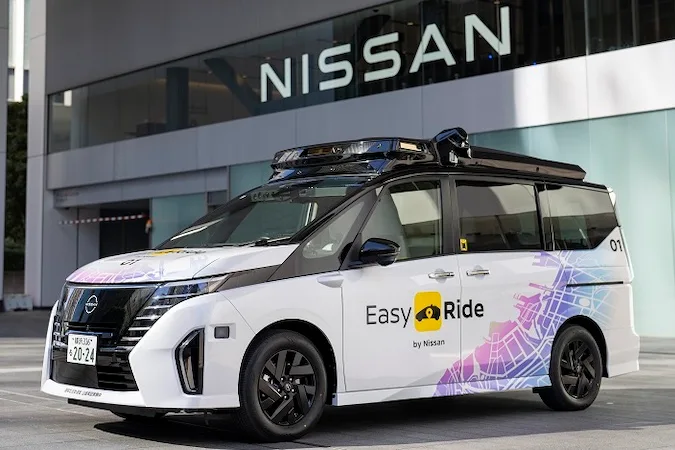
Nissan has unveiled new autonomous driving test vehicles based on its Serena minivan at its Yokohama headquarters, marking a significant milestone in Japan’s self-driving technology development.
The vehicles are equipped with 14 cameras, nine radars, and six LiDAR sensors, similar to the Nissan Leafs used in last year’s trials, though with one less radar.
See also: Nissan Plans Autonomous Ride Service in Japan by 2027
The key advancement in Nissan’s latest trials lies in the Serena’s capabilities—becoming the first test vehicle in Japan to navigate a complex urban environment on public roads without a driver onboard.
The automaker has been steadily advancing its autonomous driving technology and is preparing for large-scale service demonstrations in Yokohama between the 2025 and 2026 financial years with around 20 test vehicles.
Nissan aims to launch regular autonomous driving mobility services with remote monitoring by fiscal 2027 in collaboration with municipalities and transport companies.
See also: Nissan Launches Autonomous Driving Trials in Japan with LEAF Prototype
The project is supported by Japan’s Ministry of Economy, Trade and Industry, the Ministry of Land, Infrastructure, Transport and Tourism, and the City of Yokohama. These government bodies are backing autonomous mobility initiatives through the Level 4 Mobility Acceleration Committee.
Nissan is leveraging research from its Japan-based labs, its Advanced Technology Center in Silicon Valley, and its participation in the UK’s evolvAD project to refine its self-driving technology for global traffic conditions.
See also: Nissan and UK Government Collaborate on Groundbreaking evolvAD Autonomous Driving Project
With Japan’s aging population driving demand for autonomous mobility solutions, Nissan’s efforts align with growing interest from global players like Google’s sister company, Waymo, which is also planning trials in Japan.