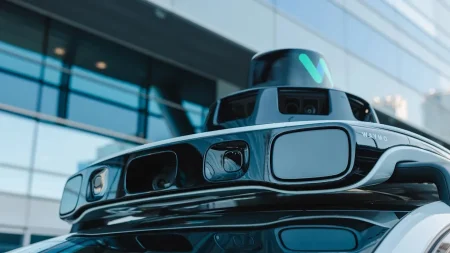


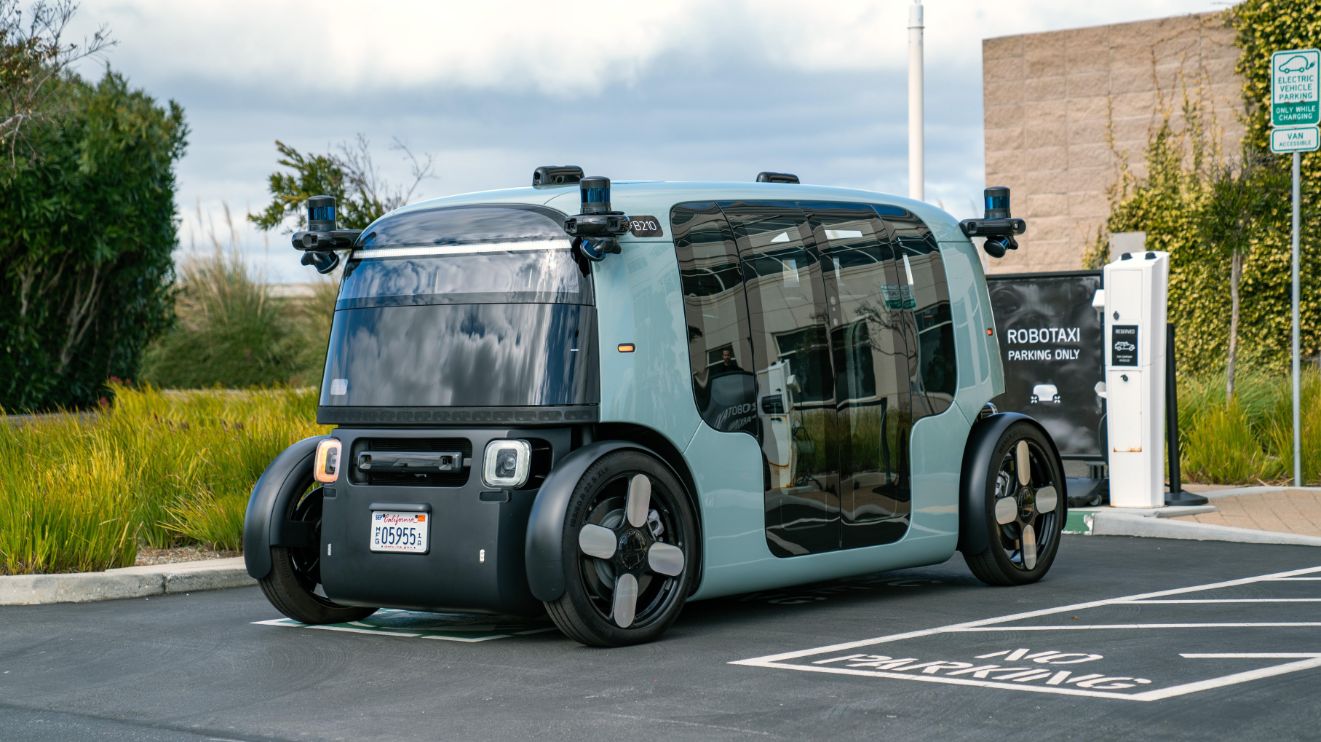
Zoox, a self-driving taxi service owned by Amazon, has begun ferrying employees in Foster City, California using its robotaxis. This marks the first time in history that a purpose-built autonomous taxi without manual controls has transported passengers on open public roads, the company said in a tweet.
The robotaxis, which can handle left and right-hand turns, bi-directional turns, and navigate traffic lights, cyclists, pedestrians, vehicles and other road users, have received approval from the California Department of Motor Vehicles, but currently can only operate on designated roads.
See also: Amazon-Owned Zoox preparing to launch a robotaxi business in California
“Putting the vehicle on (an) open public road and validating our approach to all of the different requirements, including regulatory, is a big step and we would not have done it unless internally we were already looking at the line of sight for going commercial,” Chief Executive Aicha Evans told reporters on a conference call.
Zoox, the California-based autonomous vehicle developer, has recently celebrated its ninth anniversary since its establishment. After years of research and development to bring distinctive robotaxi technology to public roads, the company appointed Aicha Evans, former Intel chief strategist, as its CEO in early 2019.
A year and a half later, Amazon acquired Zoox for an impressive $1.2 billion, allowing the startup to focus on designing a custom EV for the robotaxi market, unlike its competitors who retrofit existing vehicles for autonomy.
In late 2020, Zoox unveiled its all-electric, autonomous shuttle with a massive 133 kWh battery pack. The company developed its vehicle through a rigorous process that included lab testing, simulation, and real-world data collection using a fleet of level 3 autonomous vehicles that have logged over one million autonomous miles across San Francisco, Las Vegas, and Seattle. In July 2020, Zoox made history as the first company to self-certify a purpose-built, fully-autonomous, passenger EV with the Federal Motor Vehicle Safety Standards (FMVSS).
See also: Baidu and Pony.ai Get Licenses to Operate Robotaxis in Beijing
The slow progress of the automated vehicle sector is due to the complexity of the technology. Ford and Volkswagen announced the closure of their Argo AI self-driving unit to prioritize driver-assistance technology that delivers immediate returns. However, some companies, including General Motors’ Cruise unit and Alphabet’s Waymo, continue to invest in the development of autonomous driving technology.