

ZF has unveiled a software-defined commercial vehicle demonstrator capable of connecting directly with logistics yard infrastructure, allowing operators to remotely control vehicle safety functions such as the parking brake from outside the cab.
The proof-of-concept vehicle was presented during ZF’s CV Tech Day 2026 near Hanover, Germany, as part of the company’s efforts to prepare its chassis technologies for the next generation of software-defined commercial vehicles (SdCVs).
Vehicle Connects Directly to Yard Infrastructure
The demonstrator uses a service-oriented architecture, middleware, and standardized vehicle application programming interfaces (APIs) to enable vehicle-to-infrastructure (V2I) communication.
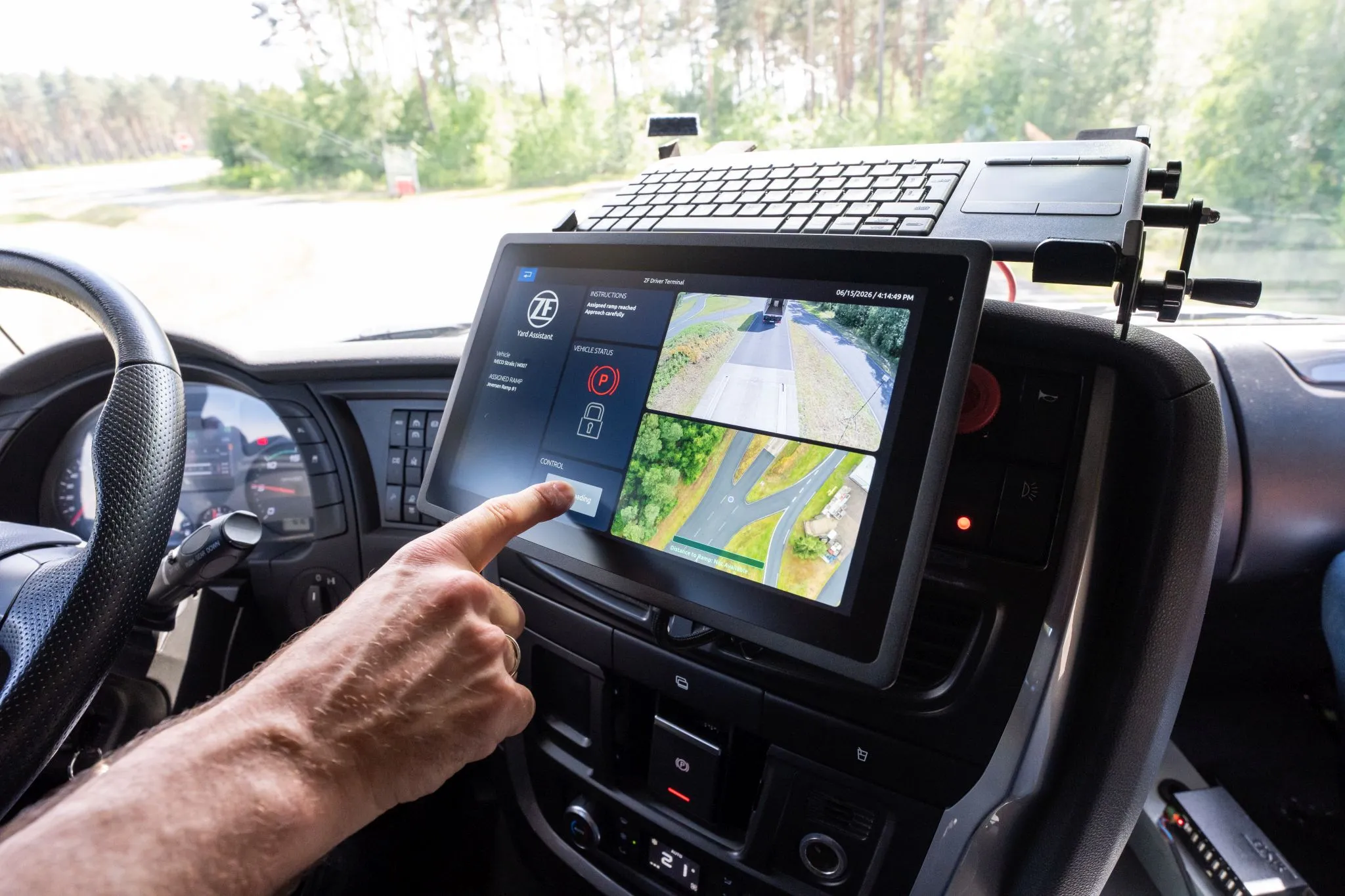
According to ZF, the system automatically connects to the local environment when the truck enters a logistics yard, enabling selected vehicle functions to be accessed remotely.
The company said operators can control features such as the parking brake and digital wheel chocks from outside the vehicle, helping streamline loading and unloading procedures.
Designed to Improve Safety During Loading Operations
The prototype also incorporates Bluetooth Low Energy (BLE)-based personnel detection technology.
If a worker enters a designated safety zone during loading activities, the system can automatically stop vehicle movement. BLE-enabled wearable devices can also activate emergency-stop functions when required.
ZF said these features are intended to improve safety in busy logistics environments where trucks, forklifts, and pedestrians frequently operate in close proximity.
Shift Toward Software-Defined Commercial Vehicles
ZF said the project reflects a broader industry transition from traditional signal-based vehicle architectures to service-oriented software platforms.
Under this approach, vehicle functions become software services that can be accessed, updated, and managed independently of the underlying hardware.
The demonstrator combines existing production technologies, including ZF’s Electronic Brake System (EBS), with a prototype high-performance computing (HPC) domain controller and future braking technologies under development.
Preparing for Future Mobility Platforms
ZF views the project as an early-stage demonstration of how connected software platforms could support future commercial vehicle operations and enable greater integration between vehicles and logistics infrastructure.
“Software and connected system intelligence are becoming the key ingredients to unlock next-level potentials of commercial vehicles,” said Ivan Brajdic, Head of R&D at ZF’s Commercial Vehicle Solutions division.
“The vehicle demonstrates a shift to a service-oriented architecture with middleware and standardized vehicle APIs, enabling scalable Vehicle-to-Infrastructure integration and preparing the platform for Software-Defined Commercial Vehicles,” added Thomas Dieckmann, ZF’s Technology & Innovation Officer.
ZF plans to further showcase the technologies at IAA Transportation 2026 in Hannover from September 15–20.
The company said software-defined architectures are expected to play an increasingly important role in commercial vehicles by enabling greater connectivity, flexibility, and operational efficiency across future fleet operations.