
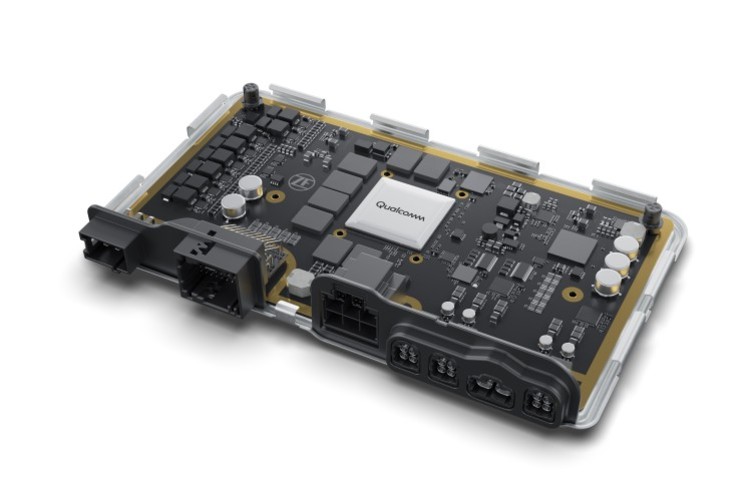
German automotive supplier ZF and U.S. chipmaker Qualcomm said they are collaborating on a new advanced driver assistance system (ADAS) platform aimed at offering automakers turnkey solutions for a range of vehicle types and automation levels up to SAE Level 3.
The joint solution is designed to address growing demand for software-defined vehicles and will combine Qualcomm’s Snapdragon Ride system-on-chips with ZF’s ProAI automotive computer. The partners said the platform will be offered to carmakers as a complete, production-ready package, integrating hardware, software and development tools.
See also: Leapmotor Introduces Central Vehicle Computer Using Qualcomm Chips for Flagship Model
According to ZF, the collaboration “brings together cutting-edge automotive electronics and real-time perception,” enabling vehicle manufacturers to accelerate development while retaining flexibility in system design.
From an architectural perspective, the combined ProAI and Snapdragon Ride system can be deployed as a domain, zonal or central computer. ZF said the aim is to create a robust, open architecture that allows seamless integration of third-party software while enabling automakers to tailor ADAS solutions to specific vehicle requirements.
See also: Qualcomm, Valeo Expand Partnership to Deliver Scalable ADAS and Automated Driving Solutions
Key elements of the platform include ZF’s ProAI family of central computers, which are designed for cross-domain and end-to-end architectures and can deliver more than 1,500 trillion operations per second (TOPS) in their highest configuration. ZF will also contribute a portfolio of around 25 ADAS functions covering safety, comfort and parking features, from which automakers can select for individual vehicle lines.
On the Qualcomm side, the Snapdragon Ride Pilot system provides camera-based artificial intelligence perception for object detection, lane and traffic sign recognition, parking assistance, driver monitoring and real-time mapping. The system supports hands-free motorway driving, including automated lane changes, as well as urban driving assistance. The broader Qualcomm integration platform offers a modular architecture with dynamic allocation of computing resources and interoperability across vehicle electronic control units.
See also: QCraft Expands into Europe, Partners with Qualcomm for Autonomous Driving
A comprehensive set of development tools will allow automakers to rapidly prototype, validate and adapt both ADAS and infotainment functions, the companies said.
For Qualcomm, the partnership also serves to strengthen its competitive position in automotive computing, where it faces rivals such as Nvidia. In October 2024, Qualcomm introduced its Snapdragon Elite Automotive Platform, which it described as featuring the fastest processors available for automotive applications at the time.
See also: ZF Group Agrees To Sell ADAS Business to Harman In €1.5 Billion Deal
“We are pleased to deepen our longstanding collaboration in advancing ADAS innovation with ZF,” said Anshuman Saxena, vice president and general manager of Qualcomm’s ADAS and robotics unit. “By combining our strengths in high-performance automotive computing, perception, and computer vision, we’re enabling automakers to deliver intelligent, safer, and more cost-effective driver assistance systems across their vehicle portfolios.”
ZF framed the collaboration as part of its broader push into software-defined vehicle architectures. “The combination of ZF’s scalable, cross-domain ProAI computing platform with the Snapdragon Ride platform from Qualcomm Technologies offers our customers additional design options for ADAS and infotainment systems in vehicles,” said Dr. Christian Brenneke, head of ZF’s electronics and ADAS division.
However, the partnership comes against the backdrop of significant structural change at ZF. In December, the supplier announced it would sell its ADAS business unit — including compute platforms, smart cameras, radar technology and driver assistance software — to U.S.-based in-cabin electronics specialist Harman International for 1.5 billion euros ($1.6 billion). The deal, which is subject to regulatory approval, is expected to close in the second half of 2026.
Once completed, around 3,750 ZF employees are expected to transfer to Harman. ZF said it will retain its electronics activities related to chassis technology, passive safety and driver assistance and autonomous driving for commercial vehicles.
See also: Horizon Robotics and ZF Deepen Partnership with Launch of coPILOT Driver-Assistance System for China
The divestment marks a further step in ZF’s broader realignment, following agreements with employee representatives in autumn 2025 on extensive job cuts in its Electrified Powertrain Technologies division, as the company restructures to address financial and competitive pressures.