
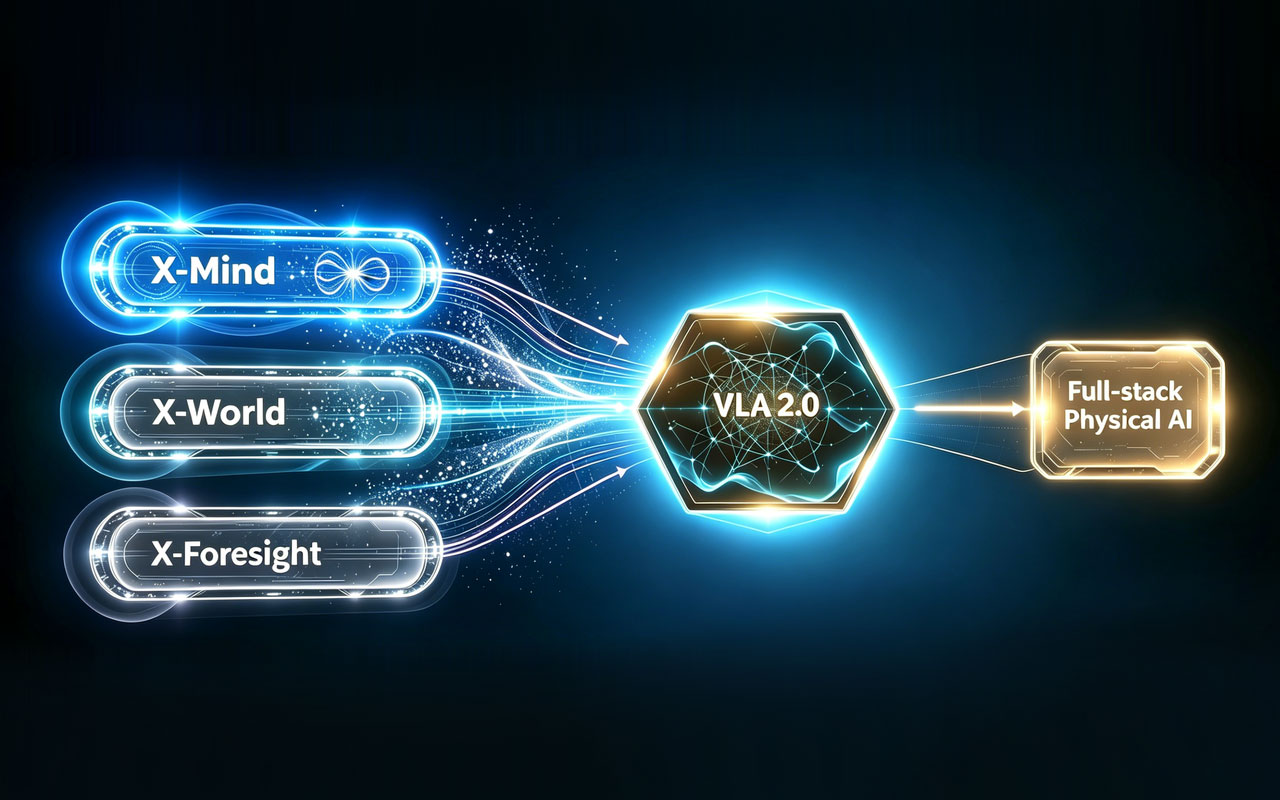
Xpeng has unveiled X-Mind, a new artificial intelligence framework designed to enhance autonomous driving by enabling vehicles to predict how surrounding traffic conditions may evolve before executing driving decisions.
The company introduced the technology during the Foundation Model Workshop at the Computer Vision and Pattern Recognition (CVPR) conference held in Denver this month.
X-Mind forms the latest component of Xpeng’s Physical AI research programme, joining the previously announced X-World and X-Foresight models.
AI Model Simulates Future Driving Scenarios
Unlike conventional autonomous driving systems that primarily react to real-time sensor inputs, X-Mind introduces what Xpeng describes as a visual chain of thought that simulates near-term environmental changes before selecting a driving action.
The framework uses a module called Thought Sketch, which compresses projections of 12 future image frames into 96 tokens using a deep compression autoencoder. According to the company, the process preserves essential driving information such as road layouts, traffic signal status, and navigation intent while removing image details that are not required for planning.
X-Mind also incorporates a Recurrent Block Diffusion mechanism that generates projected future scenarios in a single forward pass, allowing the system to produce higher-quality predictions while maintaining inference speeds suitable for automotive applications.
Improved Performance in Complex Driving Conditions
According to Xpeng, comparative testing showed that X-Mind reduced both lateral and longitudinal displacement errors when compared with conventional vision-language-action autonomous driving models.
The company said the improvements were particularly noticeable in complex and less common driving situations, where accurate prediction can have a greater impact on vehicle safety and compliance with traffic regulations.
Xpeng added that the framework’s inference latency is compatible with automotive-grade computing hardware operating under practical resource constraints, an area where more computationally intensive three-dimensional reconstruction methods have faced deployment challenges.
Part of Broader Physical AI Strategy
Together, X-Mind, X-World, and X-Foresight form Xpeng’s Physical AI foundational model architecture, covering predictive reasoning, controllable environment generation, and long-range forecasting.
The company said it is also exploring the use of the technology beyond autonomous driving, with future applications expected to include broader embodied artificial intelligence systems.