

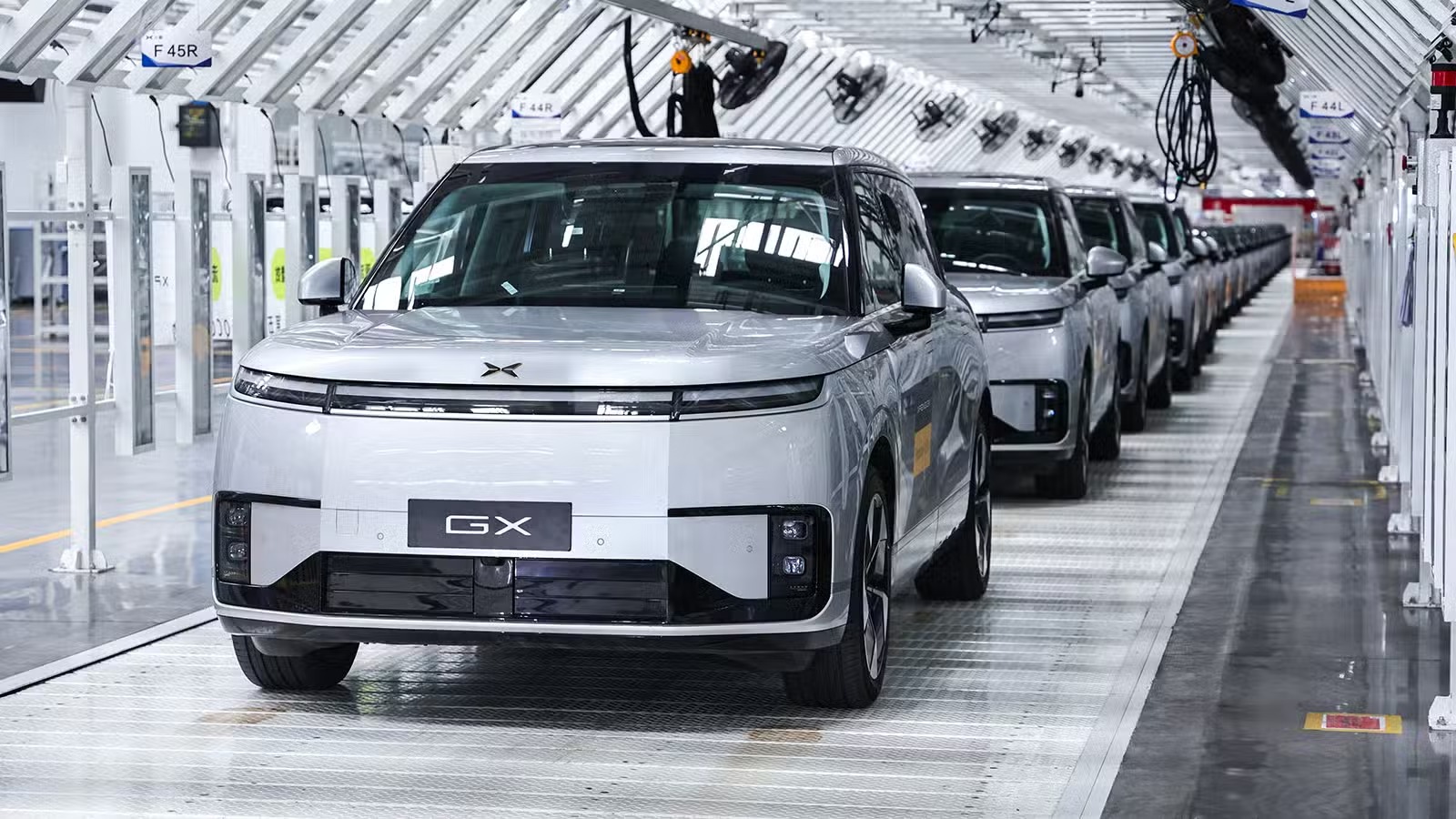
Chinese electric vehicle manufacturer Xpeng said on Monday that its first mass-produced robotaxi vehicle has rolled off the production line in Guangzhou, as the company accelerates efforts to commercialize autonomous driving technology.
Xpeng said the vehicle, developed on its GX platform, was engineered to Level 4 autonomous driving standards, making the company the first automaker in China to announce mass production of robotaxis.
The model is powered by four of Xpeng’s internally developed Turing AI chips, providing up to 3,000 tera operations per second (TOPS) of computing power for autonomous driving functions.
Unlike many competing autonomous vehicle developers, the robotaxi does not rely on LiDAR sensors or high-definition maps. Instead, the company said it uses a pure-vision autonomous driving system similar to the technology strategy deployed in Xpeng’s passenger vehicles.
According to the company, the robotaxi’s decision-making system is supported by its VLA 2.0 end-to-end large model, reducing response latency to less than 80 milliseconds.
Xpeng said the system improves the vehicle’s ability to adapt to varying urban environments, allowing deployment across multiple cities and potentially across international markets.
The robotaxi’s interior includes privacy glass, zero-gravity seats and rear-seat entertainment displays. Passengers can access multimedia functions and adjust vehicle settings through a built-in voice assistant.
The company plans to begin pilot robotaxi operations in the second half of this year to evaluate the technology, customer acceptance and commercial feasibility of the service.
Xpeng said it expects to achieve fully autonomous daily operations without on-site safety personnel by early 2027.
To support commercialization, the automaker established a dedicated robotaxi business unit in March. The division oversees product planning, research and development, testing and operational deployment of autonomous driving technologies.
The company also announced that it has opened its robotaxi software development kit (SDK), with mapping platform Amap becoming its first ecosystem partner.
Xpeng said the robotaxi programme is part of its broader “physical AI” ecosystem strategy, with the autonomous driving system sharing the same VLA 2.0 large-model foundation as the company’s humanoid robot project, Iron.
Separately, Xpeng recently began pre-sales of the GX SUV in China. The full-size sport utility vehicle has a starting pre-sale price of 399,800 yuan ($58,620) and is scheduled for official launch on May 20.
The launch forms part of Xpeng’s expansion into China’s premium electric vehicle segment, where domestic automakers are increasingly competing on advanced software and autonomous driving technologies.