




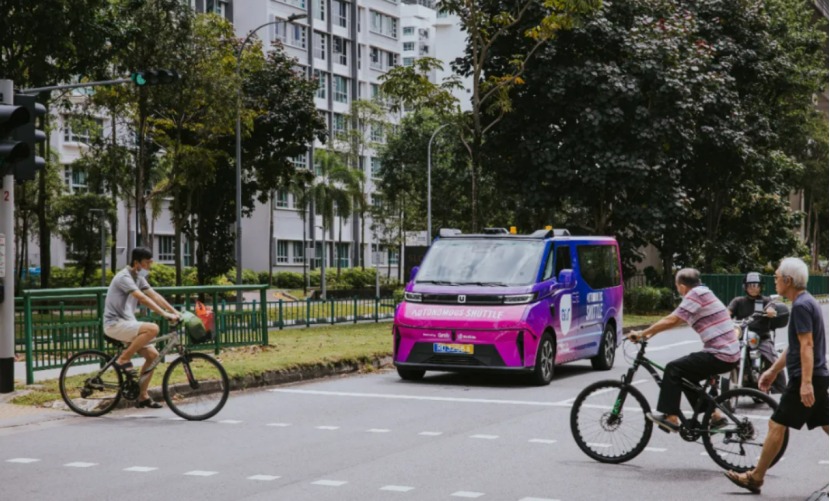
WeRide and Grab announced on November 13 that they have secured approval from Singapore’s Land Transport Authority (LTA) to conduct autonomous fleet trials in the Punggol district. The upcoming pilot will deploy vehicles developed under the joint Ai.R (Autonomously Intelligent Ride) program, marking a significant step toward introducing commercial self-driving mobility services in Singapore.
Early testing of WeRide’s GXR robotaxi began in Punggol in mid-October, representing the district’s first exposure to the model. With the LTA’s approval, both companies plan to scale up the initiative, targeting a fourfold increase in trial operations along designated feeder routes by late 2025.
See also: WeRide Secures Tens of Millions in Grab Investment for Southeast Asia Push
Ai.R is intended to serve as a public-facing autonomous mobility service operated collaboratively by WeRide and Grab. The fleet consists of eleven WeRide vehicles: ten GXR robotaxis capable of seating five passengers, and one Robobus shuttle with room for up to eight passengers.
The ongoing trial will assess the system’s performance and adherence to safety benchmarks ahead of the program’s commercial rollout. Once launched, Ai.R will operate on two feeder routes within Punggol, with service for public riders expected to begin in early 2026. If executed as planned, Punggol would become the first residential area in Singapore to introduce an autonomous shuttle offering.
See also: WeRide Receives UAE Approval for Fully Driverless Robotaxi Operations in Abu Dhabi
During testing, the autonomous vehicles collect real-world driving data to refine their AI-driven models for Singapore’s road environment. This process includes adapting to the area’s traffic patterns, navigating complex intersections, and accounting for varied pedestrian and driver behaviors.
The system is also exposed to the country’s dynamic weather conditions, enabling testing under sudden rainfall and strong sunlight. Ongoing improvements will focus on enhancing vehicle maneuverability, navigation in dense urban settings, and smoother operation at pickup and drop-off points.
The GXR robotaxi and Robobus utilize a combination of lidar and camera sensors to deliver 360-degree perception with detection capabilities extending up to 200 meters. Their sensing systems are designed to support obstacle detection in wet weather, enabling timely responses to potential hazards. For safety assurance throughout the testing phase, each vehicle will be accompanied by a trained safety operator who oversees system behavior in real time.
The operators are being trained jointly by WeRide and GrabAcademy, with the first cohort—comprising more than ten Grab drivers shifting into this role—having completed both classroom and closed-course training before moving into supervised on-road operations.


