




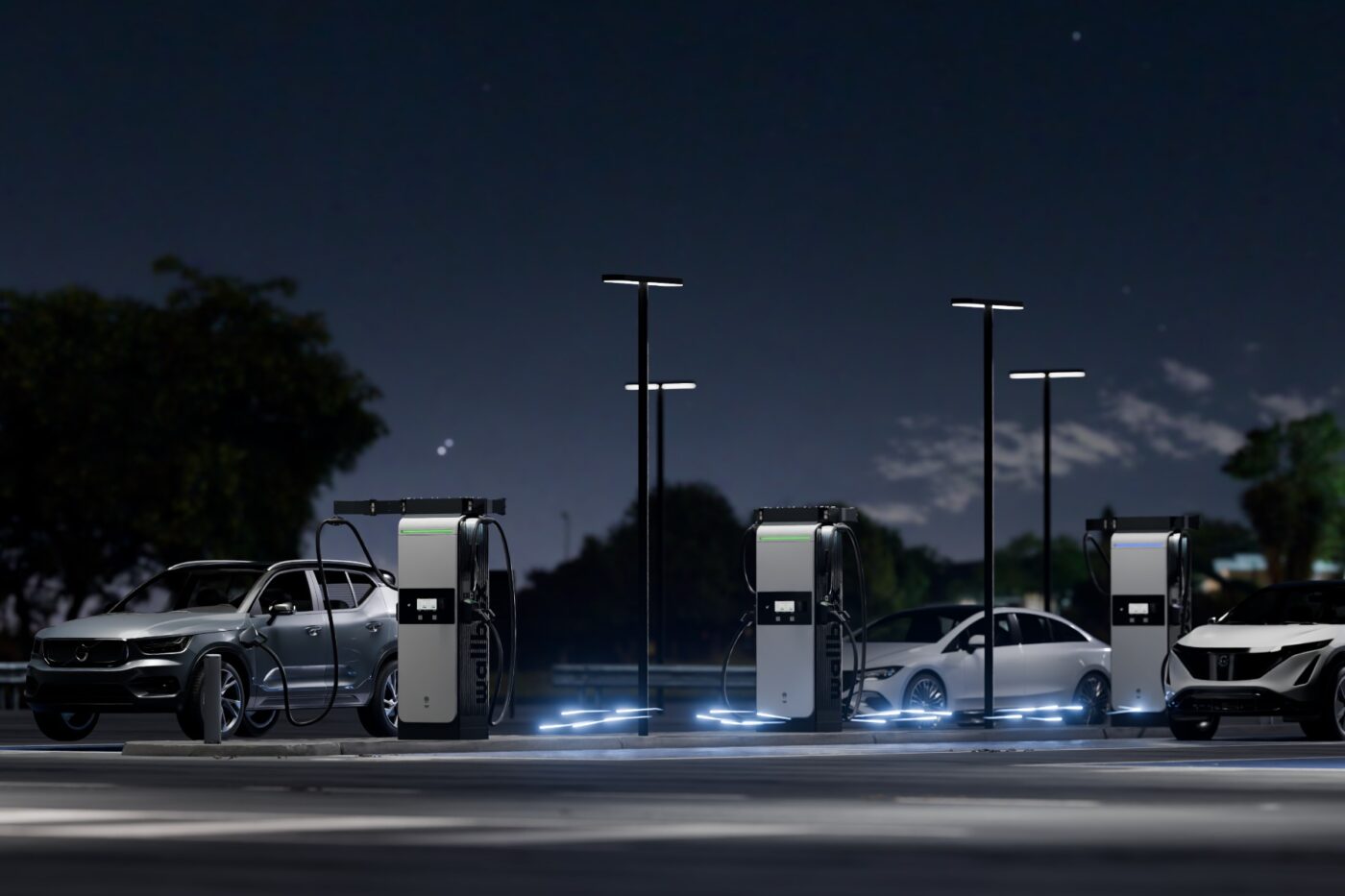
Wallbox has introduced the Supernova PowerRing, a modular DC fast-charging system capable of delivering up to 400 kW per outlet and 720 kW per site, aimed at supporting public and semi-public charging infrastructure. The system is designed to enable dynamic power sharing and scalable operation across multiple units, allowing operators to adapt to varying site requirements.
According to Wallbox, the PowerRing connects several Supernova chargers within a unified network that distributes power dynamically between outlets. Each configuration can include up to three Supernova units and six charging points, with available installed capacities of 240 kW, 480 kW, or 720 kW. The modular architecture allows future expansion without major infrastructure changes, providing flexibility for operators as charging demand grows.
See also: Wallbox to Deploy 58 Fast Chargers Across Central and Northern Italy by 2025
In its initial phase, the PowerRing will introduce power sharing between connected units, redistributing unused capacity to active charging sessions to optimize energy use and maintain high availability. Wallbox said this design helps manage power demand during busy periods and simplifies installation. Future development phases will introduce connector-level power sharing and site-wide energy distribution for improved efficiency and user experience.
The phased rollout of the Supernova PowerRing is expected to begin in early 2026, starting in Southern Europe, Benelux, the UK, and Ireland, before expanding to additional regions, including the United States. Wallbox noted that the compact footprint and scalable configuration make the PowerRing suitable for retail centers, forecourts, and commercial parking facilities, with simplified installation aimed at reducing deployment time and cost.
See also: Wallbox and Hera Group to Deploy 58 Fast Chargers Across Emilia-Romagna by 2025
Eduard Castañeda, Chief Product and Technology Officer at Wallbox, said the system was designed to balance flexibility, performance, and reliability, emphasizing that it enables operators “to serve more drivers with less space, less cost, and less complexity” while maintaining a focus on charging speed and overall user experience.