


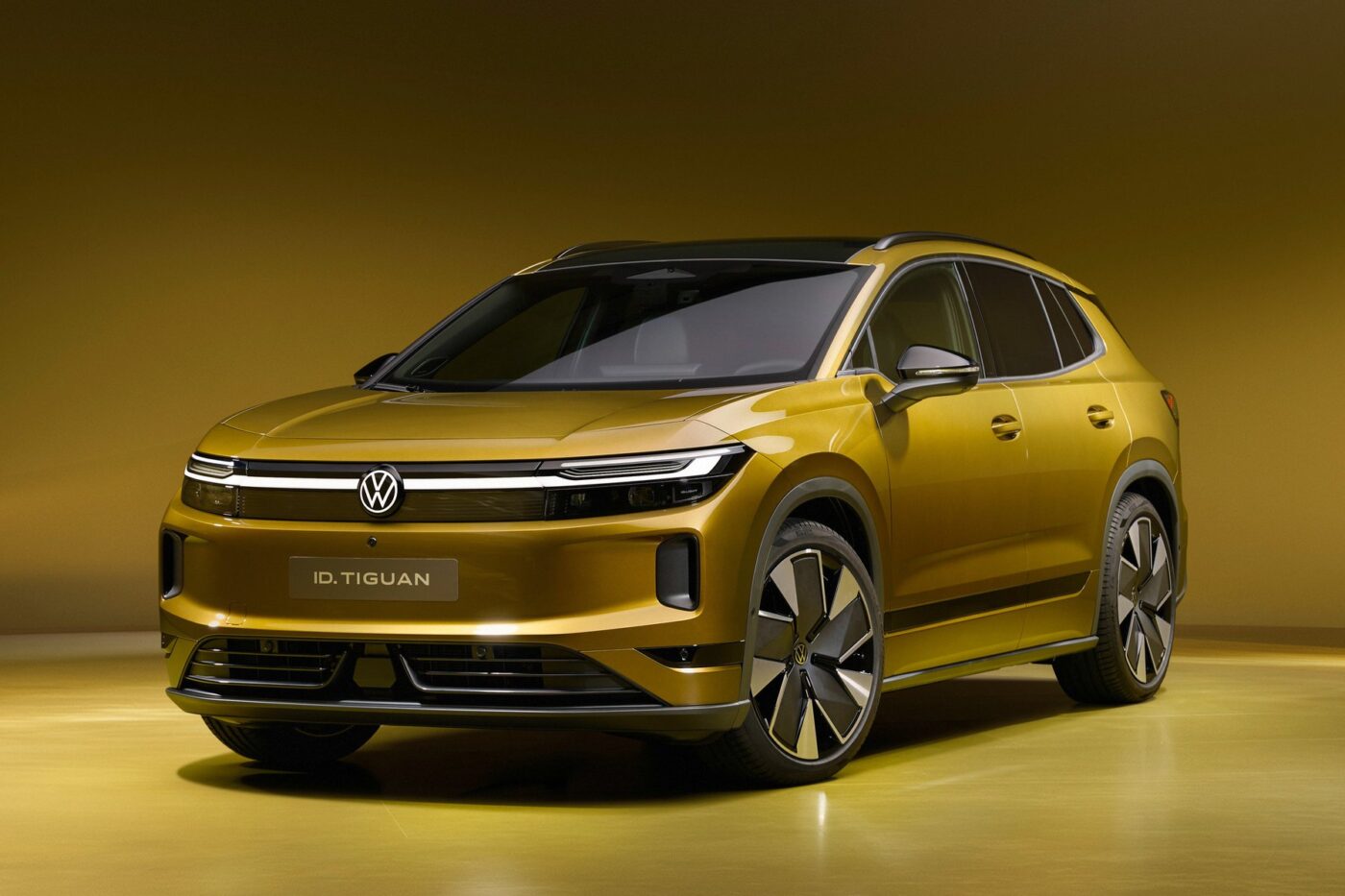
Volkswagen has unveiled the ID. Tiguan, an all-electric SUV set to replace the ID.4 and ID.5 in its electric vehicle lineup. Scheduled to reach the market in early 2027, the new model combines a range of up to 600 kilometres with power outputs of up to 220 kW and a maximum towing capacity of 2,000 kilograms.
The launch brings Volkswagen’s established Tiguan nameplate into its electric SUV range. Built around the company’s updated MEB+ platform, the ID. Tiguan features a redesigned exterior, revised cabin controls and new digital displays. Production will take place in Emden, Germany.
Volkswagen plans to open pre-orders in Germany and several other European markets on 13 October. Prices will start at €42,695, although detailed pricing has not yet been announced. The SUV measures 4.62 metres long, 1.86 metres wide and 1.62 metres high, with a wheelbase of 2.77 metres.
Three Powertrain Configurations
The ID. Tiguan will launch with three powertrain options, combining two battery capacities with rear-wheel-drive and all-wheel-drive configurations.
The entry-level version produces 140 kW and uses a 58 kWh lithium iron phosphate (LFP) battery. A more powerful rear-wheel-drive variant delivers 210 kW with a 77 kWh nickel manganese cobalt (NMC) battery. The range-topping model produces 220 kW, equivalent to 299 PS, and pairs the same 77 kWh battery with Volkswagen’s 4MOTION all-wheel-drive system.
Volkswagen expects the models to achieve WLTP driving ranges of up to 450 km, 600 km and 560 km, respectively. The figures remain subject to completion of homologation.
| Specification | 140 kW | 210 kW | 220 kW |
|---|---|---|---|
| Drivetrain | Rear-wheel drive | Rear-wheel drive | All-wheel drive |
| Net battery capacity | 58 kWh | 77 kWh | 77 kWh |
| Battery chemistry | LFP | NMC | NMC |
| Maximum WLTP range | 450 km | 600 km | 560 km |
| 0–100 km/h | 8.5 seconds | 6.6 seconds | 6.3 seconds |
| Top speed | 160 km/h | 180 km/h | 180 km/h |
Four equipment grades will be available: Trend, Life, Style and R-Line.
Charging and Bidirectional Power Features
Charging performance varies by battery configuration. Both versions support AC charging at up to 11 kW. The 58 kWh battery supports DC fast charging at up to 105 kW, while the 77 kWh battery raises the maximum DC charging rate to 165 kW.
Volkswagen estimates that charging from 10% to 80% will take approximately 26 minutes with the smaller battery and 29 minutes with the larger unit.
The ID. Tiguan will also support several charging and energy-management functions. Plug & Charge is designed to simplify compatible public charging sessions, while Smart Charging supports intelligent charging management.
Bidirectional charging capabilities include Vehicle-to-Load (V2L), which allows the vehicle battery to power external devices; Vehicle-to-Home (V2H), which enables integration with household energy systems; and Vehicle-to-Grid (V2G), which allows electricity to be supplied back to the public grid.
Family-Oriented Interior and Towing Capacity
Volkswagen has positioned the ID. Tiguan as a family SUV intended for everyday driving and longer journeys. The five-seat cabin offers up to 534 litres of boot capacity, complemented by a 32-litre storage compartment beneath the front bonnet.
Towing capability is another focus. Models equipped with the 58 kWh battery can tow up to 1,800 kg, while versions using the 77 kWh battery can handle up to 2,000 kg. The latter capacity is intended to accommodate larger trailers and caravans.
Available comfort features include ventilated and massage-function seats, as well as a Harman Kardon sound system.
Three Displays and Revised Physical Controls
The cockpit introduces a passenger display to a European Volkswagen model for the first time. Measuring 12 inches diagonally, the screen allows the front passenger to access infotainment, information and gaming features independently of the driver.
Volkswagen says a Privacy Mode makes the passenger display invisible from the driver’s viewing angle. Passengers can also listen to audio through paired Bluetooth headphones.
The display is accompanied by a 10-inch Digital Cockpit for the driver and a central 15-inch infotainment screen.
Volkswagen has also revised the operating layout compared with the ID.4. Physical buttons return for important functions, including basic climate controls, which are arranged on a panel in the centre console. A tactile dial handles audio volume and station or track selection, while two Qi2-standard inductive charging points provide wireless charging for the driver’s and passenger’s smartphones.
The multifunction steering wheel also returns to physical buttons rather than touch-sensitive surfaces.
New Exterior Design Language
The ID. Tiguan adopts Volkswagen’s Pure Positive design language, replacing the softer crossover styling associated with its predecessors with a more defined SUV appearance.
According to Volkswagen, precise lines and sculpted surfaces are intended to give the vehicle a stronger visual presence and a more substantial appearance. The model also brings back conventional loop-style door handles.
Volkswagen brand chief Thomas Schäfer said the electric SUV combines the appeal of the Tiguan nameplate with the company’s existing electric vehicle experience.
“The Tiguan is our best-selling model worldwide, and the ID.4 and ID.5 are among our most successful electric cars. The ID. Tiguan brings these two success stories together. A pure, confident design with the presence of a vehicle from the next class up, intuitive operation and, thanks to MEB+, a range of up to 600 kilometres: a new benchmark for our electric SUVs made in Germany. Together with the Tiguan from Wolfsburg, the ID. Tiguan from Emden is part of one of the strongest SUV duos in Europe.”
With pre-orders scheduled to begin in October and market launch planned for early 2027, the ID. Tiguan will become a central addition to Volkswagen’s electric SUV portfolio, bringing multiple battery and drivetrain choices together with revised cabin technology and practical towing capability.


