





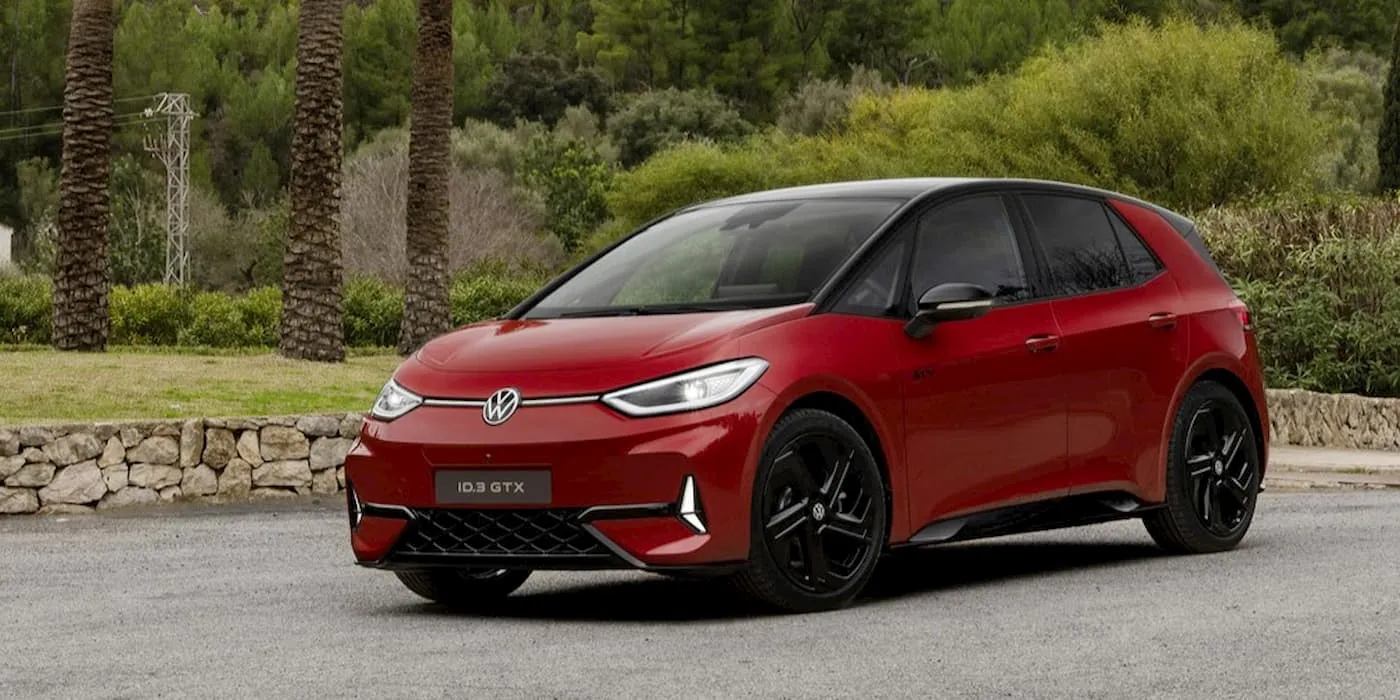
The Volkswagen ID.3 has overtaken the Tesla Model Y to become the most widely registered battery-electric vehicle in Germany, reflecting stronger sales momentum for Volkswagen models during 2025, according to new data from the Kraftfahrt-Bundesamt (KBA).
Germany’s electric vehicle fleet surpassed two million units for the first time, reaching 2,034,260 vehicles as of January 1, 2026. Within that total, the ID.3 accounted for 116,053 units, representing 5.7% of all battery-electric vehicles in the country.
See also: Volkswagen to End ID.4 Production at Chattanooga Plant, Shift Focus to Atlas SUV
The change in ranking follows a year of stronger growth for Volkswagen’s compact EV. The ID.3 recorded a 26.4% increase in registrations during 2025, compared with an 8.8% rise for the Model Y, which reached 106,184 units and moved into second place. The Volkswagen ID.4 and Volkswagen ID.5, grouped together by the KBA, also expanded by 17.8% to 97,120 units.
Several other models based on Volkswagen’s MEB platform showed comparatively strong growth. The Skoda Enyaq rose by 24.7% to 80,970 units, while the Cupra Born recorded the highest increase among the top ten, up 36.3% to 60,256 units.
See also: Volkswagen and Rivian Joint Venture Completes Winter Tests for SDV Architecture
By contrast, growth slowed for some earlier high-volume models. The Tesla Model 3 increased by 1.1% to 81,352 units, maintaining fourth place. Several models saw slight declines, including the Renault Zoe (-2.3%), Smart Fortwo Electric (-2.2%), and Volkswagen e-Up (-1.0%), reflecting their phase-out from the market.
The data suggests that newer electric models, particularly those built on Volkswagen’s MEB platform, gained share in Germany during 2025, while demand growth moderated for some earlier entrants.
Regional data from the KBA shows that electric vehicle adoption remains concentrated in Germany’s most populous states. North Rhine-Westphalia leads with 454,782 EVs, followed by Bavaria and Baden-Württemberg. However, EV penetration varies, with western and southern states reporting shares between 4.3% and 4.7% of total passenger car fleets, compared with 2.0% to 2.3% in eastern regions. Hamburg recorded the highest share at 5.3%.


