




TIER IV and the Technical University of Munich (TUM) have established the TUM Autoware Research Center through a multi-year strategic research collaboration focused on open-source autonomous driving technology.
The center will bring together three TUM research groups to work on safety architecture, evaluation methods and scalable deployment of Autoware, an open-source autonomous driving software stack developed by TIER IV. The initiative is supported by strategic research funding from TIER IV.
The companies have not disclosed the funding amount or the exact duration of the collaboration.
Research Focuses on Safety, Evaluation and Scalability
The center’s research programme will cover three main areas.
Safety architecture: Researchers plan to develop a hybrid architecture combining deep-learning-based driving models with rule-based supervision. A verifiable safety component, described as a “safety guardian,” will monitor vehicle behaviour and intervene when defined safety constraints are at risk of being breached.
Evaluation and verification: The collaboration will work on benchmarking and verification methods for testing individual components and complete autonomous driving systems. The framework is intended to cover simulation, offline analysis and real-world operation, drawing on TUM’s EDGAR research platform and expertise in CommonRoad.
Scalable deployment: Researchers will develop repeatable methods for adapting and evaluating Autoware in new operating environments. Improvements may be contributed to relevant open-source projects where appropriate.
The participating TUM groups are the Chair of Automotive Technology (FTM), the Professorship of Cyber Physical Systems (CPS) and the Professorship of Autonomous Vehicle Systems (AVS).
The center is also intended to support open-source software development, doctoral training and collaboration between academic researchers, industry participants and public-transport projects. Demonstrations and benchmarking challenges are among the activities planned.
EDGAR Provides a Real-World Research Platform
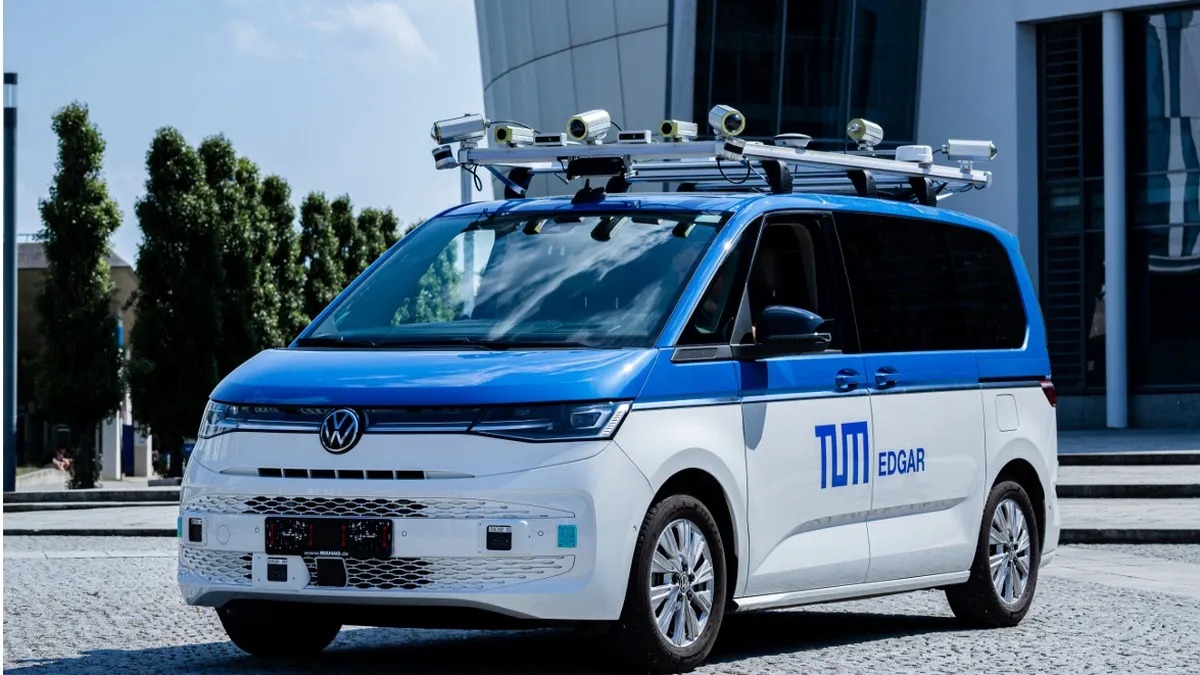
TUM’s EDGAR autonomous research vehicle uses the Autoware software stack and serves as a platform for testing and demonstrating automated driving technologies.
During IAA MOBILITY 2025, EDGAR provided public demonstration rides between Messe München and central Munich. TUM’s Chair of Automotive Technology described the journey as an approximately 40-minute autonomous drive covering urban, rural and highway environments.
TIER IV also reported that TUM’s team deployed EDGAR in Berlin within a week and demonstrated autonomous operation on urban roads. The demonstration was conducted with TÜV-Verband to test an assessment methodology for Level 4 autonomous driving under real-world traffic conditions for the German government, according to TIER IV.
The research center is expected to build on this type of testing to develop methods for assessing autonomous driving systems across different environments and operating conditions.
TIER IV and TUM Outline Research Objectives
Shinpei Kato, founder and CEO of TIER IV, said the collaboration would address several technical requirements for deploying autonomous driving systems at scale.
“Safe autonomous driving at scale requires progress across AI, system architecture, verification and deployment,”
Kato said.
“By combining TUM’s research capabilities with TIER IV’s experience in developing and deploying Autoware, we aim to create technologies and open benchmarks that benefit the broader autonomous driving ecosystem. This collaboration also marks an important step toward advancing the open autonomous driving ecosystem in Europe, providing OEM manufacturers with technologies and evaluation methods that support the development of safe and scalable autonomous driving systems.”
Johannes Betz, Professor of Autonomous Vehicle Systems at TUM, said the research combines learning-based approaches with rule-based systems and real-world testing.
“At TUM, we are combining learning-based methods with traditional rule-based systems to make autonomous systems that can scale but are also verifiably safe, and actually deploying them in the real world. Our autonomous research platform EDGAR is built upon the open-source software stack Autoware, which provides a great baseline for autonomous driving research and education.”
European Open-Source Vehicle Development
The initiative also relates to broader European discussions about software-defined vehicles and shared automotive software infrastructure.
TIER IV and TUM cited the European Commission’s concept paper on an open European software-defined vehicle platform, which identifies open-source development, reference implementations, standardised software components and shared validation tools as potential foundations for cooperation across the European automotive industry.
The partners said the research center aims to support the development of an open autonomous driving ecosystem in Germany and elsewhere in Europe. They also intend to develop technologies and evaluation methods that vehicle manufacturers can use when developing autonomous driving systems.
These remain objectives of the collaboration. The announcement did not identify participating vehicle manufacturers or provide a timeline for delivering specific research outputs.


