



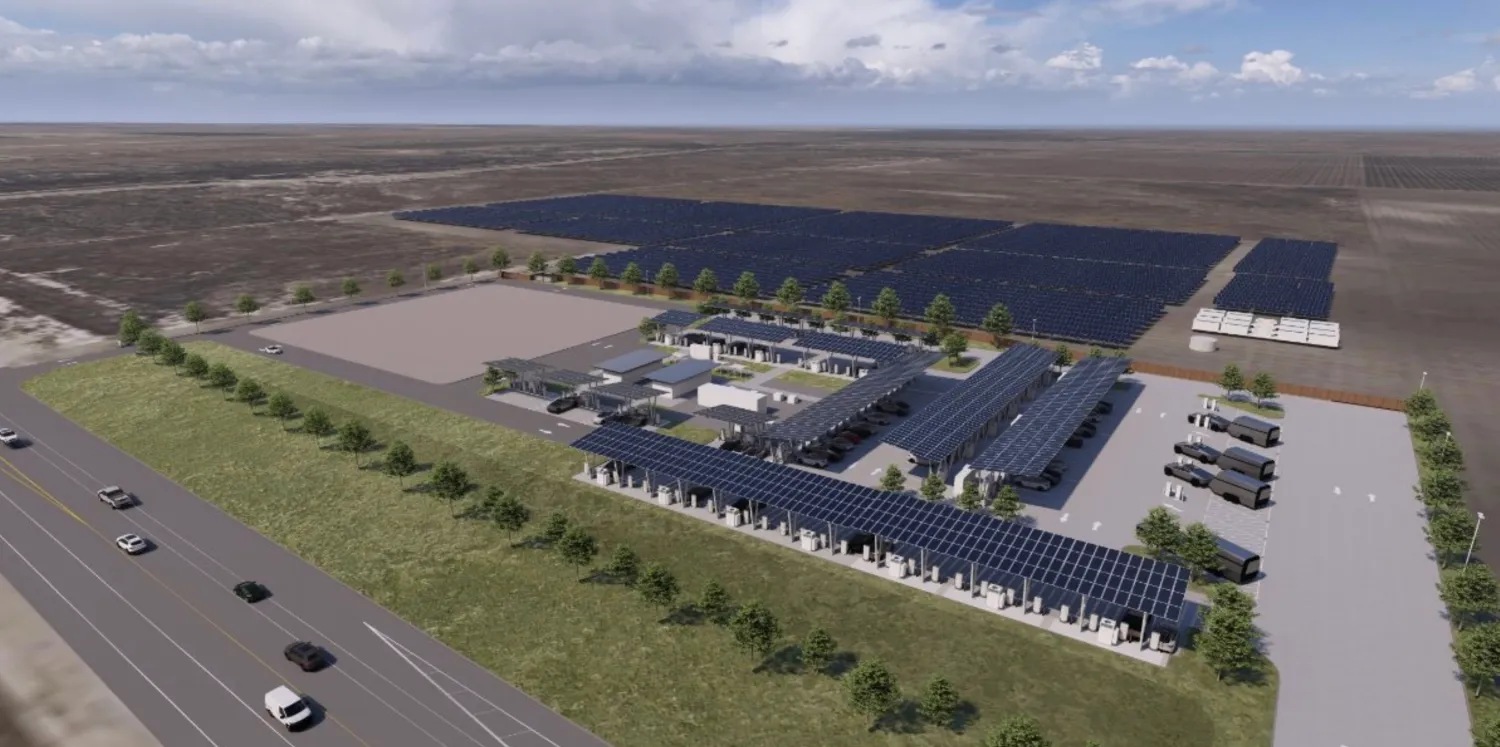
Tesla is expanding its “Oasis” Supercharger station concept with a new installation in Coalinga, California. The station, though smaller in energy capacity, will mirror the design of its predecessor with 168 charging stalls and the potential to operate off-grid, marking a significant step in Tesla’s strategy to build independent, solar-powered charging hubs.
The Coalinga station, located approximately 50 miles from the initial Oasis project on Interstate 5, features less than 1 megawatt (MW) of solar capacity and 15.5 megawatt-hours (MWh) of energy storage. By comparison, the original Oasis project boasts 11 MW of solar power and 39 MWh of storage, enough to operate mostly independent of the grid. This “mini Oasis” will primarily use its microgrid as a backup to the grid, though Tesla has hinted at potential future expansions of its solar and battery capacity.
A massive new Supercharger is coming soon to Coalinga, California!!
Permits have been filed for a 168-stall station in a vacant plot of land located right off Interstate 5 at W Jayne Ave.
The site will also include restrooms, as well as a large solar array and battery storage. pic.twitter.com/dV2o1NL1Ut
— MarcoRP (@MarcoRPi1) November 2, 2024
In line with Tesla’s vision of a sustainable Supercharger network, the Coalinga project will be outfitted with restrooms, a feature typically reserved for larger charging sites. CEO Elon Musk, who has advocated for solar-powered, off-grid Superchargers since 2016, may be seeing the concept come to life with these newer installations, which offer a model for scaling sustainable charging infrastructure.
Both the Oasis projects serve the busy route between Los Angeles and the Bay Area, underscoring Tesla’s focus on providing extensive fast-charging solutions along high-traffic corridors. Tesla’s approach signals continued investment in self-sustaining charging stations, with renewable energy playing an increasingly central role.


